
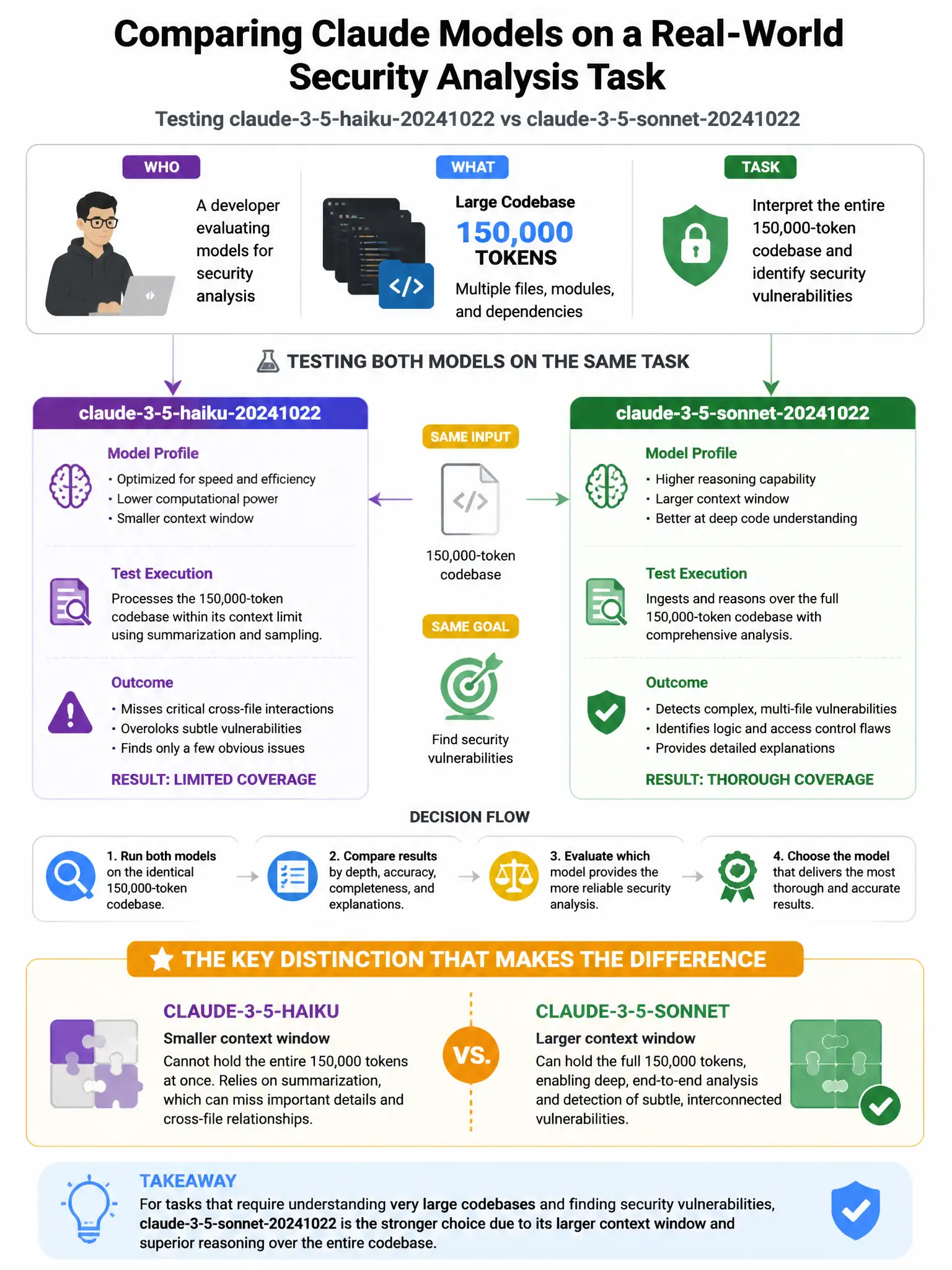
A developer tests both claude-3-5-haiku-20241022 and claude-3-5-sonnet-20241022 on a task that requires interpreting a 150,000-token codebase and identifying security vulnerabilities. Claude 3.5 Haiku returns results in 4 seconds; Claude 3.5 Sonnet takes 22 seconds. Both have 200K context windows. A stakeholder argues for Haiku to reduce latency. What is the architect's most important counter-consideration?
Select an answer to reveal the explanation.
Short Explanation
Here's the deal — the right answer is that Haiku's speed isn't free: at 150K-token, multi-file security analysis, its reasoning quality can drop below Sonnet's. In security work, you care more about missing a vulnerability than about a slower scan.
Full Explanation
The correct answer is that Haiku's speed isn't free: at the frontier of its capability, complex multi-file security analysis at 150,000 tokens, its reasoning quality can be materially lower than Sonnet's. In security applications, a missed vulnerability, or false negative, is a more serious failure than a slow scan. The architect must surface this quality-latency tradeoff explicitly rather than allowing a latency optimization to silently reduce security coverage. The output-token-limit argument, which contrasts Haiku's 4,096-token output cap with Sonnet's 8,192-token cap, is wrong because while output token limits differ between models, 4,096 output tokens is sufficient for most vulnerability reports; this is a secondary concern compared to analysis quality. The cost-convergence argument is wrong because the per-call cost difference between Haiku and Sonnet does not converge at high input token counts; they have distinct input pricing regardless of token volume, so that claim is factually incorrect. The tool-use argument is wrong because Claude 3.5 Haiku does support tool use and is a capable model for tool-calling workflows.