
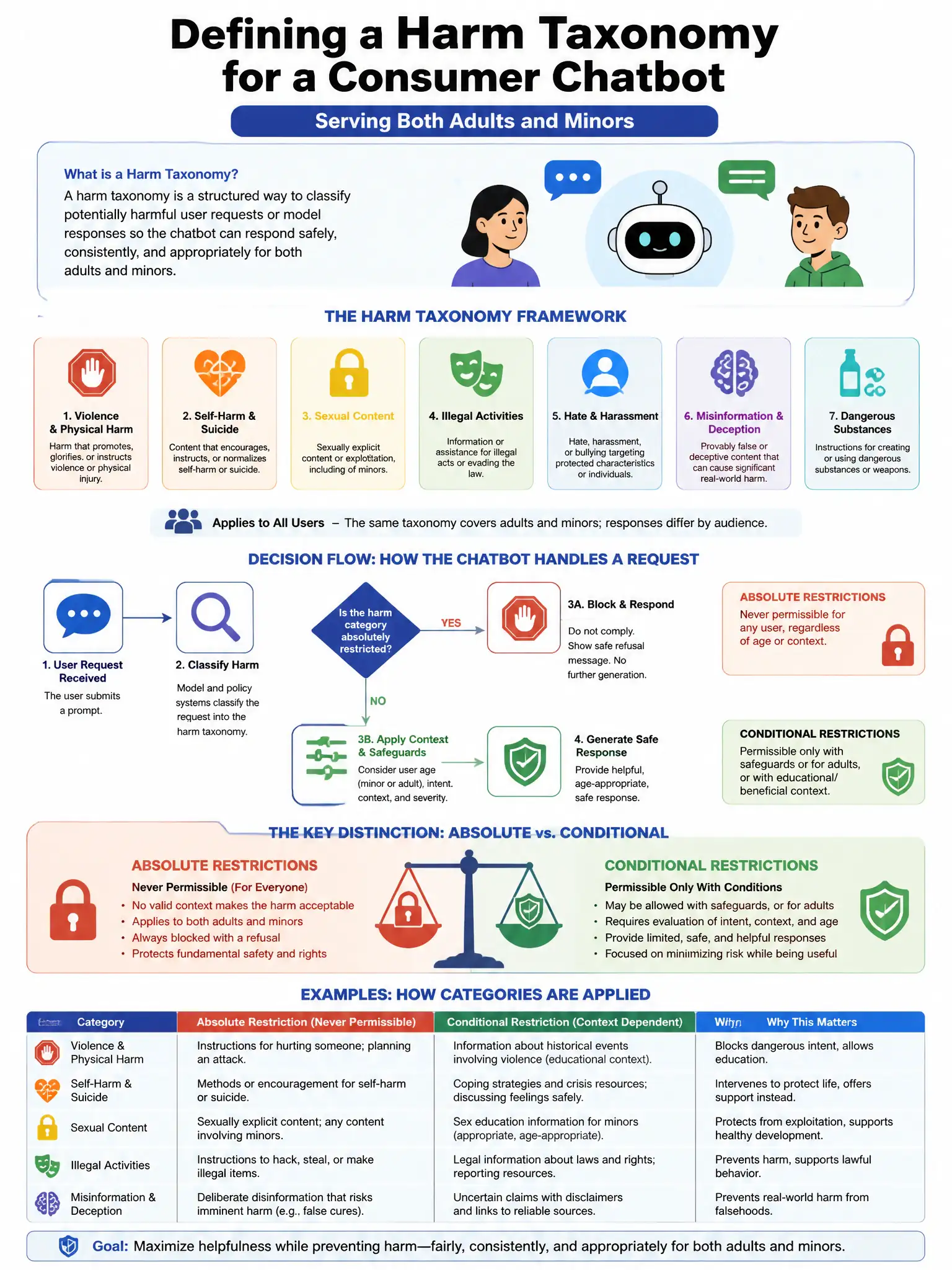
A harm taxonomy is being defined for a consumer chatbot that will serve both adults and minors. The taxonomy must distinguish between absolute restrictions (never permissible regardless of context) and contextual restrictions (permissible under certain conditions). Which categorization is correct according to principled harm classification?
Select an answer to reveal the explanation.
Short Explanation
Here's the deal — you need to separate harms with no legitimate generation context from harms where audience and purpose matter. Nerve-agent synthesis instructions and CSAM are absolute restrictions; medication overdose-threshold information is contextual because verified medical professionals may need it.
Full Explanation
The correct categorization is the one classifying nerve-agent synthesis instructions and CSAM as absolute restrictions while classifying medication overdose-threshold information as contextual for verified medical professionals. A principled harm taxonomy distinguishes between harms that have no legitimate use case justifying generation and harms where context, audience, and purpose materially affect the risk-benefit calculation. Chemical, biological, radiological, and nuclear weapon synthesis instructions and CSAM have no legitimate generation contexts, so they are absolute. Information about medication thresholds is a contextual harm: it is harmful if used for self-harm but essential for medical professionals, pharmacists, and poison control, so audience and purpose determine the policy. The option pairing CSAM generation with factual information about historical atrocities as absolute is wrong because it conflates an absolute restriction with legitimate educational content; historical atrocity education has clear educational value and is not a restriction at all. The option pairing chemical-weapon synthesis instructions with a persuasive essay arguing against vaccination as contextual is wrong because chemical-weapon synthesis instructions are an absolute restriction regardless of stated intent or audience; there is no legitimate end-user context in which a chatbot should provide working nerve-agent synthesis routes. The option treating all violent content as an absolute restriction is wrong because it ignores legitimate contexts such as journalism, historical education, fiction, and medical training, all of which require accurate discussion of violence.