
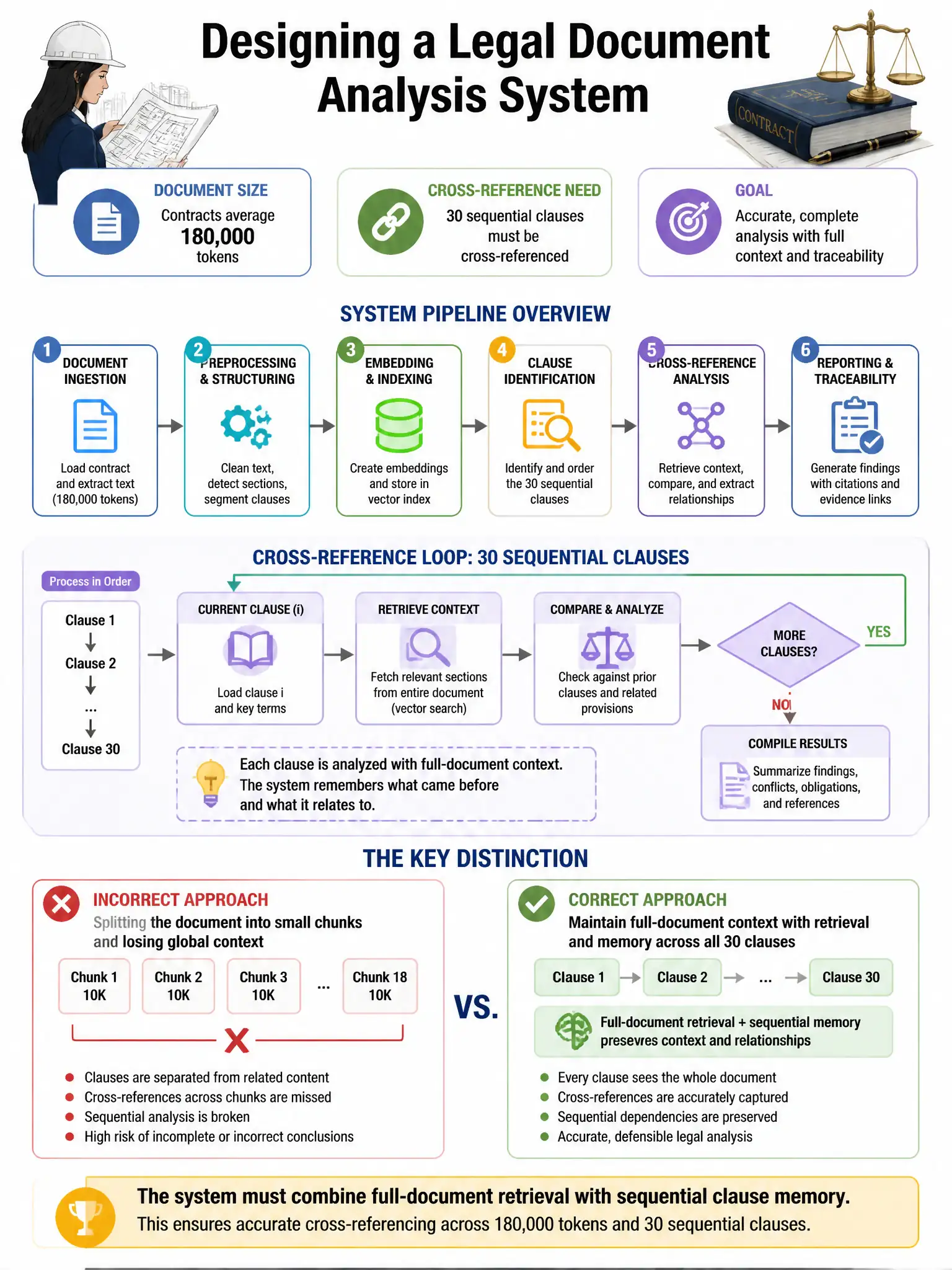
An architect is designing a legal document analysis system that must process contracts averaging 180,000 tokens. The pipeline requires 30 sequential clauses to be cross-referenced against a regulatory database, generating detailed reasoning chains for each. The team is debating between claude-3-5-sonnet-20241022 and claude-3-opus-20240229. Latency is secondary; accuracy and completeness of reasoning is the primary requirement. Which model selection rationale is most defensible?
Select an answer to reveal the explanation.
Short Explanation
You should pick claude-3-5-sonnet-20241022 because it matches or beats Opus on complex reasoning benchmarks while costing less per token. When latency isn't the main concern, that makes it the sensible default for accurate, complete reasoning.
Full Explanation
The correct rationale is to use claude-3-5-sonnet-20241022 because it scores at or above claude-3-opus-20240229 on most complex reasoning benchmarks, including graduate-level STEM and law, while costing significantly less per token. When latency is tolerable, that makes Sonnet the rational default for most high-accuracy tasks, including detailed legal reasoning chains.
The rationale claiming claude-3-5-sonnet-20241022 is strictly superior for all long-document tasks is wrong because it overstates the case; selection depends on benchmark evidence, not a blanket rule. The rationale favoring claude-3-opus-20240229 because a slower, more deliberate generation pattern produces more reliable multi-step legal reasoning is wrong because that pattern is not a documented architectural advantage of Opus; it conflates verbosity with accuracy. The rationale favoring claude-3-opus-20240229 because it supports a larger context window than claude-3-5-sonnet-20241022 is wrong because both models share the same 200K token context window, so Opus has no window advantage.