
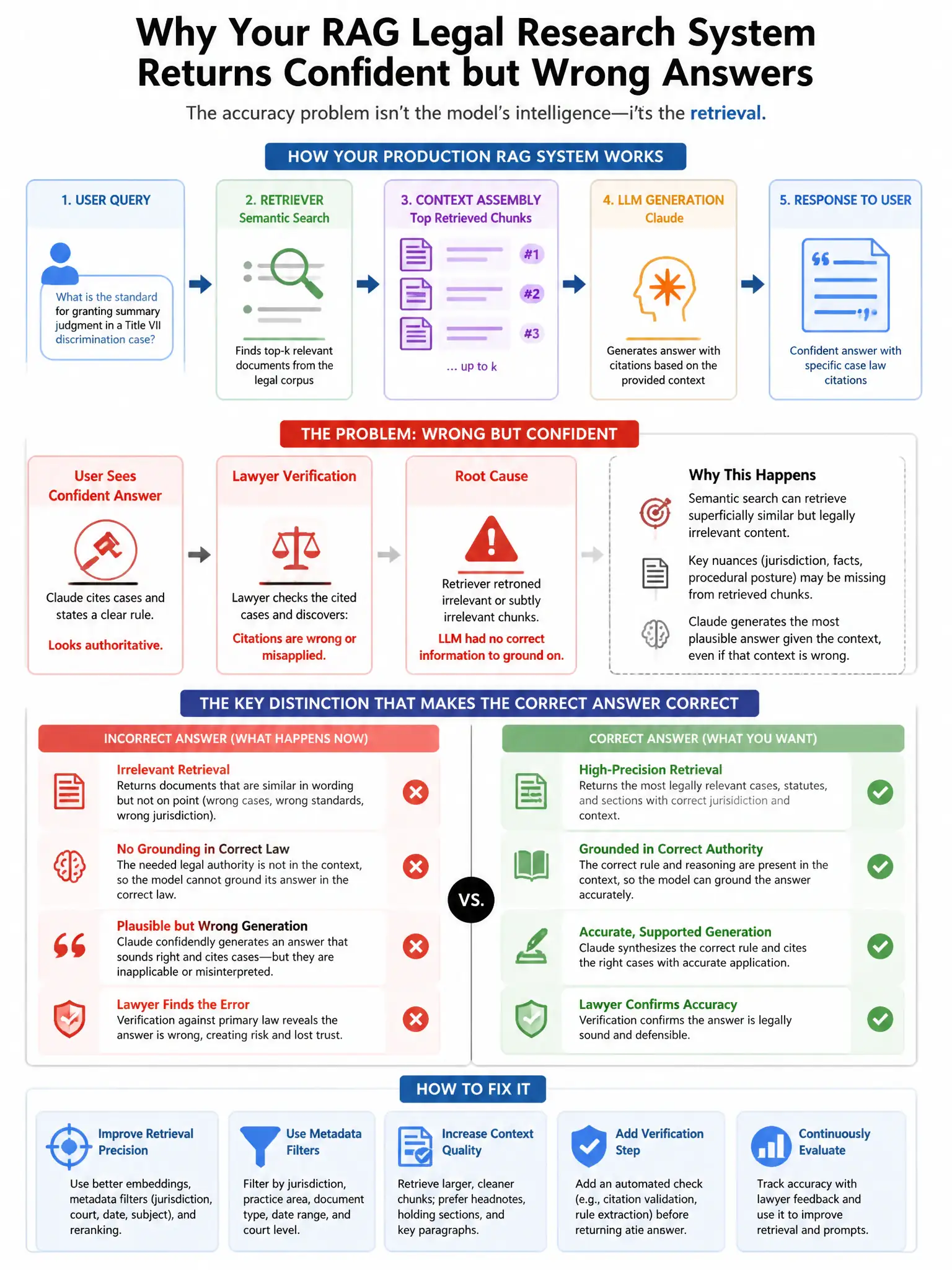
A production RAG system for enterprise legal research is experiencing accuracy issues. Users report that Claude provides confident answers citing specific case law, but lawyers verify that the cited cases don't support the stated proposition — the case law exists in the corpus but the holding is being mischaracterized. Retrieval metrics show high recall (relevant documents are being retrieved) but the grounding step is failing. The vector similarity scores for retrieved documents average 0.72. Which architectural change most directly addresses this specific failure mode?
Select an answer to reveal the explanation.
Short Explanation
Here's the deal — when high recall proves retrieval is working, the fix is attribution-aware generation. You make Claude quote the exact supporting text, then validate the quote exists in the retrieved document before returning the answer. That stops confident mischaracterizations of case holdings.
Full Explanation
Attribution-aware generation with quote validation is the correct fix for case law mischaracterization. The problem is not retrieval, because high recall confirms the relevant documents are already being retrieved; the problem is that Claude is reading retrieved case documents and generating inaccurate summaries of holdings. Requiring Claude to output exact verbatim quotes for each proposition, then validating those quotes exist in the retrieved documents, creates two catching mechanisms: Claude cannot fabricate a holding because it must find the actual text, and the downstream validation layer can deterministically verify quotes against source documents, rejecting mischaracterized propositions before they reach the user. The cross-encoder reranking step improves retrieval precision, but the failure is generation, not retrieval; better reranking would surface better chunks, yet Claude can still mischaracterize a holding from a highly ranked chunk. The BM25 hybrid retrieval change also addresses retrieval specificity rather than the generation grounding problem. Increasing the retrieved document count from five to fifteen adds more context, but more documents means more opportunities for mischaracterization without fixing the core grounding mechanism.