
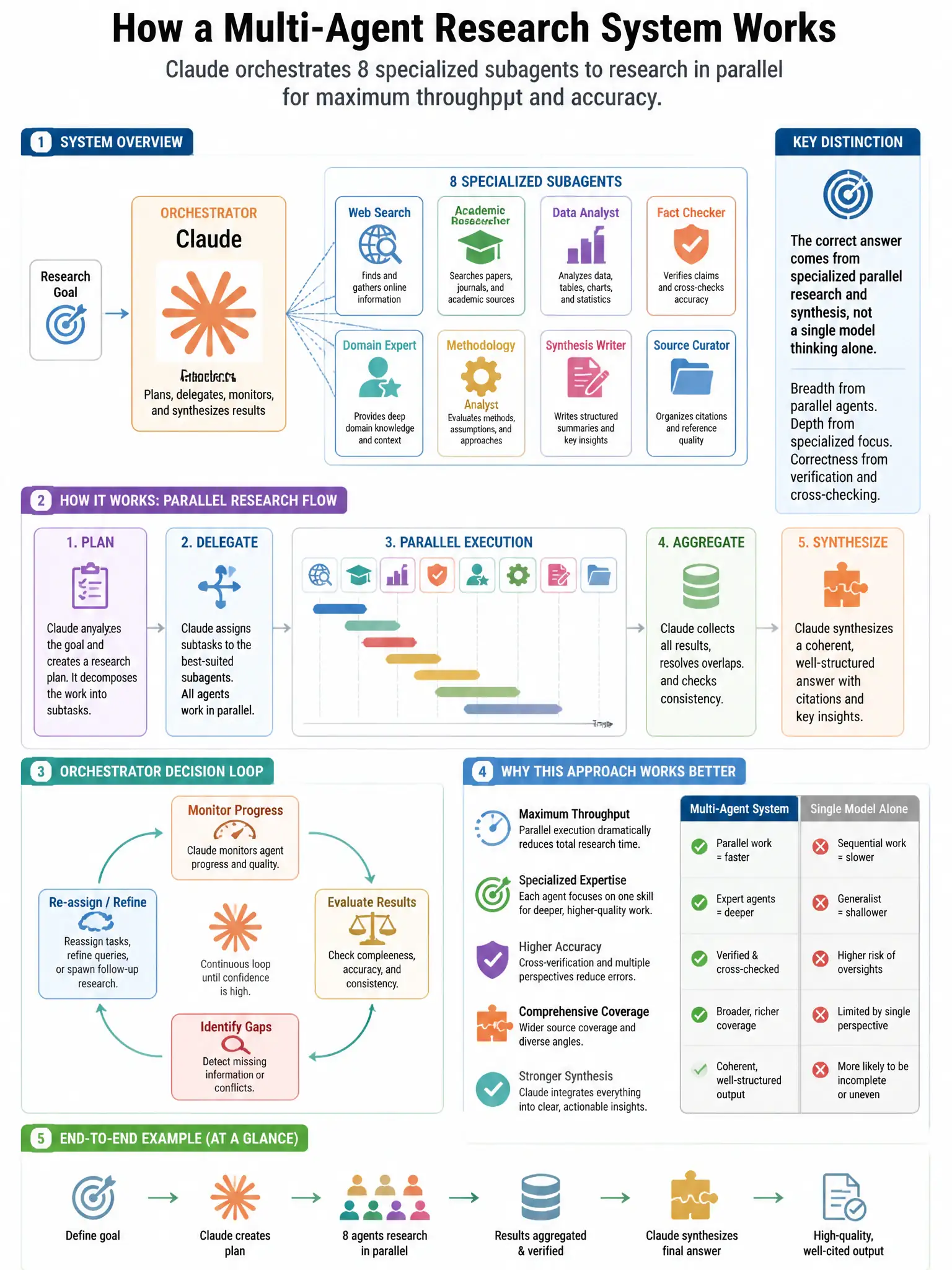
A multi-agent research system has Claude as an orchestrator and 8 specialized subagents. The orchestrator distributes research subtasks in parallel to maximize throughput. During a complex investigation, the orchestrator sends conflicting instructions to two subagents — agent A is told to 'compile all positive evidence for hypothesis X' and agent B is told to 'compile all evidence objectively for hypothesis X.' When both return results, the orchestrator synthesizes them into a biased report because agent A's one-sided framing dominates. What orchestration design flaw caused this, and what is the fix?
Select an answer to reveal the explanation.
Short Explanation
If the recipe card is wrong, tasting the soup harder won't fix it. The bias started when the orchestrator handed out a one-sided task, so you fix it at dispatch by validating each subagent instruction before it goes out.
Full Explanation
The flaw is in task decomposition: the orchestrator wrote a confirmation-bias instruction for one subagent, and everything downstream inherited it. Anthropic's multi-agent research write-up says each subagent needs a clear objective, an output format, guidance on tools and sources, and clear task boundaries, which puts responsibility for instruction quality at dispatch. Validating task assignments against a schema before sending them, and rejecting directional phrasing such as collecting only positive evidence, stops the problem at its source. Adding a reconciliation agent after aggregation is a reasonable defense layer, but it detects the damage after it has happened rather than naming the cause. Leaving dispatch unchanged and tagging results with their framing so synthesis can down-weight them explicitly accepts that biased tasks will keep going out, which treats the symptom and leaves the design flaw in place. Switching to sequential execution slows the system and does nothing to prevent the orchestrator from writing a biased instruction. On the exam, when a question asks what caused a failure, choose the fix that acts where the defect originated. Operationally, log rejected subagent instructions so prompt authors can see which orchestration patterns produce biased framing.