
A multi-agent pipeline orchestrates 6 specialized Claude agents: a research agent, a data analysis agent, a writing agent, a fact-checking agent, a formatting agent, and a quality review agent. The pipeline processes business intelligence reports. During production, the team observes that when the research agent returns partial results (due to tool timeouts), downstream agents proceed with incomplete data and produce confidently wrong reports. The pipeline uses a linear sequential architecture. What failure recovery architecture best addresses this? The team needs a deterministic, auditable definition of 'complete' at every stage.
Select an answer to reveal the explanation.
Short Explanation
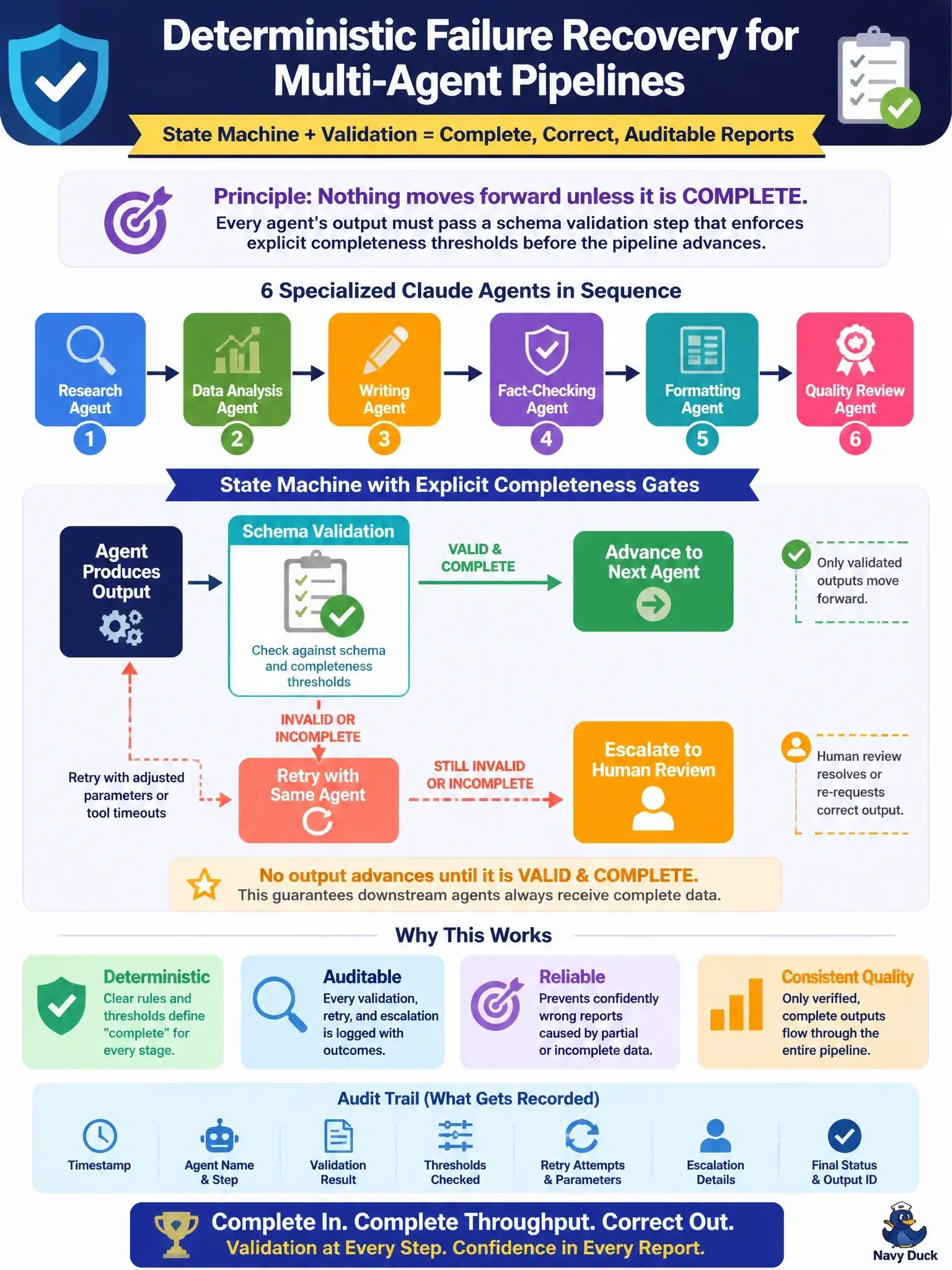
Think of it as a turnstile between every stage: no valid ticket, no entry. A state machine with schema checks gives you a fixed, auditable definition of done, so partial research can't slip downstream just because something thought it looked okay.
Full Explanation
A state machine with explicit completeness thresholds and schema validation fixes the root cause, which is the missing gate between stages. Each agent's output gets a machine-checkable definition of done, validation runs after every stage, and only passing outputs advance; failures are retried or escalated to a human. Anthropic's guidance on prompt chaining describes exactly this kind of programmatic gate on intermediate steps. Because the check is code, it is deterministic and auditable, which the stem now requires. A supervisor agent that uses its own judgment about whether results look complete adds cost and latency and, more importantly, is not deterministic: the same partial output can pass one run and fail the next, and its reasoning cannot be audited like a rule. Per-agent retries with backoff address the tool timeouts but still let a partial result flow forward after the final attempt. Running all six agents in parallel ignores real dependencies, since writing needs finished research and fact-checking needs finished writing. On the exam, when a stem demands a deterministic or auditable criterion, prefer programmatic validation over model judgment. Operationally, record every gate decision with the rule that fired so reviewers can trace why a report advanced or stopped.