
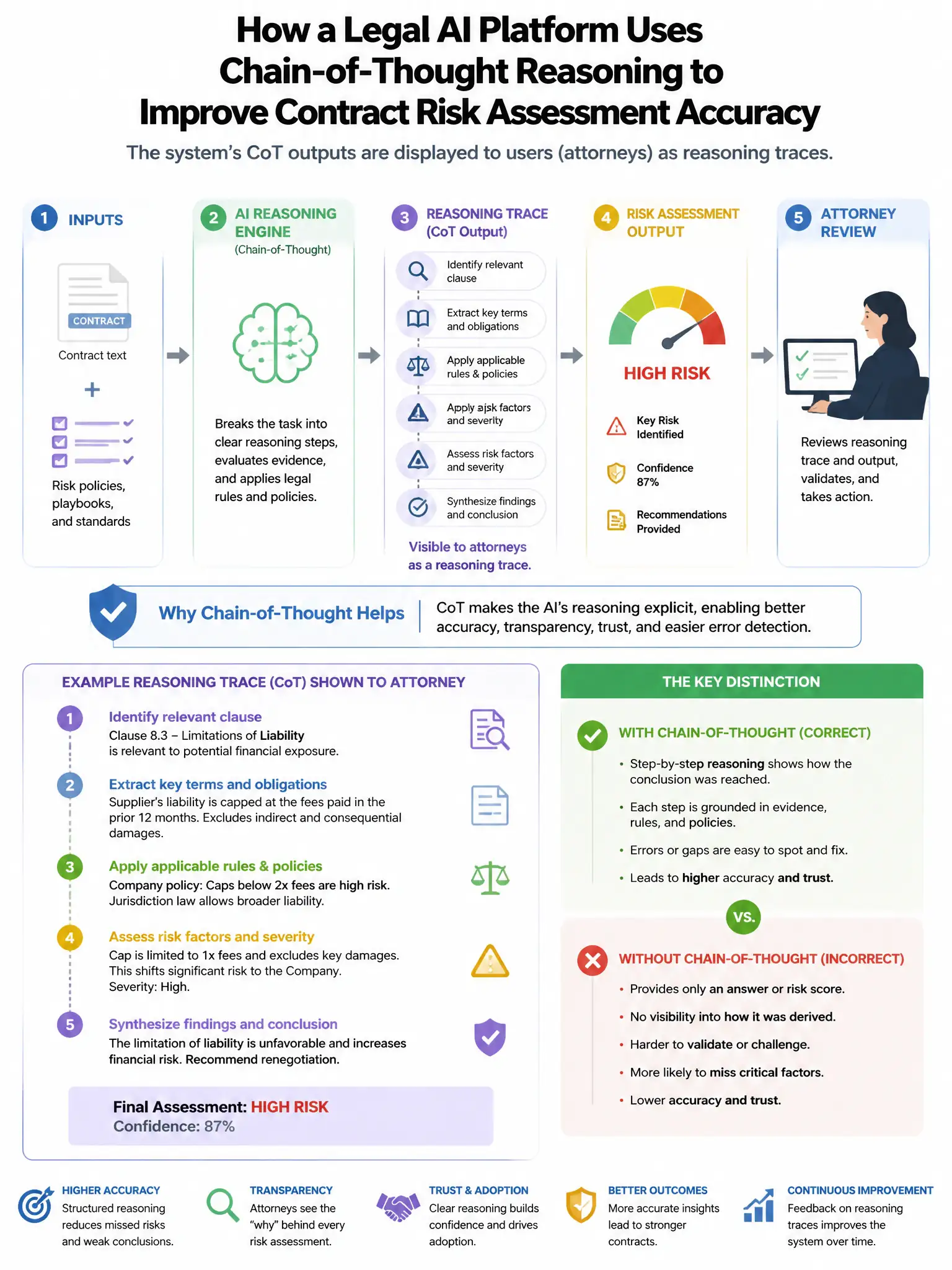
A legal AI platform uses chain-of-thought reasoning to improve contract risk assessment accuracy. The system's CoT outputs are displayed to users (attorneys) as 'reasoning traces.' Attorneys report that Claude's visible reasoning sometimes leads to correct final answers via incorrect intermediate steps — for example, citing the wrong legal precedent in the reasoning but reaching the correct risk conclusion. The team debates whether to (A) hide the reasoning trace, (B) validate intermediate steps before displaying, or (C) add instructions for Claude to verify its own reasoning. Which approach is architecturally correct given that attorneys rely on reasoning traces to build trust?
Select an answer to reveal the explanation.
Short Explanation
Here's the deal — you need the intermediate-step validation approach, because legal citations in visible reasoning are factual claims that must be checked externally. Break it into structured reasoning, validate each precedent with tool calls, then produce the final risk assessment from only verified steps.
Full Explanation
The intermediate-step validation approach is architecturally correct. The core problem is that intermediate reasoning steps cite legal precedents that should be verifiable — an incorrect precedent citation in the reasoning trace is a factual error, not just a model opinion. The correct fix is a two-stage pipeline with external validation: generate structured reasoning steps with explicit precedent citations, validate each cited precedent against a legal database via tool calls, then generate the final assessment using only validated reasoning. That creates a reliable, auditable process, and attorneys can trust the displayed reasoning because each step has been externally verified. The hide-reasoning approach is wrong because it destroys the trust-building purpose of the system — attorneys explicitly need to see reasoning to validate AI-assisted legal work; this is a UX and professional responsibility requirement. The self-verification instruction approach is wrong because it has a well-documented weakness: a model that generates an incorrect intermediate step is likely to confirm it as correct during self-review — the same biases produce both the error and the validation. The extended-thinking alternative is wrong because separating internal from displayed reasoning does not fix the underlying factual accuracy of the displayed conclusion — attorneys still need to understand why the risk assessment was reached.