
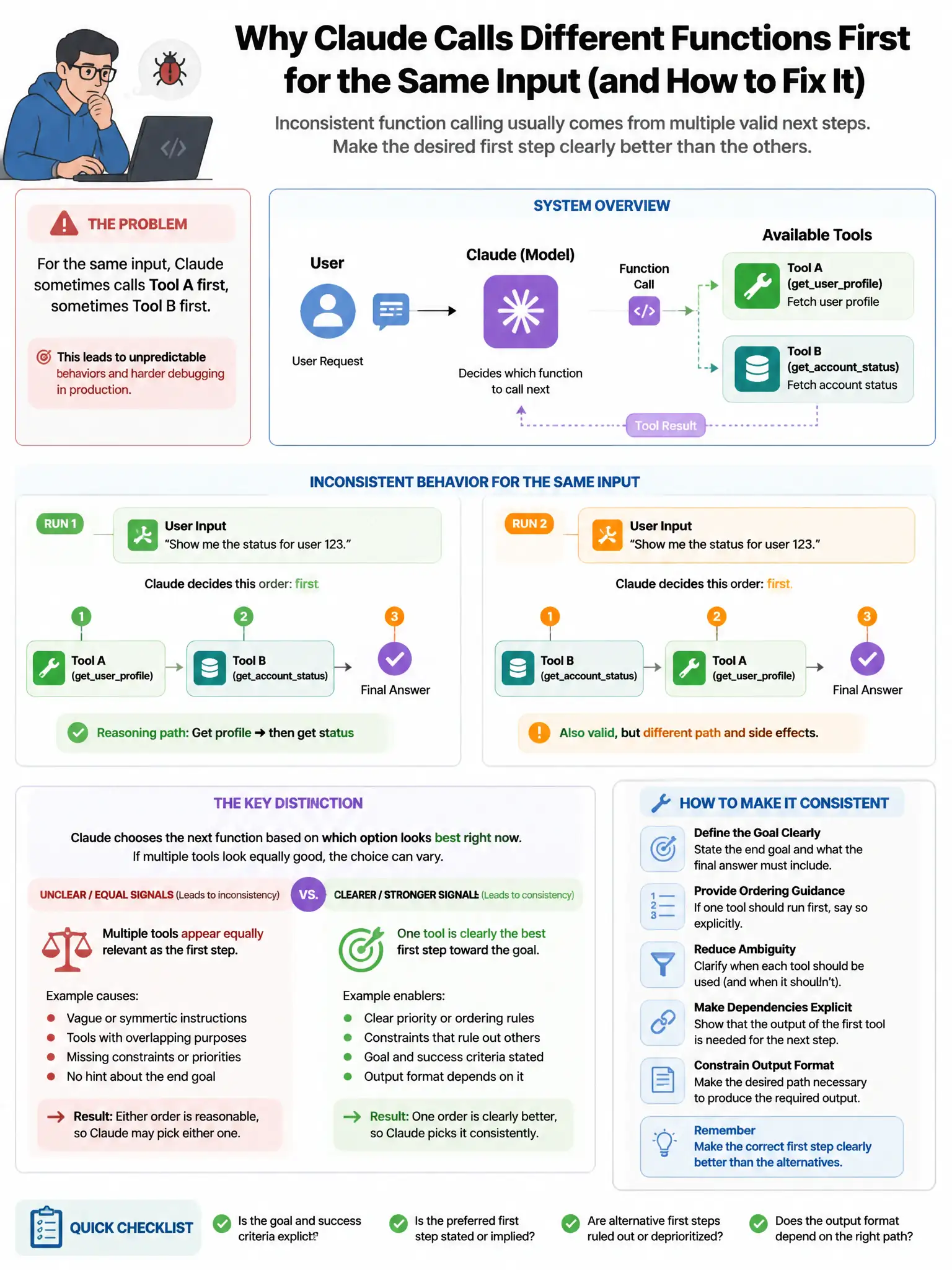
A developer is debugging a production issue where Claude's function calling behavior is inconsistent. For the same input, Claude sometimes calls tool A first, sometimes tool B first, even with temperature: 0. The tools are: search_knowledge_base(query) and get_user_profile(user_id). The task is: 'Find the user's account history and any relevant support articles.' The developer expects a deterministic sequence: get_user_profile first, then search_knowledge_base. How should this be enforced architecturally?
Select an answer to reveal the explanation.
Short Explanation
Here's the deal — you need to make the wrong tool impossible to call. Remove search_knowledge_base from the tools array on the first API call, then add it back after get_user_profile returns. That way the sequence is enforced by the API, not by hoping Claude follows instructions.
Full Explanation
The most robust architectural enforcement of tool call sequence is removing unavailable tools from the tools array. If search_knowledge_base is not in the tools list on the first call, Claude literally cannot call it — the sequence is enforced by API design, not by model behavior. After get_user_profile returns its result, search_knowledge_base is added for the second call. This approach is deterministic regardless of model behavior, temperature settings, or prompt phrasing. The tool_choice approach that forces get_user_profile on the first call and then switches to auto for the second call correctly enforces the first tool, but auto does not make search_knowledge_base the only tool the model can select once the profile result is present; if the second call's context makes Claude want to call get_user_profile again, it can. The prompt-sequencing approach that tells Claude to retrieve the profile first and then search the knowledge base is a reasonable soft approach but not architecturally robust — model behavior with multiple available tools can deviate from textual sequence instructions, especially under edge-case inputs. The temperature/top_p approach that sets both to their minimum values is factually incorrect: temperature and top_p affect sampling randomness but tool selection in agentic contexts is not purely sampling-based — multiple valid orderings may have similar likelihoods.