
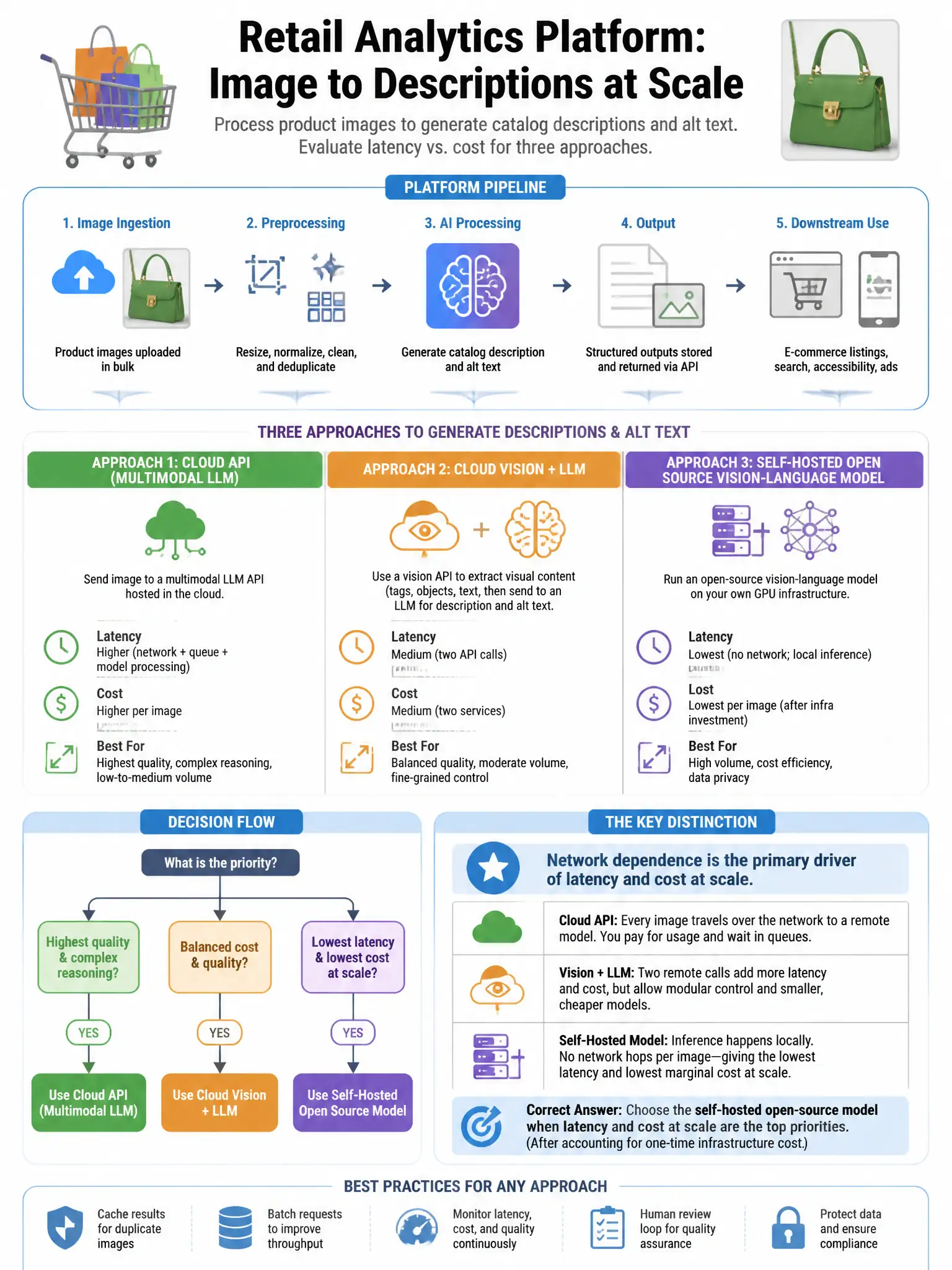
A retail analytics platform processes product images to generate catalog descriptions and alt text at scale. The team is evaluating latency vs. cost for three approaches: (A) Claude Haiku with vision, (B) Claude Sonnet with vision, (C) Pre-classify images with a lightweight CNN, then route simple products to Haiku and complex lifestyle photos to Sonnet. Product mix is 70% simple product-on-white images and 30% lifestyle photography. Haiku cost is $0.25/1K images, Sonnet cost is $1.50/1K images. Which approach minimizes cost while maintaining catalog quality?
Select an answer to reveal the explanation.
Short Explanation
You'll get the best cost-quality balance by using the lightweight image classifier to route simple product-on-white images to Haiku and lifestyle photos to Sonnet. That mix costs about $0.625 per 1K images, cutting Sonnet-only spend by 58% while keeping quality where it matters.
Full Explanation
The lightweight image classifier routing approach achieves the optimal cost-quality balance. With 70% of images sent to Haiku and 30% to Sonnet, the blended cost is (0.70 × $0.25) + (0.30 × $1.50) = $0.175 + $0.45 = $0.625 per 1K images, a 58% reduction versus using Sonnet for all images while preserving quality on lifestyle images that require it. The lightweight image classifier adds minimal overhead and cost given its lightweight nature. The all-Haiku approach is cheapest but degrades quality on 30% of catalog images — lifestyle photos require understanding composition, mood, and context that Haiku handles less accurately. The all-Sonnet approach wastes 70% of budget on simple images where Haiku is sufficient. The lightweight image classifier routing variant tuned to send 90% of images to Haiku, reducing cost to approximately $0.30 per 1K images, is aggressive because it routes too much to Haiku; the mix should reflect actual complexity distribution, not an arbitrary cost target, to preserve quality.