
A developer building a creative writing platform discovers that users frame requests as 'fiction' or 'hypothetical scenarios' to get Claude to generate content it would otherwise decline (e.g., detailed illegal instructions wrapped in story format). What is the correct architectural and policy response?
Select an answer to reveal the explanation.
Short Explanation
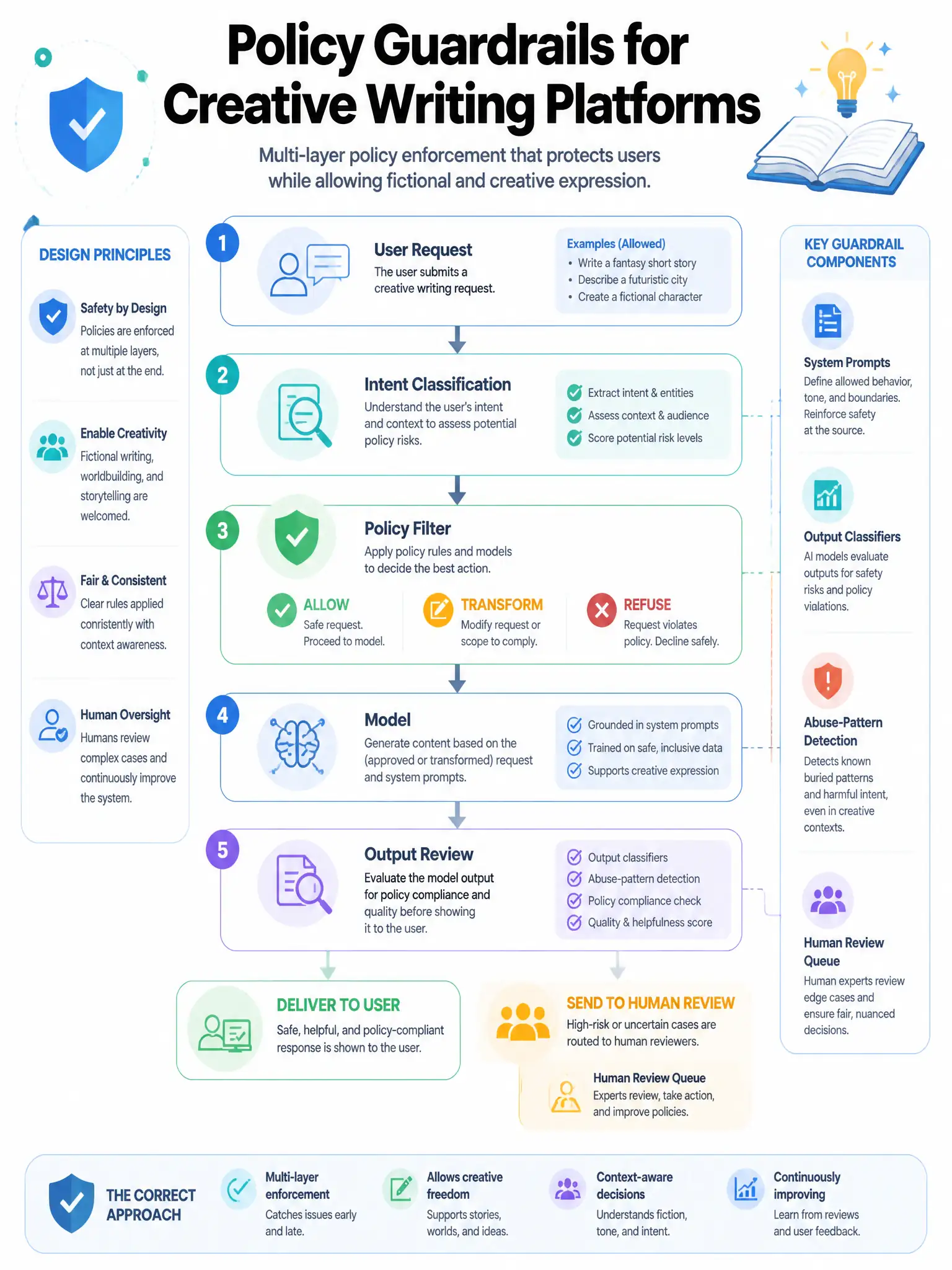
Here's the deal — fictional framing jailbreaks are a known attack pattern. You need defense in depth: configure the system prompt with clear creative content boundaries, rely on Claude's Constitutional AI training to recognize that fictional framing doesn't make harmful instructions safe, and add output monitoring to catch violations that slip through.
Full Explanation
Fictional framing jailbreaks are a known attack pattern. The correct response is defense in depth: configure the system prompt with clear creative content boundaries and explicit handling of fictional framing, rely on Claude's Constitutional AI training, which recognizes that fictional framing doesn't transform dangerous real-world instructions into safe content because the instructions remain equally dangerous whether embedded in a story or not, and add output monitoring to catch violations that slip through. The option that blocks all fictional and creative writing requests is an extreme overcorrection that destroys the platform's core use case. The option that treats all fiction requests as real requests and refuses to generate content in fiction that would not be generated in response to a direct request is also overcorrective — it prevents legitimate creative writing by treating all fictional scenarios as equivalent to direct harmful requests. The option that relies only on Claude's Constitutional AI training and says no additional architectural measures are needed is insufficient alone; defense in depth requires layered controls at both the model and application layers.