
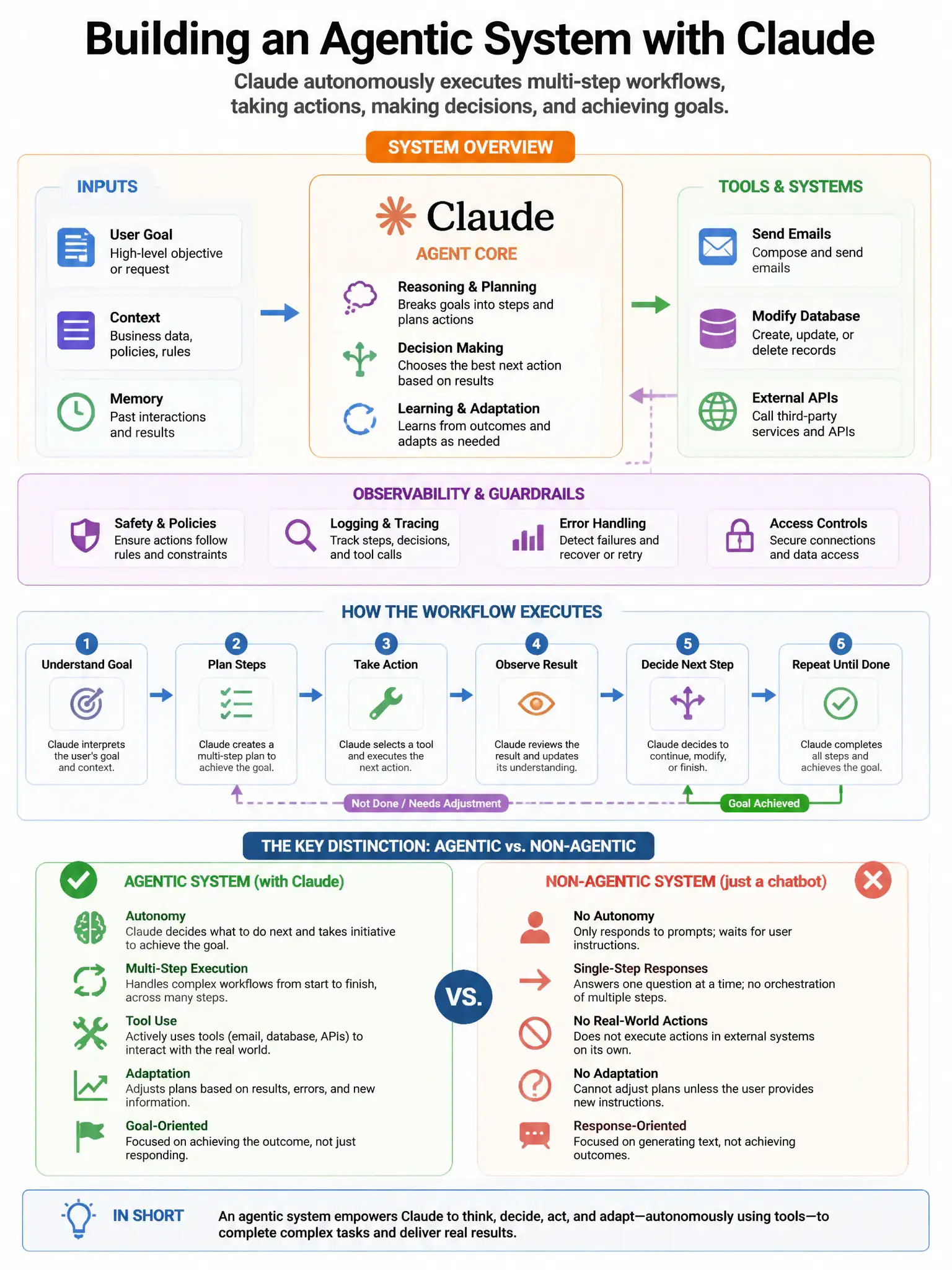
A team is building an agentic system where Claude autonomously executes multi-step workflows including sending emails, modifying database records, and calling external APIs. A senior architect raises concerns about the safety profile. What architectural principle should govern this design?
Select an answer to reveal the explanation.
Short Explanation
Here's the deal — you need minimal footprint: give Claude only the permissions it needs, prefer reversible actions, confirm before consequential side effects, and log everything for auditability. That keeps useful autonomy while containing real-world risk.
Full Explanation
Anthropic's guidance for agentic systems emphasizes minimal footprint: Claude should only request permissions needed for the current task, prefer reversible operations over irreversible ones, avoid acquiring resources or capabilities beyond immediate needs, and pause to confirm with users before consequential actions. This balances autonomy with safety. The checkpoint-only-for-irreversible approach is partially correct because it focuses on irreversible actions, but it is too permissive — 'reversible' is context-dependent, and read operations can have privacy implications. The require-approval-for-everything approach defeats the purpose of automation and makes the system impractical; the architecture must enable useful autonomy while containing risk. The Constitutional-AI-alone approach is insufficient as an architectural safeguard — Constitutional AI reduces harmful outputs but doesn't replace architectural controls for agentic side effects; both are necessary.