
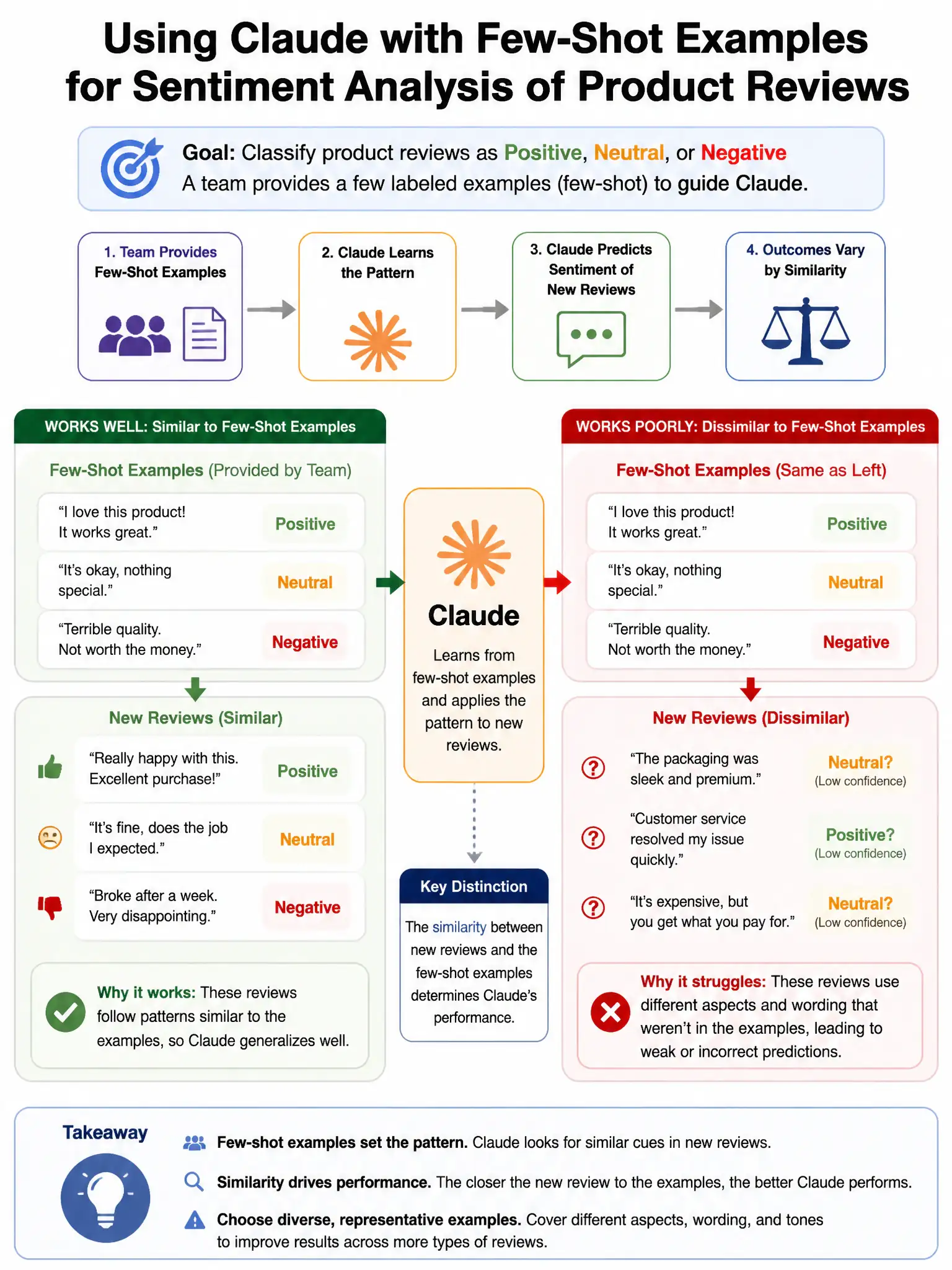
A team uses Claude with few-shot examples to perform sentiment analysis on product reviews. The model performs well on examples similar to the few-shot set but poorly on reviews with unusual phrasing or mixed sentiment. What is the most effective architectural improvement?
Select an answer to reveal the explanation.
Short Explanation
Here's the deal — your few-shot set is missing the hard cases. Diversify the examples to cover mixed sentiment, sarcasm, and unusual phrasing, then add chain-of-thought steps that show how to reason through ambiguity.
Full Explanation
The team's issue is distribution shift — their few-shot examples don't cover the edge cases encountered in production. The fix is to diversify examples to include the failure modes (mixed sentiment, sarcasm, ambiguous phrasing) and add chain-of-thought demonstrations that explicitly show the reasoning process for ambiguous cases. This teaches Claude both the pattern and the reasoning strategy. Adding more few-shot examples until the model generalizes better, targeting 20+ examples in the system prompt, helps only if the new examples cover the distribution gaps; quantity alone doesn't address quality gaps. Removing few-shot examples entirely and relying on Claude's pre-trained sentiment analysis capability with zero-shot instructions removes the behavioral anchoring that few-shot provides — Claude's default sentiment analysis may be less calibrated to the specific product domain and review style. Fine-tuning Claude on the target review domain using the Anthropic fine-tuning API for maximum generalization invents an Anthropic fine-tuning API that is not a publicly available feature for Claude models in this exam's scope.