
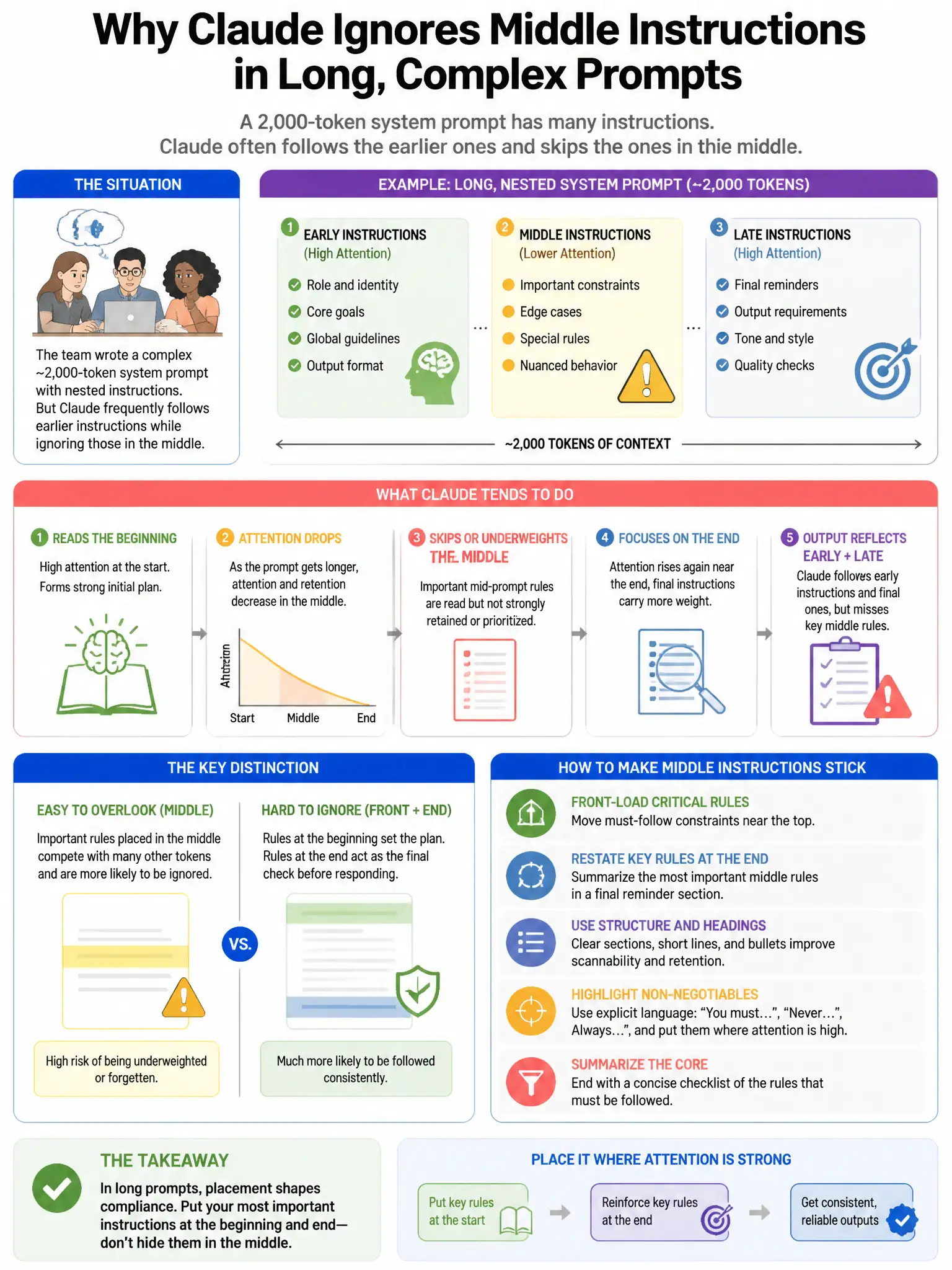
A team has written a complex 2,000-token system prompt with nested instructions but observes that Claude frequently follows earlier instructions while ignoring those in the middle of the prompt. Which structural technique most directly addresses this attention degradation issue?
Select an answer to reveal the explanation.
Short Explanation
Here's the deal — Claude pays more attention to the beginning and end of a prompt than to the middle, so you should put the most critical instructions at both ends. Use XML tags to make clear sections and state the priority order so Claude knows which rules win when they conflict.
Full Explanation
Large language models including Claude exhibit recency and primacy effects — they tend to weight instructions at the beginning and end of context more heavily than those in the middle. The mitigation is to place critical instructions at both the beginning and end of the system prompt to capture both effects, use XML tags to create explicit hierarchical sections that Claude's training associates with structured importance, and explicitly state instruction priority ('If any rules conflict, priority order is: 1. Safety 2. Format 3. Style'). Increasing max_tokens to give Claude more room to process instructions before generating output is irrelevant — this is an input attention issue, not an output length issue. Using markdown headers to structure the system prompt helps readability but doesn't specifically address middle-of-prompt attention degradation, and it doesn't establish the same explicit hierarchical priority signal. Breaking the system prompt into multiple separate API calls each containing only the relevant instructions for that specific task phase fragments instructions across calls, losing holistic coherence needed for consistent behavior.