
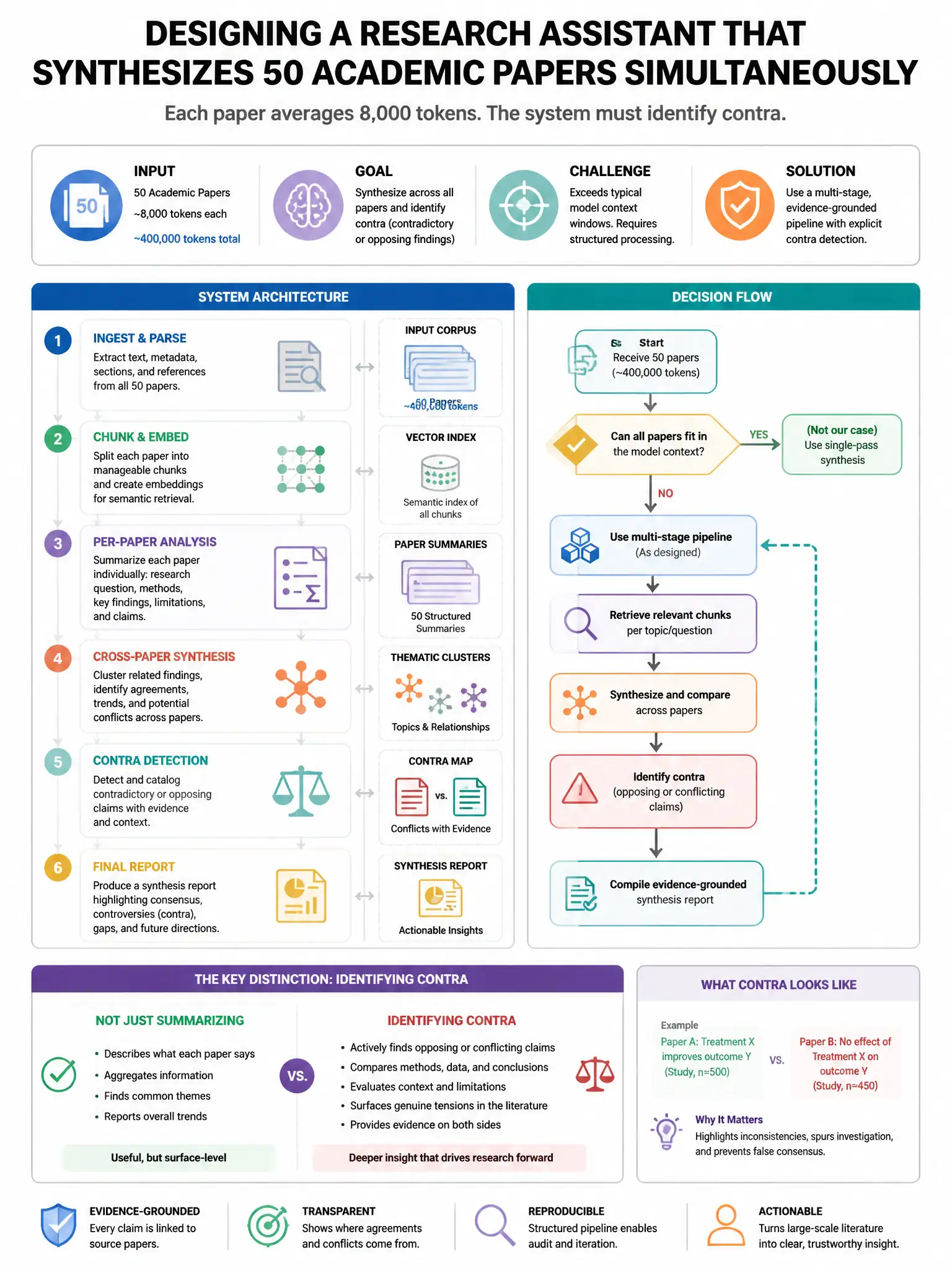
An architect is designing a research assistant that must synthesize information from 50 academic papers simultaneously, each averaging 8,000 tokens. The system must identify contradictions across papers and generate a unified literature review. What is the primary architectural consideration?
Select an answer to reveal the explanation.
Short Explanation
Here's the deal — 50 papers at 8,000 tokens each totals 400,000 tokens, so you can't shove all of them into Claude's 200K context window. Use embeddings to pull the most relevant papers into a curated set instead of blindly splitting them into batches.
Full Explanation
50 papers at 8,000 tokens each totals 400,000 tokens, exceeding Claude's 200K context window. The right architectural response is selective retrieval: use embeddings to identify the most relevant papers for a given research question, retrieve the top 20-25 that fit the context window, and use that curated set. This produces higher-quality synthesis than arbitrary batching because relevance filtering reduces noise. The claim that a map-reduce pipeline is mandatory regardless of model choice is wrong because selective retrieval is architecturally superior for synthesis tasks. The claim that all 50 papers fit in one call with no special handling is factually incorrect because 400K tokens exceeds the 200K limit. The two-equal-batches approach is wrong because it loses cross-batch contradiction detection, which is the core requirement. Randomly sampling papers until the prompt fits is also wrong because it discards potentially relevant papers and cannot guarantee that contradictions across the full corpus are detected.