
Your organization is conducting a formal safety evaluation of a new Claude-based application before production deployment. The application handles sensitive mental health support conversations. What evaluation framework elements are essential for a rigorous pre-deployment safety assessment?
Select an answer to reveal the explanation.
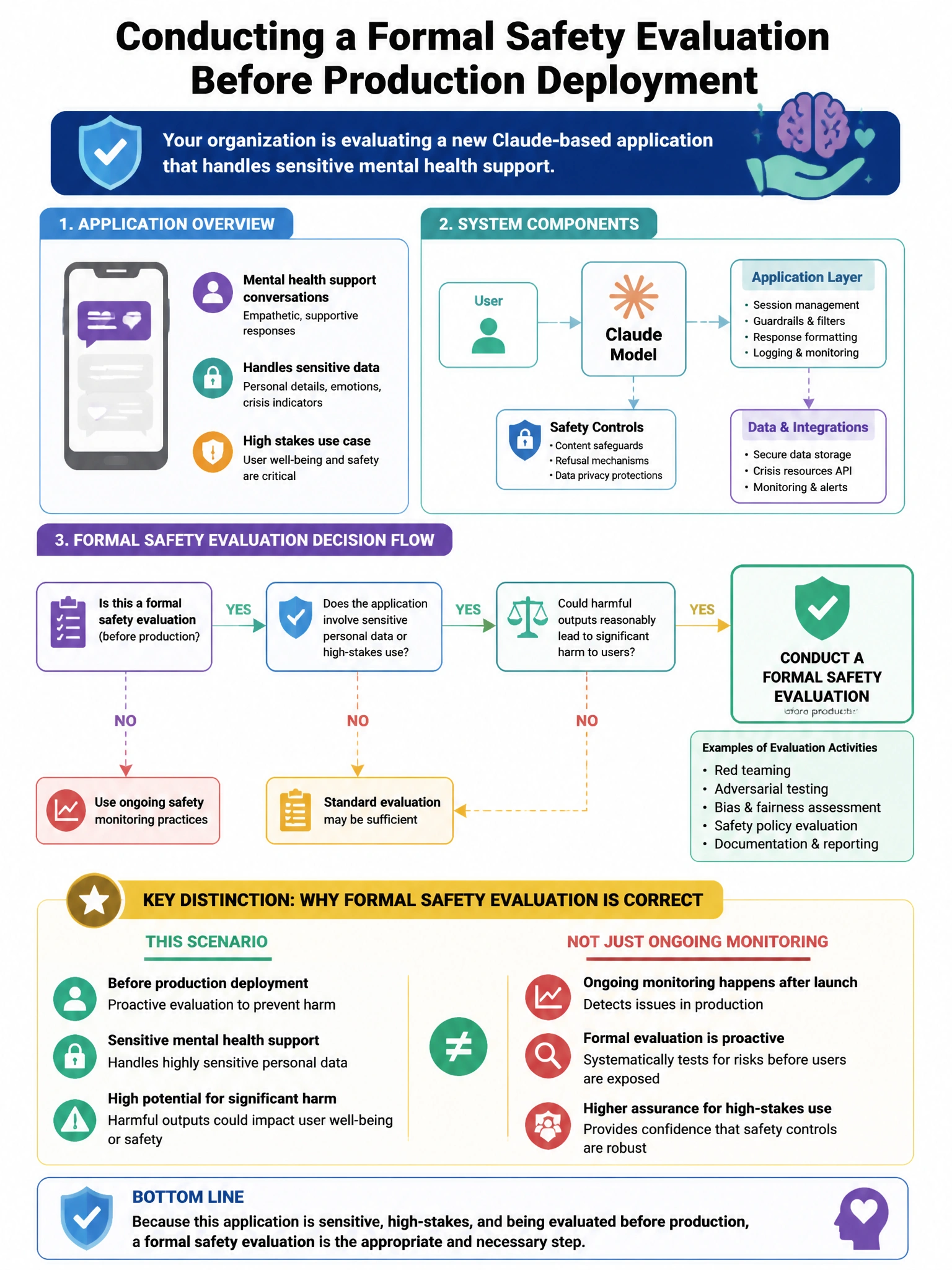
Short Explanation and Infographic
Here's the deal — b is correct because mental health support applications require adversarial safety evaluation, not just functional testing. A rigorous pre-deployment framework must include red team probing for the specific failure modes in this domain: inadequate crisis response (e.g., failing to escalate active suicidality), inappropriate clinical advice or diagnosis, failure to route to professional help when warranted, and demographic inconsistency (responding differently based on perceived user identity).
Full explanation below image
Full Explanation
B is correct because mental health support applications require adversarial safety evaluation, not just functional testing. A rigorous pre-deployment framework must include red team probing for the specific failure modes in this domain: inadequate crisis response (e.g., failing to escalate active suicidality), inappropriate clinical advice or diagnosis, failure to route to professional help when warranted, and demographic inconsistency (responding differently based on perceived user identity). Ongoing post-deployment monitoring is essential because red teams cannot exhaustively cover all real-world inputs. A is wrong because no automated classifier provides sufficient coverage for sensitive mental health edge cases — automated tools miss nuanced contextual failures that require human judgment to identify. C is wrong because user satisfaction measures whether users like the experience, not whether the application is safe; users in mental health crisis may prefer responses that are engaging but harmful. D is wrong because a 100-conversation sample reviewed by one expert is statistically insufficient for a sensitive application and does not cover the adversarial probe space needed to surface edge-case safety failures.