
Your team needs to build an idempotent document processing pipeline using the Claude API. Each document should be processed exactly once even if the triggering event fires multiple times (e.g., due to message queue redelivery). What design ensures idempotency at the API integration layer?
Select an answer to reveal the explanation.
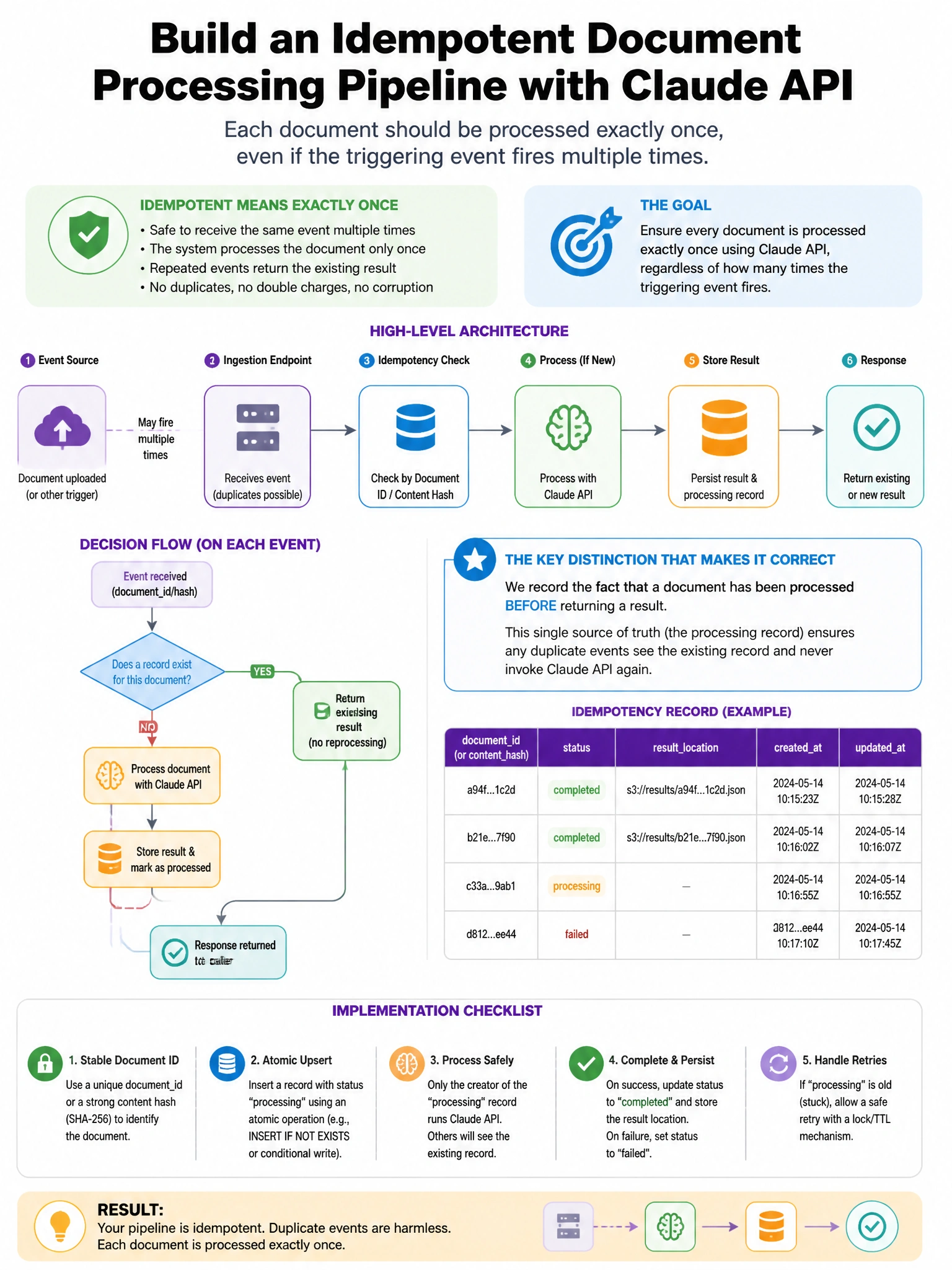
Short Explanation and Infographic
Here's the deal — c is correct because the Anthropic API does not natively support idempotency keys for deduplication. Idempotency must be implemented in the application layer using a state store (e.g., Redis, DynamoDB, or a database) to track processed document IDs.
Full explanation below image
Full Explanation
C is correct because the Anthropic API does not natively support idempotency keys for deduplication. Idempotency must be implemented in the application layer using a state store (e.g., Redis, DynamoDB, or a database) to track processed document IDs. The check-before-call + atomic mark-as-processed pattern is the standard approach for building idempotent event-driven pipelines. A is wrong because Anthropic's API does not expose an idempotency_key request parameter; this feature does not exist in the API as described. B is wrong because while temperature 0 produces more consistent outputs, Claude is not guaranteed to produce bit-identical responses on identical inputs, and harmlessness of duplicate processing depends entirely on the downstream system — duplicate writes to a database are not harmless. D is wrong because streaming stream IDs are connection artifacts for a single request, not deduplication mechanisms across requests.