
An architect is configuring Claude for an enterprise legal assistant. The system prompt contains firm-specific guidelines, a detailed persona definition, extensive jurisdiction-specific rules, formatting instructions, and a 50-document knowledge base excerpt. The combined system prompt is 28,000 tokens. The team observes that some instructions toward the end of the system prompt are being inconsistently followed. What is the most likely cause and correct remediation?
Select an answer to reveal the explanation.
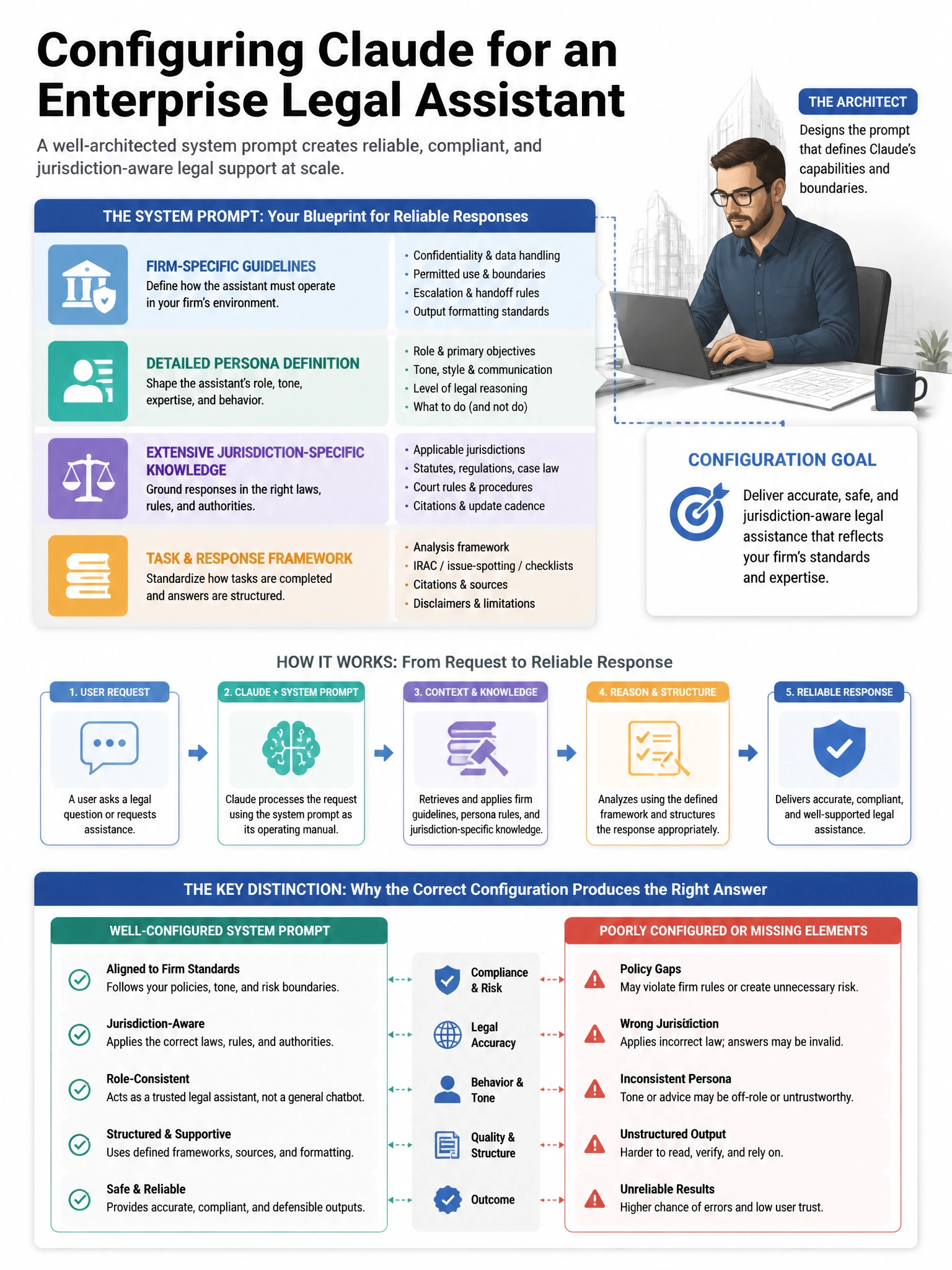
Short Explanation and Infographic
Here's the deal — c is correct because long-context attention is not uniform — models exhibit reduced attention to content in the middle of very long prompts (the 'lost in the middle' phenomenon). Placing critical behavioral rules at the top and bottom of the system prompt exploits the primacy and recency effects.
Full explanation below image
Full Explanation
C is correct because long-context attention is not uniform — models exhibit reduced attention to content in the middle of very long prompts (the 'lost in the middle' phenomenon). Placing critical behavioral rules at the top and bottom of the system prompt exploits the primacy and recency effects. Moving the 50-document knowledge base to RAG retrieval is the correct architectural fix — it converts static embedding to dynamic retrieval, freeing system prompt space for instructions. A is wrong because Anthropic does not enforce a hard 20,000-token system prompt limit, and truncation behavior is not the described symptom (inconsistent following, not consistent omission of a specific block). B is wrong because the Anthropic API accepts only a single system-role message; there is no multi-system-message architecture in the Messages API. D is wrong because temperature controls output randomness and has no effect on which parts of a system prompt the model attends to.