
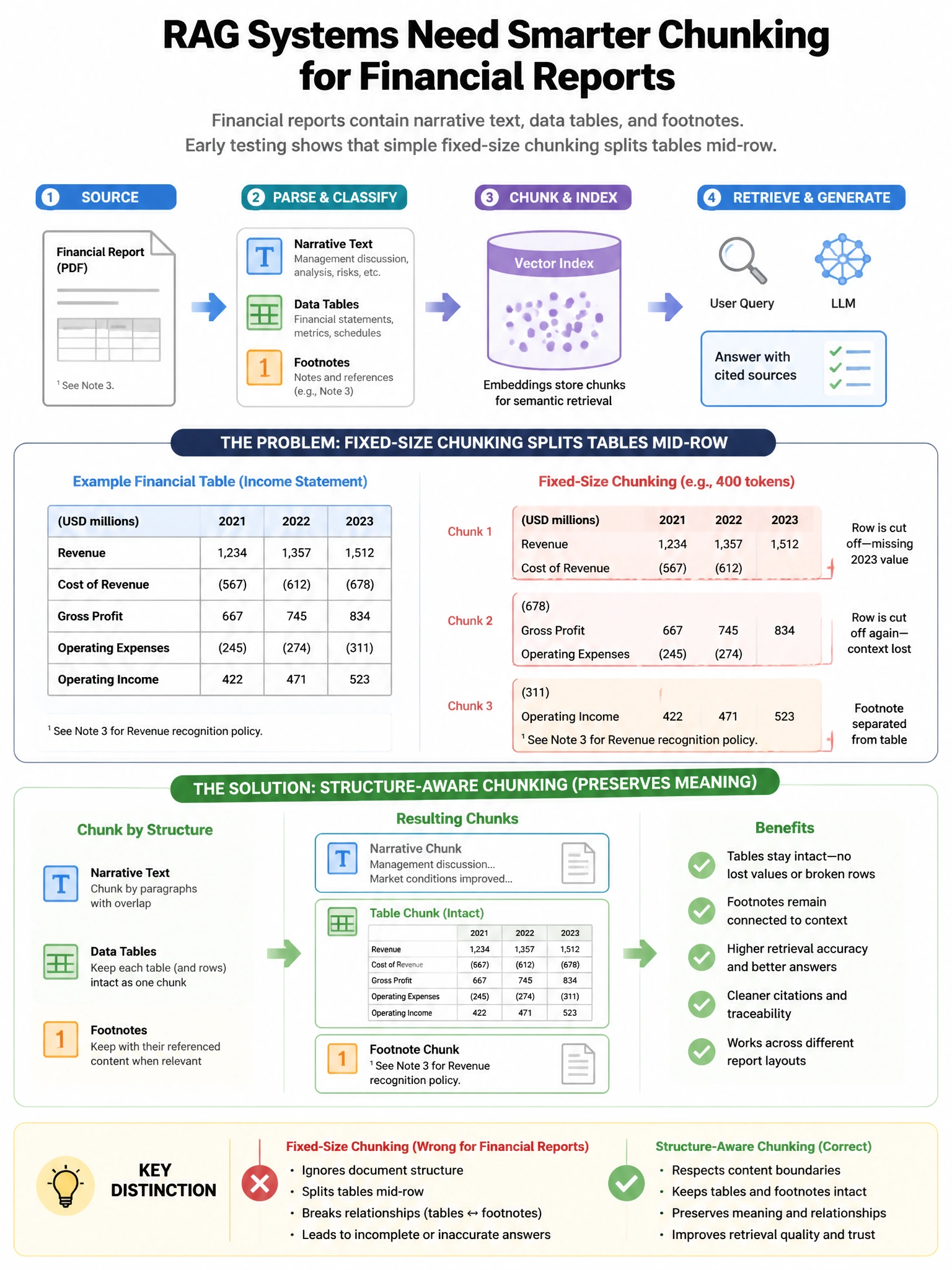
A RAG system indexes financial reports that contain narrative text sections, data tables, and footnotes. Early testing shows that simple fixed-size chunking splits tables mid-row and separates footnotes from the text that references them, causing Claude to misinterpret financial figures. What chunking strategy preserves semantic integrity for this document type?
Select an answer to reveal the explanation.
Short Explanation and Infographic
Here's the deal — a is correct because financial documents have rich structure that fixed-size chunking destroys: tables are semantic units where row/column relationships are essential for interpreting figures; footnotes provide qualifications that change the meaning of the figures they annotate. Structure-aware chunking that respects these boundaries and attaches metadata (section headers, table captions) preserves the semantic integrity needed for accurate financial interpretation.
Full explanation below image
Full Explanation
A is correct because financial documents have rich structure that fixed-size chunking destroys: tables are semantic units where row/column relationships are essential for interpreting figures; footnotes provide qualifications that change the meaning of the figures they annotate. Structure-aware chunking that respects these boundaries and attaches metadata (section headers, table captions) preserves the semantic integrity needed for accurate financial interpretation. B is wrong because reducing chunk size to 128 tokens makes table splitting worse, not better — smaller chunks are more likely to split mid-table, not less; and tables may exceed 128 tokens. C is wrong because overlapping chunks duplicate content (increasing index size and retrieval noise) and still split table rows mid-entry — overlap does not create semantic boundaries, only redundant coverage. D is wrong because converting tables to natural language loses the structured data format that makes table retrieval valuable — Claude can interpret table structure visually or through JSON; prose conversion loses precision and adds ambiguity.