
A RAG system's retrieval component returns the top-5 documents for each query. The team wants to measure retrieval quality before evaluating end-to-end answer quality. Which metrics provide the most complete picture of retrieval performance?
Select an answer to reveal the explanation.
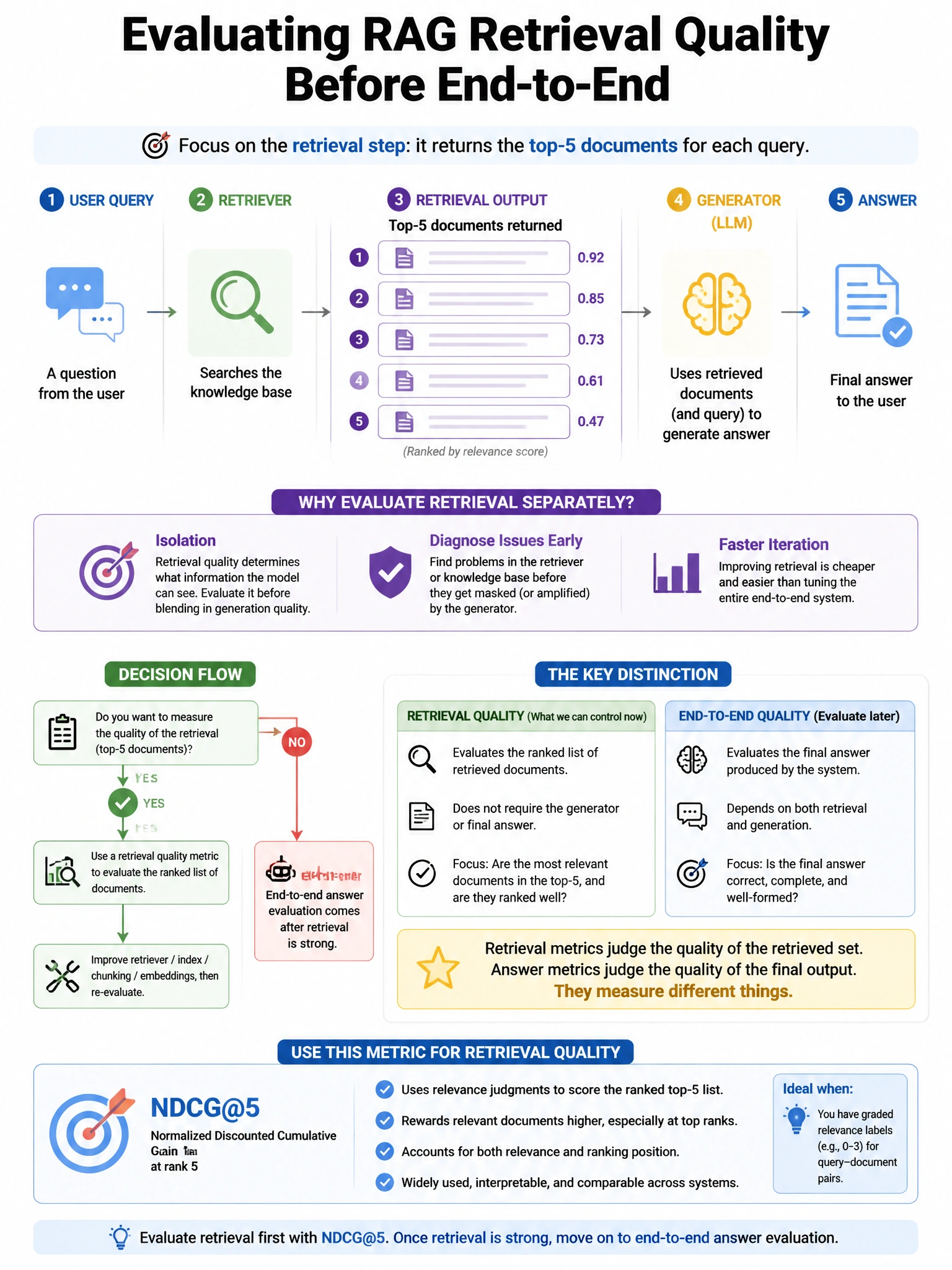
Short Explanation and Infographic
Here's the deal — d is correct because Precision@5 and Recall@5 together provide complementary signals: Precision@5 measures whether the retrieved documents are relevant (important when context length limits the number of documents passed to Claude), and Recall@5 measures whether all relevant information was captured (important for completeness). A human-labeled relevance dataset provides ground truth for objective measurement.
Full explanation below image
Full Explanation
D is correct because Precision@5 and Recall@5 together provide complementary signals: Precision@5 measures whether the retrieved documents are relevant (important when context length limits the number of documents passed to Claude), and Recall@5 measures whether all relevant information was captured (important for completeness). A human-labeled relevance dataset provides ground truth for objective measurement. A is wrong because end-to-end answer accuracy confounds retrieval quality with generation quality — good retrieval with poor prompting can still produce wrong answers, and poor retrieval with very capable generation can sometimes produce correct answers through memorized knowledge. C is wrong because latency and throughput measure system performance, not retrieval relevance quality — a fast retriever returning irrelevant documents is worse than a slower one returning relevant documents. B is wrong because Hit Rate@5 (at least one relevant document in top-5) is a necessary condition but insufficient — a system returning 1 relevant and 4 irrelevant documents scores the same as one returning 5 relevant documents, masking precision differences.