
An architect is preparing a customer-facing Claude integration for production launch. The application processes user-submitted product descriptions and generates marketing copy. What testing strategy best ensures the prompt is robust to real-world input variation before launch?
Select an answer to reveal the explanation.
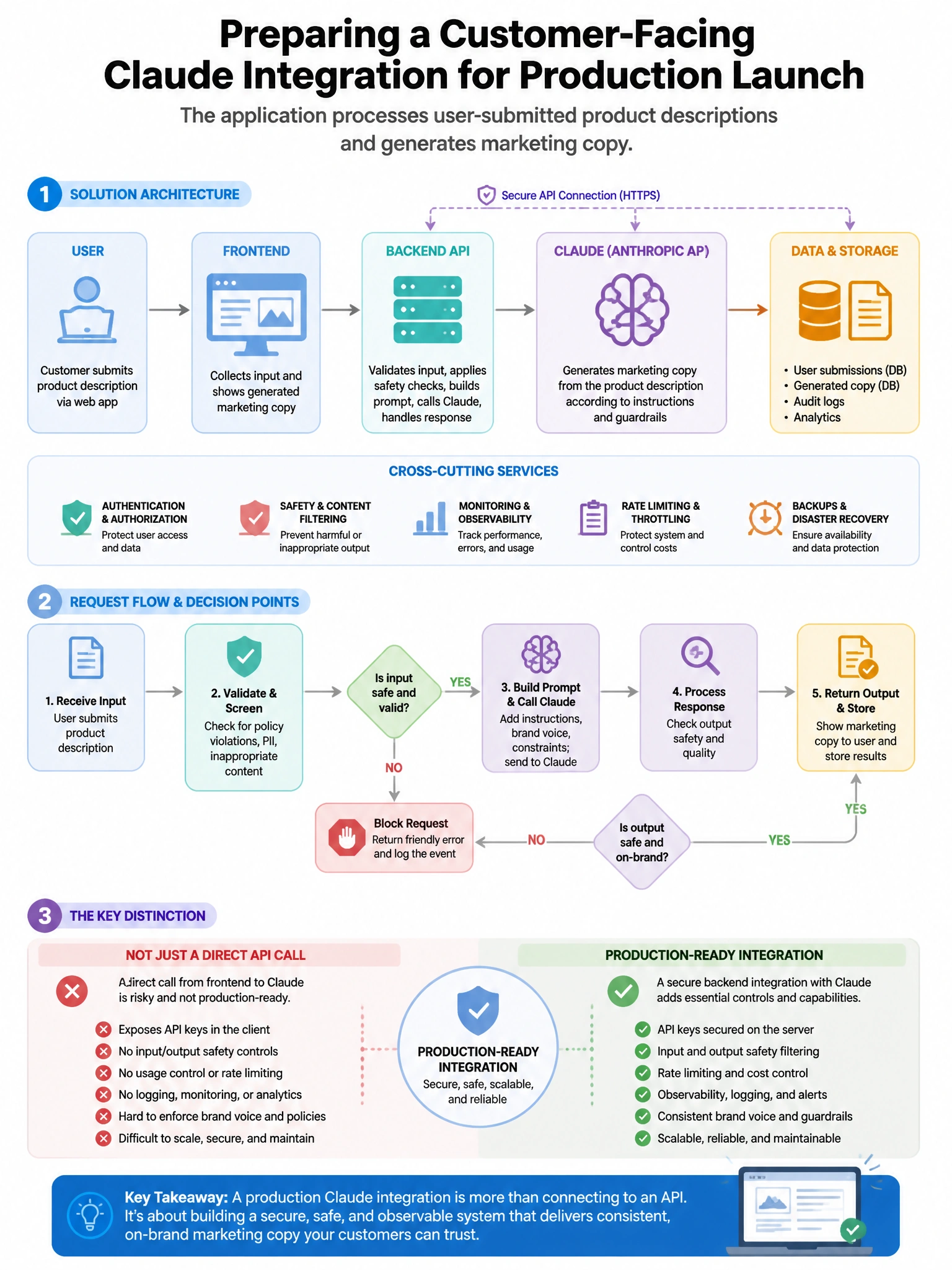
Short Explanation and Infographic
Here's the deal — c is correct because production systems must handle the full distribution of real-world inputs, not just well-formed examples. Adversarial testing reveals failure modes before users encounter them: very short inputs may produce hallucinated details, very long inputs may cause truncation or loss of key information, unexpected languages test graceful degradation, and injection attempts test security properties.
Full explanation below image
Full Explanation
C is correct because production systems must handle the full distribution of real-world inputs, not just well-formed examples. Adversarial testing reveals failure modes before users encounter them: very short inputs may produce hallucinated details, very long inputs may cause truncation or loss of key information, unexpected languages test graceful degradation, and injection attempts test security properties. A is wrong because 5 team-curated examples are not representative of the real input distribution — they will be clean, well-formed, and in the expected format, missing all edge cases. B is wrong because 'users will submit proper descriptions' is an assumption that fails in production — users regularly submit incomplete, unusual, or unexpected inputs; designing for only the happy path guarantees production incidents. D is wrong because standard NLP benchmarks measure general capability, not the behavior of this specific prompt on this application's input distribution.