
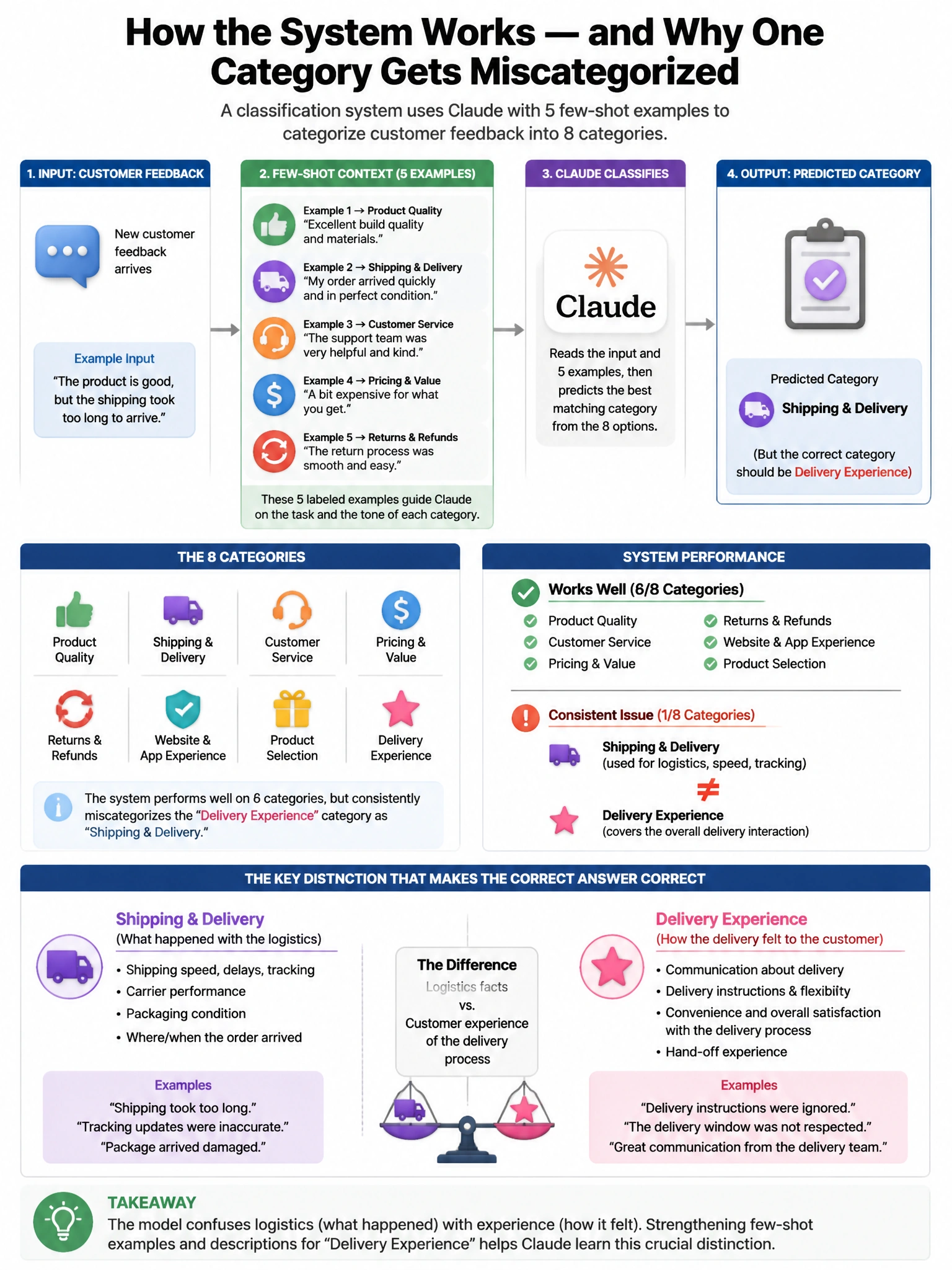
A classification system uses Claude with 5 few-shot examples to categorize customer feedback into 8 categories. The system works well for 6 categories but consistently miscategorizes 2 rare categories. Adding more examples for the rare categories would exceed the token budget. What is the most effective targeted fix?
Select an answer to reveal the explanation.
Short Explanation and Infographic
Here's the deal — b is correct because adversarial/boundary examples target the specific failure mode — if two rare categories are being miscategorized, the most informative examples are those that lie near the decision boundary between the confused categories, clearly illustrating the distinguishing features. These boundary examples provide more signal per token than generic representatives of the category.
Full explanation below image
Full Explanation
B is correct because adversarial/boundary examples target the specific failure mode — if two rare categories are being miscategorized, the most informative examples are those that lie near the decision boundary between the confused categories, clearly illustrating the distinguishing features. These boundary examples provide more signal per token than generic representatives of the category. A is wrong because removing well-performing category examples will degrade performance on those categories to fix others — net accuracy could decrease. C is wrong because higher temperature increases output randomness, which would degrade performance on all 6 well-performing categories without reliably fixing the rare category errors. D is wrong because switching to zero-shot with descriptions loses the behavioral grounding that few-shot examples provide — detailed descriptions of rare categories are typically less effective than concrete demonstrations for abstract category distinctions.