
An architect must decide whether to place detailed task instructions in the system prompt or the first user turn of a conversation. The application uses a shared Claude deployment with a fixed system prompt across all users. Which consideration most strongly argues for placing complex task instructions in the system prompt rather than the first user turn?
Select an answer to reveal the explanation.
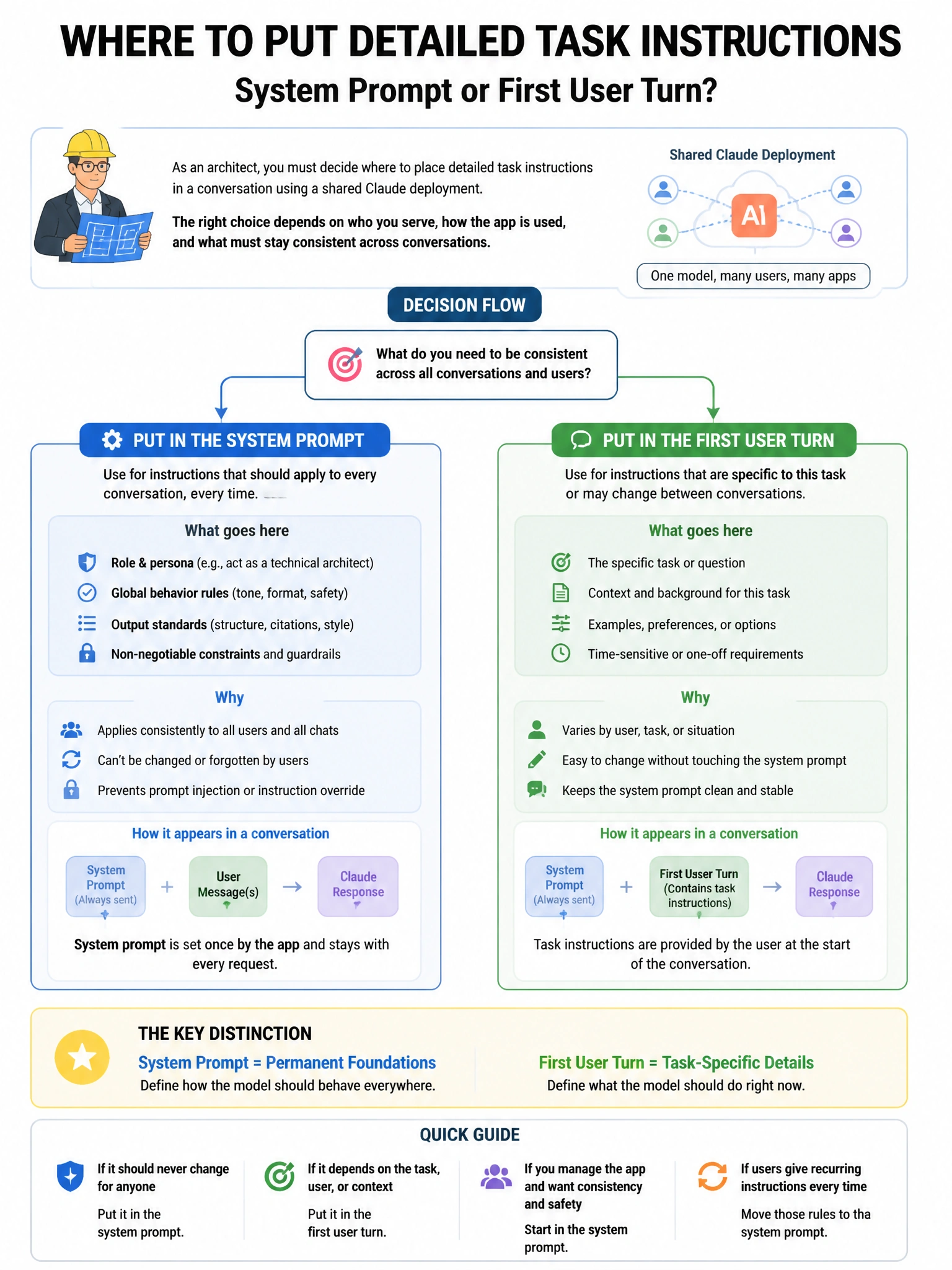
Short Explanation and Infographic
Here's the deal — d is correct because the primary architectural advantage of system prompts for shared deployments is prompt caching efficiency: the system prompt (including large instruction blocks) can be cached after the first request and reused across subsequent requests within the cache TTL, dramatically reducing input token costs. Placing large instructions in every user turn prevents this efficiency.
Full explanation below image
Full Explanation
D is correct because the primary architectural advantage of system prompts for shared deployments is prompt caching efficiency: the system prompt (including large instruction blocks) can be cached after the first request and reused across subsequent requests within the cache TTL, dramatically reducing input token costs. Placing large instructions in every user turn prevents this efficiency. A is wrong in its framing — the cost advantage is specifically because system prompts at the beginning of context are ideal cache prefixes, not because of a generic 'higher priority' caching policy. B is wrong because system prompt and user turn instructions are not prioritized differently at the architectural level — the model sees all content in context; however, effective prompt design does tend to place authoritative instructions in the system prompt for behavioral consistency. C is wrong because both system prompts and user turn content can be made invisible to end users through application design; hiding is not inherently a system prompt property.