
A multi-agent pipeline orchestrates 6 specialized Claude agents: a research agent, a data analysis agent, a writing agent, a fact-checking agent, a formatting agent, and a quality review agent. The pipeline processes business intelligence reports. During production, the team observes that when the research agent returns partial results (due to tool timeouts), downstream agents proceed with incomplete data and produce confidently wrong reports. The pipeline uses a linear sequential architecture. What failure recovery architecture best addresses this?
Select an answer to reveal the explanation.
Short Explanation and Infographic
Here's the deal — a state machine with explicit completeness thresholds and schema validation is the most robust failure recovery architecture for this pipeline. It addresses the root cause: no validation gate between stages.
Full explanation below image
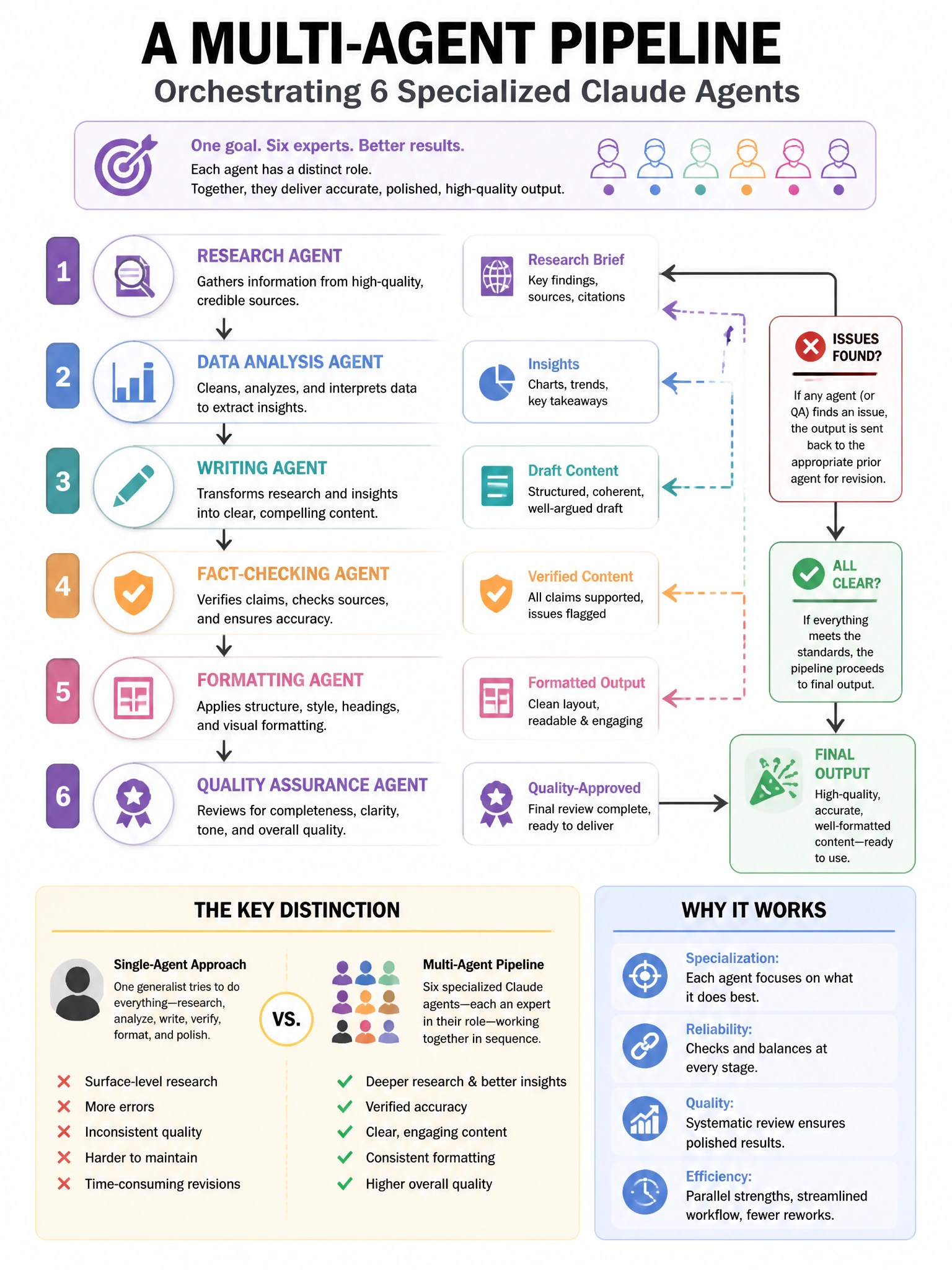
Full Explanation
A state machine with explicit completeness thresholds and schema validation is the most robust failure recovery architecture for this pipeline. It addresses the root cause: no validation gate between stages. The state machine approach: (1) defines explicit 'definition of done' for each agent's output as a validatable schema, (2) runs validation after each agent completes, (3) routes failed validations to retry or human escalation, (4) only advances the pipeline on valid, complete outputs. This is more robust than Option A (supervisor agent) because it doesn't require another LLM call to assess completeness — schema validation is deterministic and fast. Option A's supervisor agent adds latency, cost, and is itself subject to failure; a LLM-based supervisor that receives partial research results may incorrectly judge them as complete. Option B (per-agent retry) addresses tool timeouts but not the downstream propagation of partial results — an agent can retry and still return partial data, which then flows forward unmarked. Option C (full parallelism) fundamentally changes the pipeline logic and is incorrect for report generation where writing depends on completed research and fact-checking depends on completed writing; these are not truly independent tasks.