
A research platform needs Claude to analyze 200-page academic papers and produce structured summaries. The team notices that summary quality degrades for papers in specialized domains (quantum computing, synthetic biology) where Claude occasionally conflates established findings with speculative claims. The team's current prompt instructs: 'Accurately summarize this paper, clearly distinguishing between established findings and speculative claims.' Success rate is 74%. Which prompt engineering change produces the most significant improvement?
Select an answer to reveal the explanation.
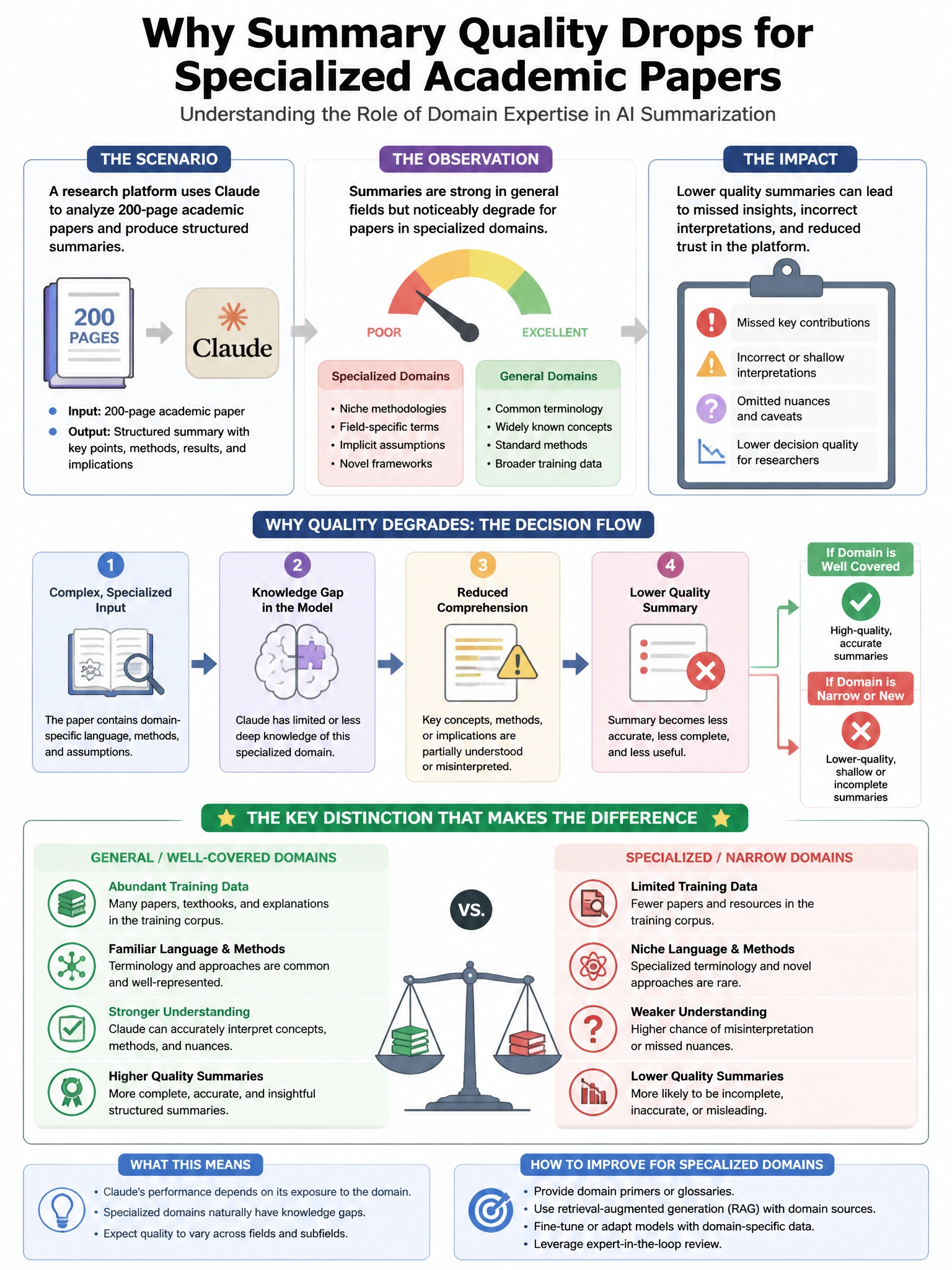
Short Explanation and Infographic
Here's the deal — explicit epistemic tagging with citation requirements is the most impactful structural change. The core failure is that Claude is conflating established and speculative claims — the instruction to 'distinguish' them is vague about what that distinction looks like in output.
Full explanation below image
Full Explanation
Explicit epistemic tagging with citation requirements is the most impactful structural change. The core failure is that Claude is conflating established and speculative claims — the instruction to 'distinguish' them is vague about what that distinction looks like in output. Requiring [ESTABLISHED]/[SPECULATIVE] tags on each claim creates two forcing functions: (1) Claude must make an explicit binary judgment per claim rather than a holistic paper-level assessment, (2) the citation requirement forces Claude to ground its classification in a specific paper section — which surfaces when the classification is unsupported. This structured output schema change fundamentally changes what Claude must produce, not just how it should think. Option C (two-step extraction then classification) is also strong but introduces an additional API call and may fragment context that helps with classification — a quantum computing claim's speculative status often depends on surrounding context in the paper. Option D (definition criteria) is a good prompt addition but the issue is applying criteria to specialized domain terminology — knowing that 'established' means 'replicated and high-citation' doesn't help Claude decide if a particular quantum error correction result meets that bar. Option B (domain few-shot examples) helps but requires many examples across both domains to meaningfully calibrate the distribution.