
An AI assistant for medical professionals needs to accurately extract medication dosages from clinical notes. The system occasionally hallucinates dosages that appear plausible but are not in the note (e.g., stating '500mg twice daily' when the note says 'standard dose'). The engineering team has tried: (1) explicit anti-hallucination instructions ('only extract what is explicitly stated'), (2) temperature: 0, (3) few-shot examples. The hallucination rate is still 4% on ambiguous notes. The team is debating two approaches: A) force Claude to quote the exact source text supporting each extraction, B) add a second validation pass with Claude to verify each extraction. Which approach is architecturally superior for this specific failure mode?
Select an answer to reveal the explanation.
Short Explanation and Infographic
Here's the deal — source quotation (Approach A) is architecturally superior for this specific failure mode — ambiguous notes where Claude is inferring dosages not explicitly stated. Requiring Claude to output the exact verbatim text supporting each extraction creates a self-grounding constraint at generation time: the model must find a specific character sequence in the note to produce a valid output.
Full explanation below image
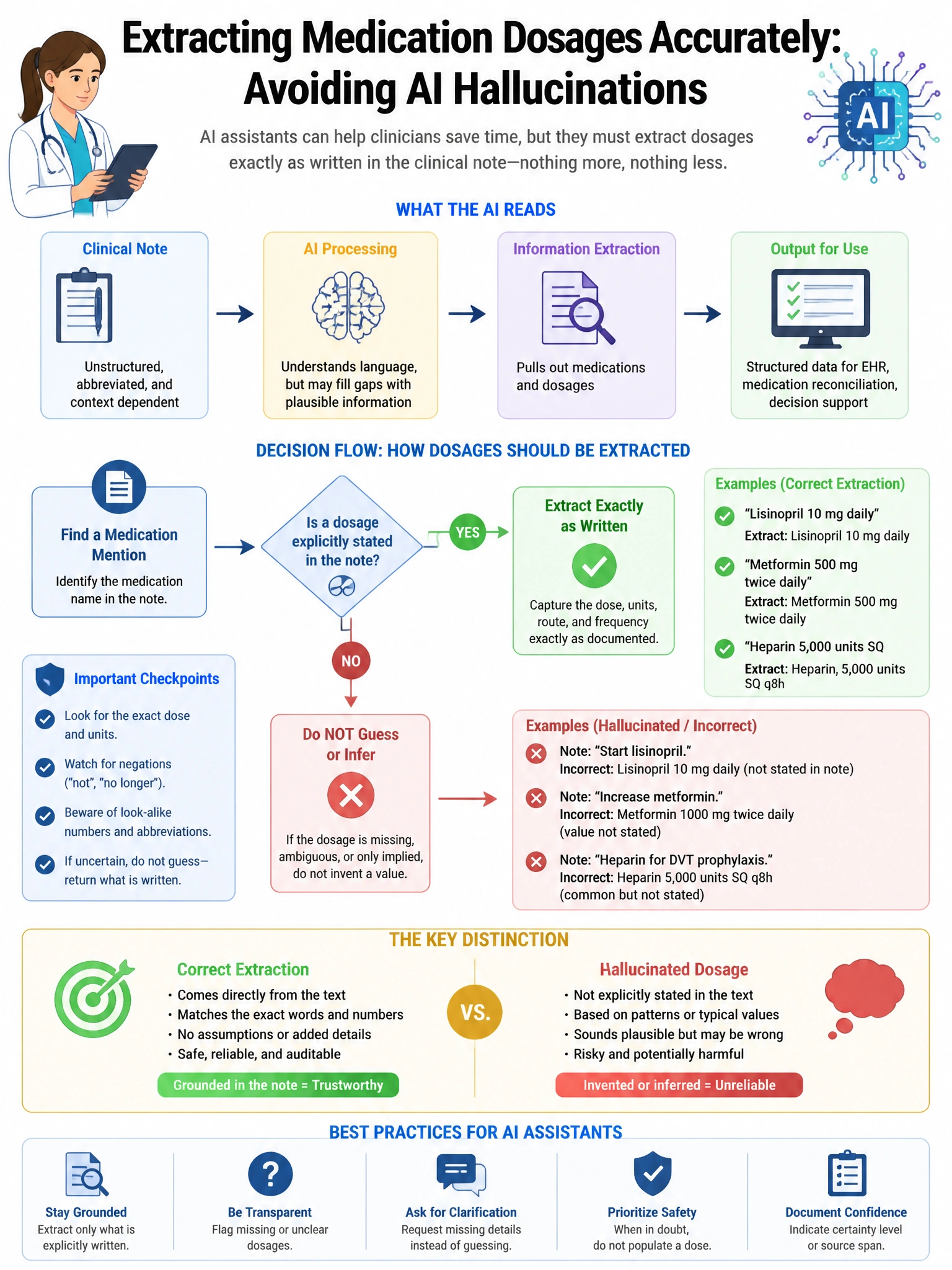
Full Explanation
Source quotation (Approach A) is architecturally superior for this specific failure mode — ambiguous notes where Claude is inferring dosages not explicitly stated. Requiring Claude to output the exact verbatim text supporting each extraction creates a self-grounding constraint at generation time: the model must find a specific character sequence in the note to produce a valid output. A hallucinated dosage cannot be grounded in a quote that doesn't exist. The downstream system can verify quotes against the source text deterministically (string matching), providing a reliable quality gate without a second LLM call. Approach B (validation pass) is weaker because: the same model re-reading the same note with the same biases may confirm a hallucination — 'yes, 500mg twice daily is stated here' when it isn't. Validation-by-same-model for factual grounding is a known weakness. Option C combines both, which adds cost and complexity; it's better than B alone but the question asks which is 'architecturally superior' as a primary approach. Option D (pre-tagging with regex) only works when dosages follow predictable patterns — exactly the ambiguous notes causing the 4% hallucination rate would evade regex matching.