
A compliance platform runs thousands of regulatory document reviews per week. The team observes that Claude's performance degraded significantly after migrating from explicit numbered instructions to a prose-style system prompt. The original prompt averaged 95% accuracy on extraction tasks; the prose version drops to 78%. Both prompts contain the same information. The team wants to restore accuracy without reverting to numbered lists exclusively. Which prompt engineering principle most directly explains the degradation, and what structural fix addresses it?
Select an answer to reveal the explanation.
Short Explanation and Infographic
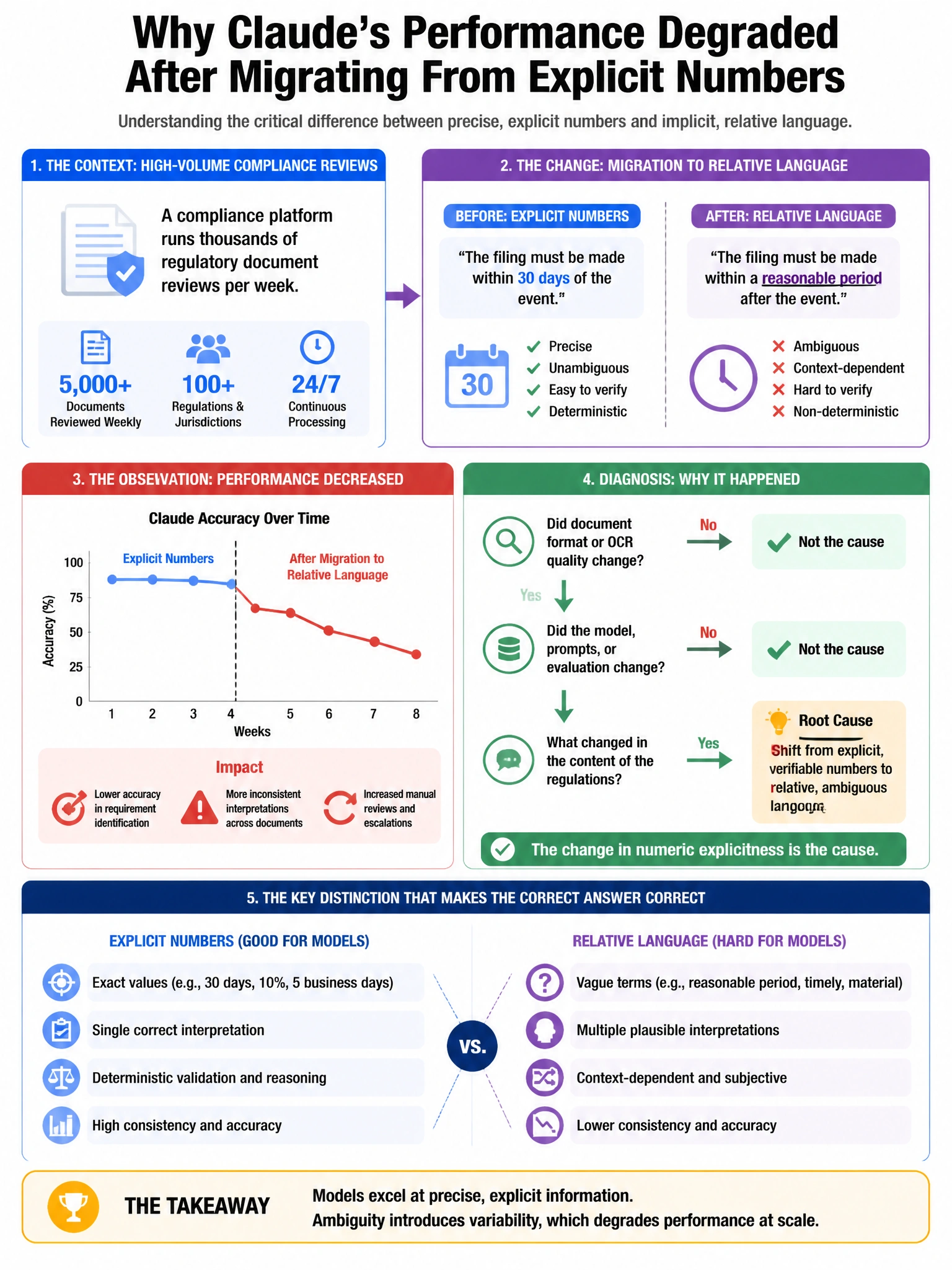
Here's the deal — prose burial of constraints is the most direct explanation for extraction accuracy degradation. In structured extraction tasks, Claude must reliably apply each specific rule to each specific input element.
Full explanation below image
Full Explanation
Prose burial of constraints is the most direct explanation for extraction accuracy degradation. In structured extraction tasks, Claude must reliably apply each specific rule to each specific input element. Numbered lists create discrete, identifiable rule units that the model can check against systematically. When the same rules are embedded in flowing prose, they merge with surrounding text — the model may process the prose holistically and miss applying individual rules precisely. XML tagging (e.g., <extraction_rule id='account_number'>...</extraction_rule>) restores the discreteness of each rule without forcing numbered list formatting, allowing prose narrative context while maintaining rule salience. Option A is plausible but the token count difference between numbered lists and equivalent prose is typically minimal — insufficient to explain a 17-point accuracy drop. Option C (moving to few-shot examples) changes the nature of the instruction from declarative to demonstrative — a valid alternative approach but a much larger change than needed, and few-shot examples for complex regulatory extraction require many examples to cover all rule types. Option D's priority-conflict hypothesis is plausible for ambiguous inputs but extraction accuracy drops across all inputs, including unambiguous cases — indicating a general rule-application problem, not just conflict-resolution.