
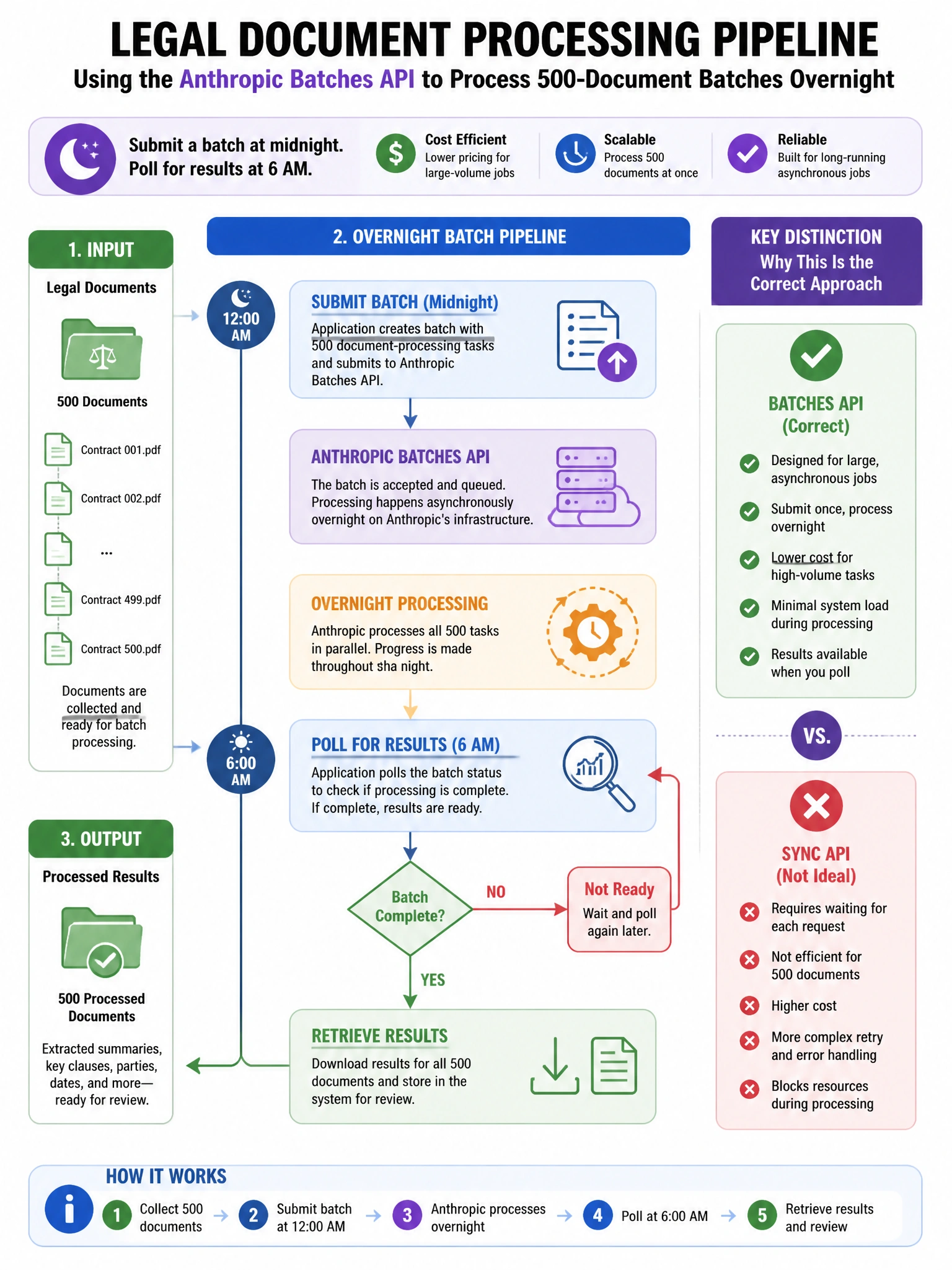
A legal document processing pipeline uses the Anthropic Batches API to process 500-document batches overnight. The system submits a batch at midnight and polls for results at 6 AM. Recently, the team discovered that batches are returning with a mix of 'succeeded' and 'errored' results — approximately 3-5% error rate per batch. The errored requests include a mixture of invalid_request_error and overloaded_error types. What is the correct handling architecture for production reliability?
Select an answer to reveal the explanation.
Short Explanation and Infographic
Here's the deal — the correct production handling for mixed batch errors requires error-type discrimination. invalid_request_error results from malformed inputs (too many tokens, invalid parameters, unsupported content types) — resubmitting them will always produce the same error, wasting batch quota.
Full explanation below image
Full Explanation
The correct production handling for mixed batch errors requires error-type discrimination. invalid_request_error results from malformed inputs (too many tokens, invalid parameters, unsupported content types) — resubmitting them will always produce the same error, wasting batch quota. These must be flagged for human review or input remediation. overloaded_error results are transient — the request was valid but the system was temporarily overloaded during processing; these should be resubmitted in a follow-up batch. This two-path handling maximizes batch efficiency and ensures eventual consistency. Option A is factually incorrect — there is no documented prioritization benefit for larger batch sizes, and this doesn't address error type handling. Option C (real-time API fallback for errors) is valid in some architectures but expensive — the question asks for production reliability architecture where cost efficiency matters; a follow-up batch is more appropriate. Option D describes fictional API functionality — the Batches API does not have a native retry_config parameter as described.