
A streaming document analysis application uses the Messages API with stream=True. Users report that the UI occasionally displays partial JSON mid-stream (e.g., '{"analysis": "The contract is') before the stream abruptly stops, leaving the UI in a broken state. The engineering team's server logs show these events correlate with HTTP 529 (overloaded) errors arriving mid-stream after approximately 2,000-4,000 tokens. What is the correct architectural fix?
Select an answer to reveal the explanation.
Short Explanation and Infographic
Here's the deal — mid-stream 529 errors require a retry architecture, not a buffering workaround. The correct fix is: detect the error event in the SSE stream, gracefully close the connection, apply exponential backoff with jitter, and retry the full request.
Full explanation below image
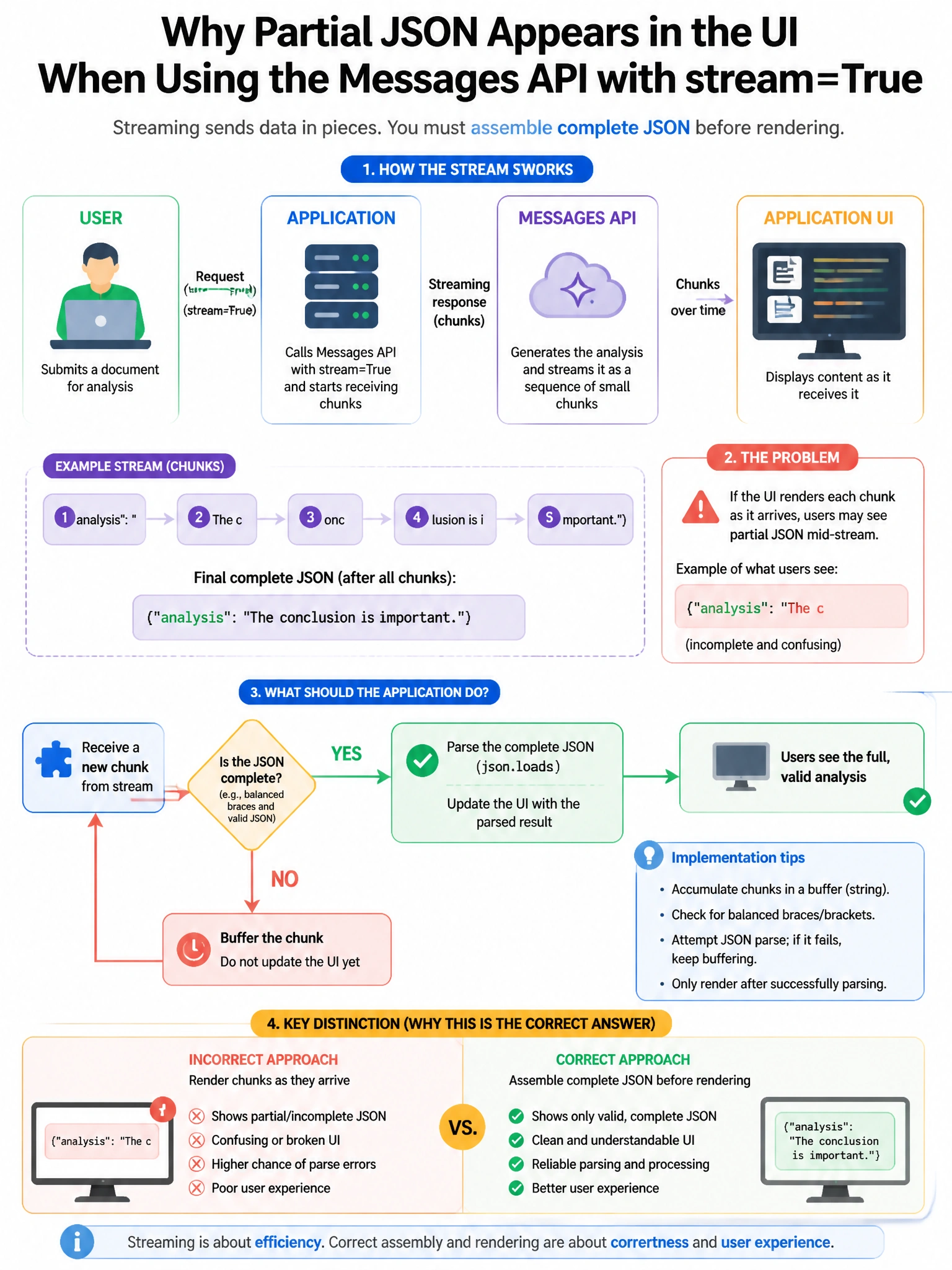
Full Explanation
Mid-stream 529 errors require a retry architecture, not a buffering workaround. The correct fix is: detect the error event in the SSE stream, gracefully close the connection, apply exponential backoff with jitter, and retry the full request. The client must restart rendering from the beginning of the retry response. This is the standard pattern for handling transient overload errors in streaming systems. Option B (client-side buffering) defeats the purpose of streaming entirely — if users must wait for the full response before anything renders, the UX is equivalent to non-streaming but with additional complexity. Crucially, 529s can happen after thousands of tokens, meaning users wait for nothing. Option A is factually incorrect — 529 overloaded errors are not streaming-specific; they can occur on any request type. Option D's structured output mode does not change how mid-stream errors are handled at the transport layer — the API can still return a 529 mid-stream regardless of output structure, and structured outputs do not imply buffering behavior.