
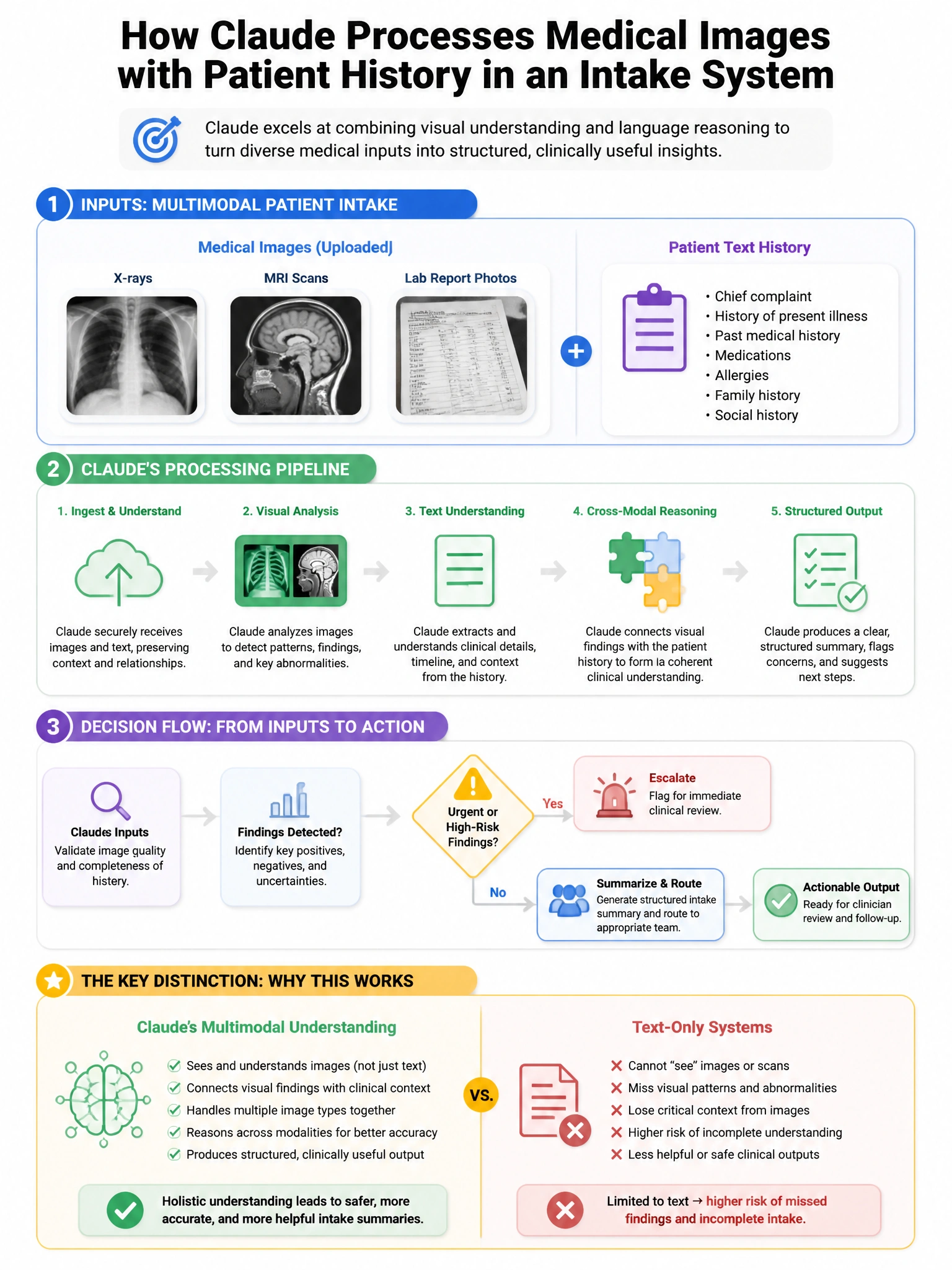
A healthcare startup is building a patient intake system where Claude must process uploaded medical images (X-rays, MRI scans, lab report photos) alongside the patient's text history — typically 15,000–25,000 tokens of clinical notes. The system must operate under HIPAA constraints with minimal latency (sub-3-second P95 response). A radiologist reviews every Claude output before any clinical decision is made. The startup has $0.02 per-interaction budget. Which model and architectural approach best satisfies all constraints simultaneously?
Select an answer to reveal the explanation.
Short Explanation and Infographic
Here's the deal — claude 3.5 Sonnet with vision is architecturally correct here. It has strong multimodal image understanding, can handle 15K-25K token clinical notes plus image inputs within its context window, and its inference speed typically supports sub-3-second responses for this input size.
Full explanation below image
Full Explanation
Claude 3.5 Sonnet with vision is architecturally correct here. It has strong multimodal image understanding, can handle 15K-25K token clinical notes plus image inputs within its context window, and its inference speed typically supports sub-3-second responses for this input size. At mid-tier pricing, $0.02/interaction is achievable. The radiologist review layer is the critical safety net, so maximum model tier is not required. Option A (Haiku) has weaker medical image comprehension — for X-rays and MRIs, the quality gap versus Sonnet is architecturally significant even with radiologist review. Option C ignores the budget constraint and overpowers the need given the review layer. Option D's split pipeline adds latency (two sequential API calls) and risks information loss when Haiku transcribes the image — medical image details can be lost in text transcription.