
A financial services firm needs to process 10,000 legal contracts per month. Each contract is approximately 80,000 tokens. The processing involves: (1) extracting 40 specific clause types, (2) flagging regulatory non-compliance, and (3) generating a structured JSON summary. The firm's SLA requires 99.9% accuracy. Throughput is not time-critical — results are acceptable within 48 hours. The legal team reports that occasional hallucinations in clause extraction have caused $2M in downstream errors. Given these constraints, which model selection strategy is architecturally superior?
Select an answer to reveal the explanation.
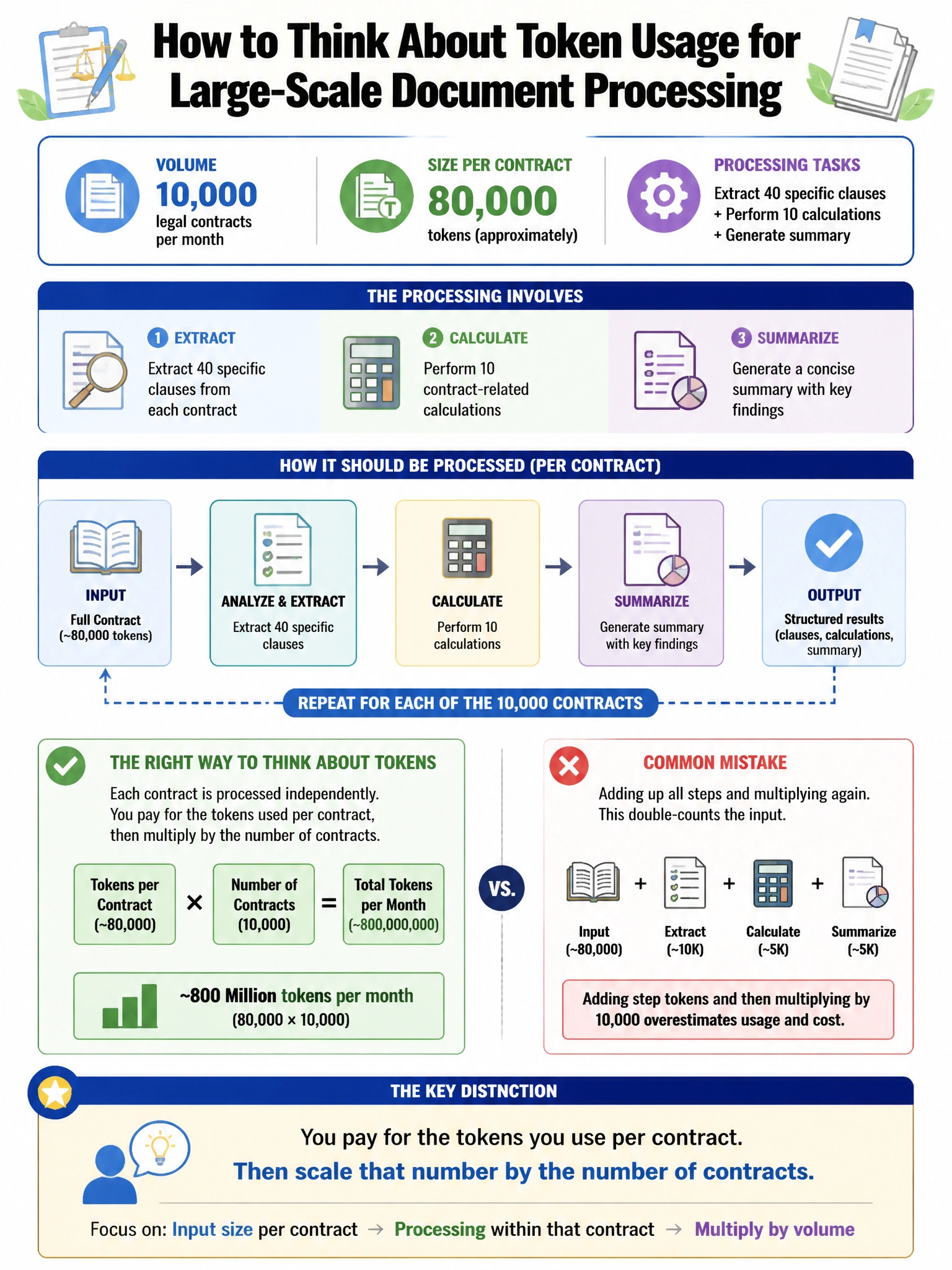
Short Explanation and Infographic
Here's the deal — when $2M hallucination errors exist and 99.9% accuracy is the SLA, the architectural answer is the highest-capability model with a verification loop — not cost optimization. Running top-tier model outputs twice and diffing JSON catches stochastic errors that any single-pass approach misses, regardless of model tier.
Full explanation below image
Full Explanation
When $2M hallucination errors exist and 99.9% accuracy is the SLA, the architectural answer is the highest-capability model with a verification loop — not cost optimization. Running top-tier model outputs twice and diffing JSON catches stochastic errors that any single-pass approach misses, regardless of model tier. The 48-hour SLA removes throughput pressure, making dual-pass feasible. Option D is plausible but flawed: self-critique by the same model is unreliable for factual extraction errors — a model that hallucinates a clause is likely to validate its own hallucination. Option B's cost routing introduces accuracy variance at the extraction stage where errors are most costly. Option A ignores the verification requirement entirely.