
A platform using MCP implements a tool server with 47 distinct tools across multiple domains. Claude agents using this server sometimes call the wrong tool due to similar tool names (e.g., send_email vs. queue_email) or vague descriptions. This causes incorrect side effects in production. What MCP schema design practices reduce tool confusion?
Select an answer to reveal the explanation.
Short Explanation and Infographic
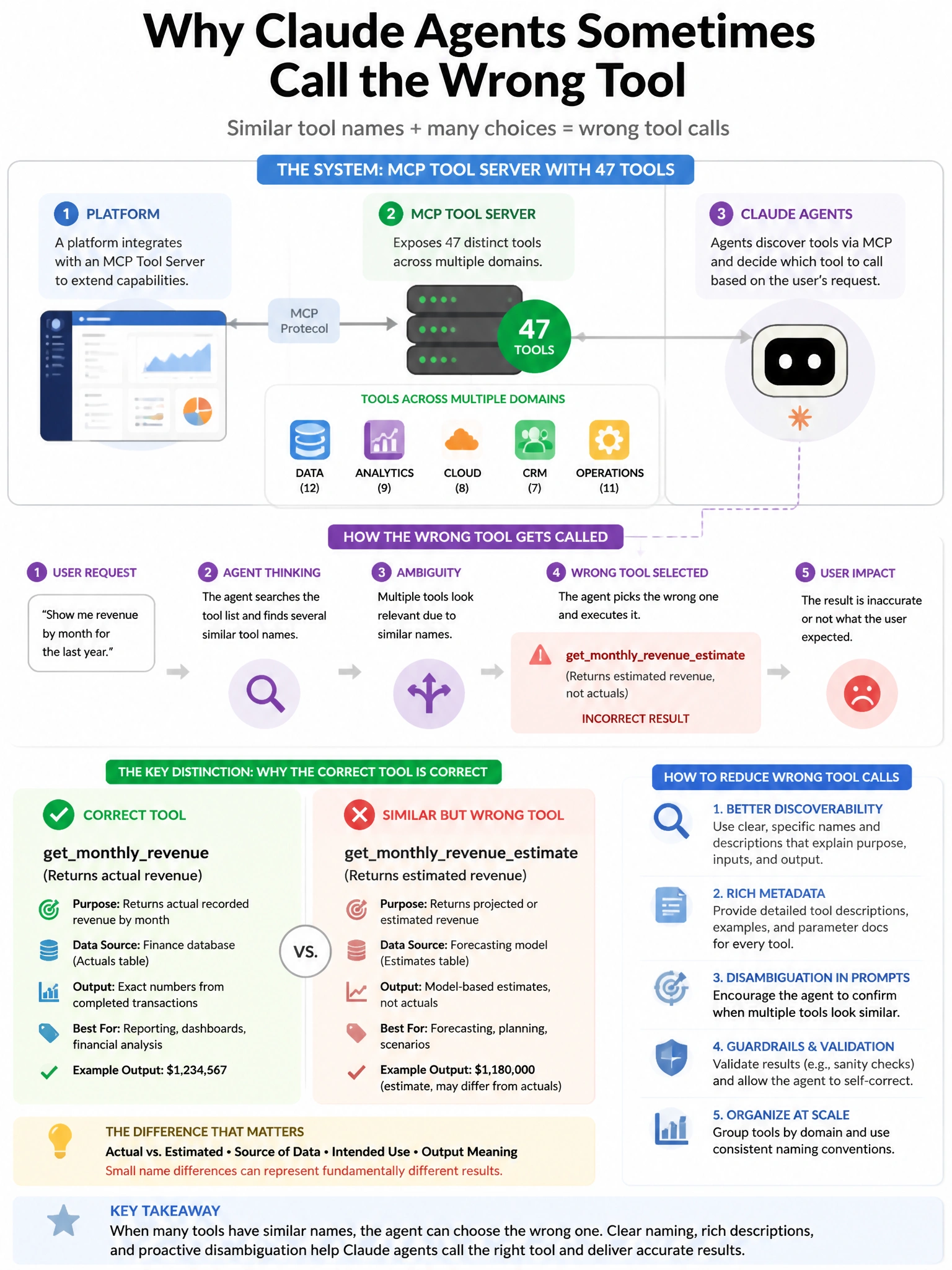
Here's the deal — mCP tool descriptions are Claude's primary signal for tool selection. Well-crafted descriptions prevent misuse by making the tool's scope, behavior, and side effects unambiguous.
Full explanation below image
Full Explanation
MCP tool descriptions are Claude's primary signal for tool selection. Well-crafted descriptions prevent misuse by making the tool's scope, behavior, and side effects unambiguous. Differentiating send_email ('immediately sends an email via SMTP, cannot be recalled after execution') from queue_email ('adds to the outbound queue for batch delivery in the next scheduled run, can be removed before the run') in the description eliminates the ambiguity. Naming conventions (prefix irreversible tools) provide an additional heuristic signal. Option A (combine into multi-function tools with 'mode' parameters) trades tool confusion for mode confusion — email_tool(mode='send') vs. email_tool(mode='queue') has the same disambiguation problem with a different UI. Option C (meta-tool) adds a round-trip and doesn't solve the underlying description quality problem — Claude would still need to understand tool differences to answer the meta-tool query. Option D (dynamic injection) is a valid scaling strategy for 47+ tools but doesn't address the description quality issue.