
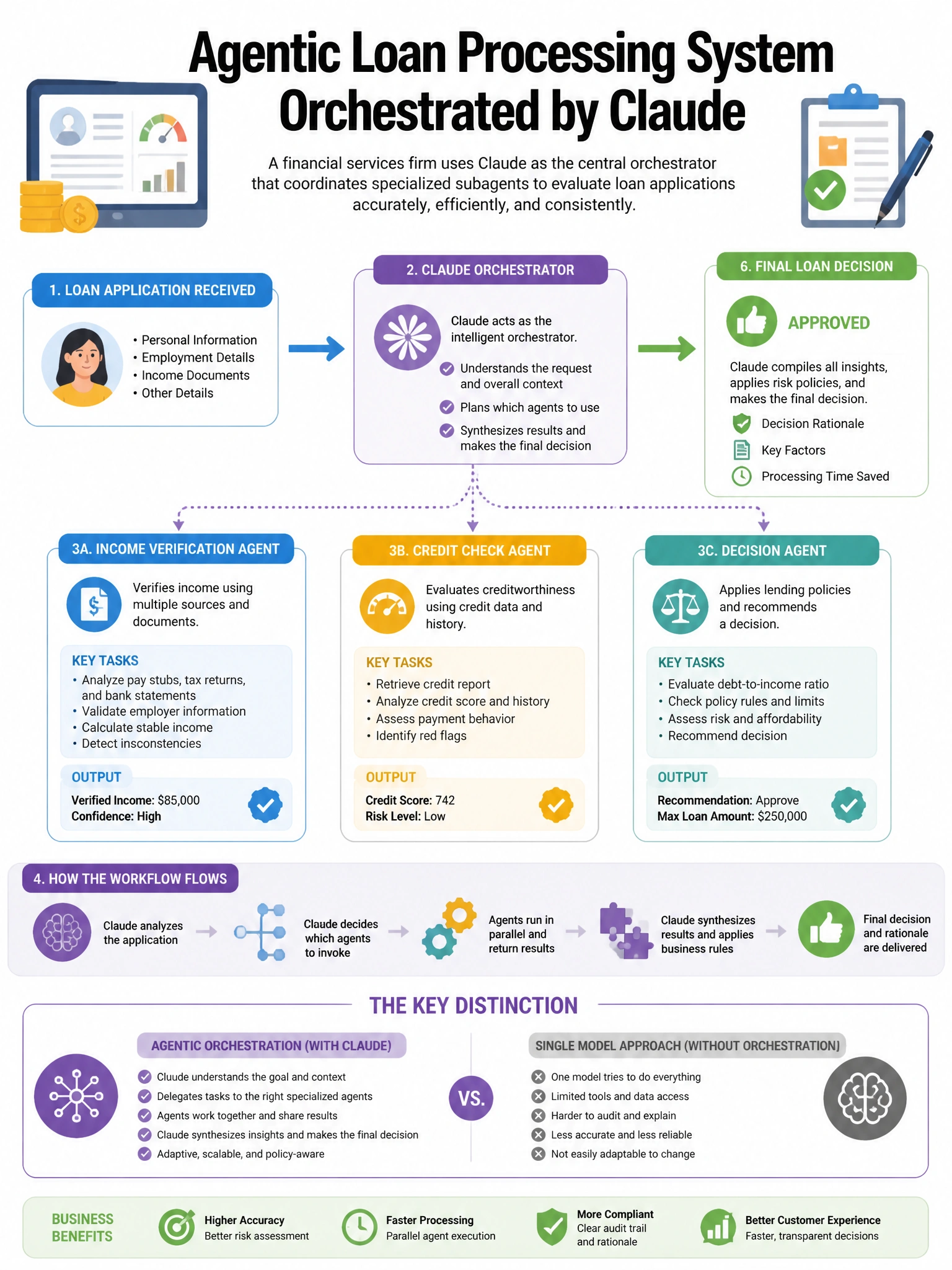
A financial services firm builds an agentic loan processing system where Claude orchestrates multiple subagents: an income verification agent, a credit check agent, and a decision agent. The decision agent produces loan approval or denial recommendations. Regulators require that every decision be explainable and auditable, with a complete record of what data each agent received and what reasoning it applied. Current architecture uses in-memory message passing between agents with no persistence. What architectural change satisfies the regulatory explainability requirement?
Select an answer to reveal the explanation.
Short Explanation and Infographic
Here's the deal — financial regulatory explainability (under regulations like ECOA, FCRA, and EU AI Act) requires complete audit trails that reconstruct exactly what happened in a decision process. 'Immutable, append-only, tamper-evident' storage satisfies the auditor's requirement that the logs cannot be retroactively altered.
Full explanation below image
Full Explanation
Financial regulatory explainability (under regulations like ECOA, FCRA, and EU AI Act) requires complete audit trails that reconstruct exactly what happened in a decision process. 'Immutable, append-only, tamper-evident' storage satisfies the auditor's requirement that the logs cannot be retroactively altered. Capturing every agent input, output, tool call, and result allows regulators and internal auditors to replay the decision process and verify that the decision followed from the data. Option A (post-hoc summary) produces generated explanations that may not accurately reflect the actual reasoning process — regulators require contemporaneous records, not retrospective summaries that could be influenced by the final outcome. Option C (summary data only) fails regulatory completeness requirements — regulators need to verify the complete reasoning chain, not just inputs and outputs. Option D (metadata only) provides no insight into the content of agent reasoning, failing explainability requirements entirely.