
A healthcare platform architect is comparing Claude model tiers for a clinical decision support tool. The tool must process 500-page patient records (notes, labs, imaging reports) and generate differential diagnoses. Accuracy and recall of rare conditions are critical — missing a rare diagnosis has severe patient safety consequences. The platform can tolerate 3–5 second response times. Cost is secondary. Which model strategy is appropriate?
Select an answer to reveal the explanation.
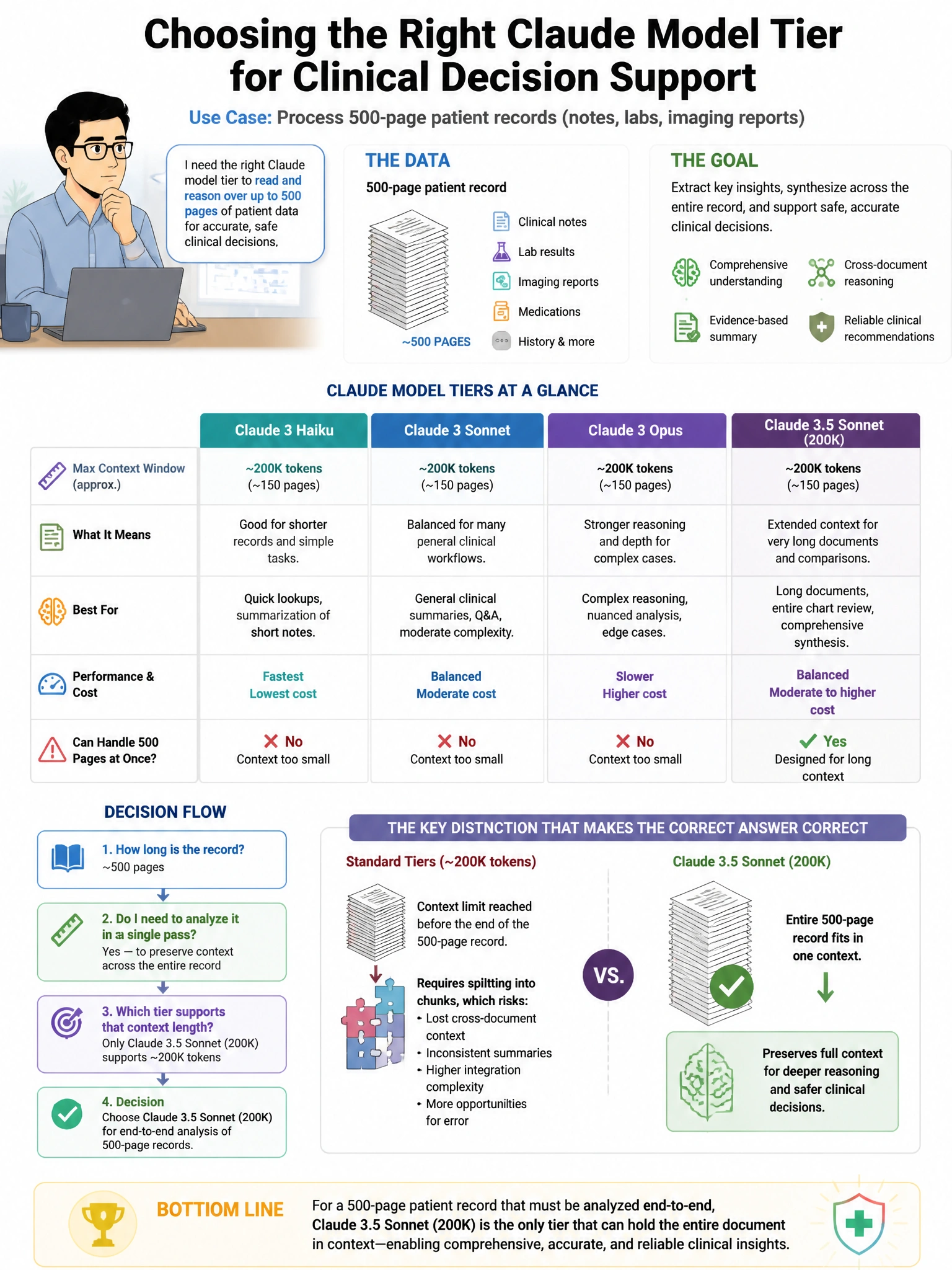
Short Explanation and Infographic
Here's the deal — when patient safety is the explicit priority and cost is explicitly secondary, the correct answer is to use the highest-capability model available. Differential diagnosis on 500-page records requires sophisticated multi-step reasoning about rare presentations, drug interactions, and subtle lab value patterns — exactly the domain where capability differences between model tiers manifest most acutely.
Full explanation below image
Full Explanation
When patient safety is the explicit priority and cost is explicitly secondary, the correct answer is to use the highest-capability model available. Differential diagnosis on 500-page records requires sophisticated multi-step reasoning about rare presentations, drug interactions, and subtle lab value patterns — exactly the domain where capability differences between model tiers manifest most acutely. The 3–5 second latency tolerance accommodates Opus. Option A (Haiku) is inappropriate for this safety-critical context — statistical rarity of edge cases does not reduce individual patient risk. Option B (Sonnet) is the cost-performance optimum for general applications but not when cost is explicitly secondary to accuracy. Option D (ensemble averaging) is not a valid approach for medical diagnosis — averaging conflicting outputs doesn't improve reliability and introduces its own failure modes when models disagree on safety-critical findings.