
A scientific publishing platform needs to summarize research papers that frequently contain complex mathematical notation, chemical formulas, and domain-specific technical figures. The team debates whether to extract text from PDFs and send it to Claude, or to render PDF pages as images and send them to Claude's vision API. Papers average 15 pages with 8 technical figures. Which approach produces higher-quality summaries and why?
Select an answer to reveal the explanation.
Short Explanation and Infographic
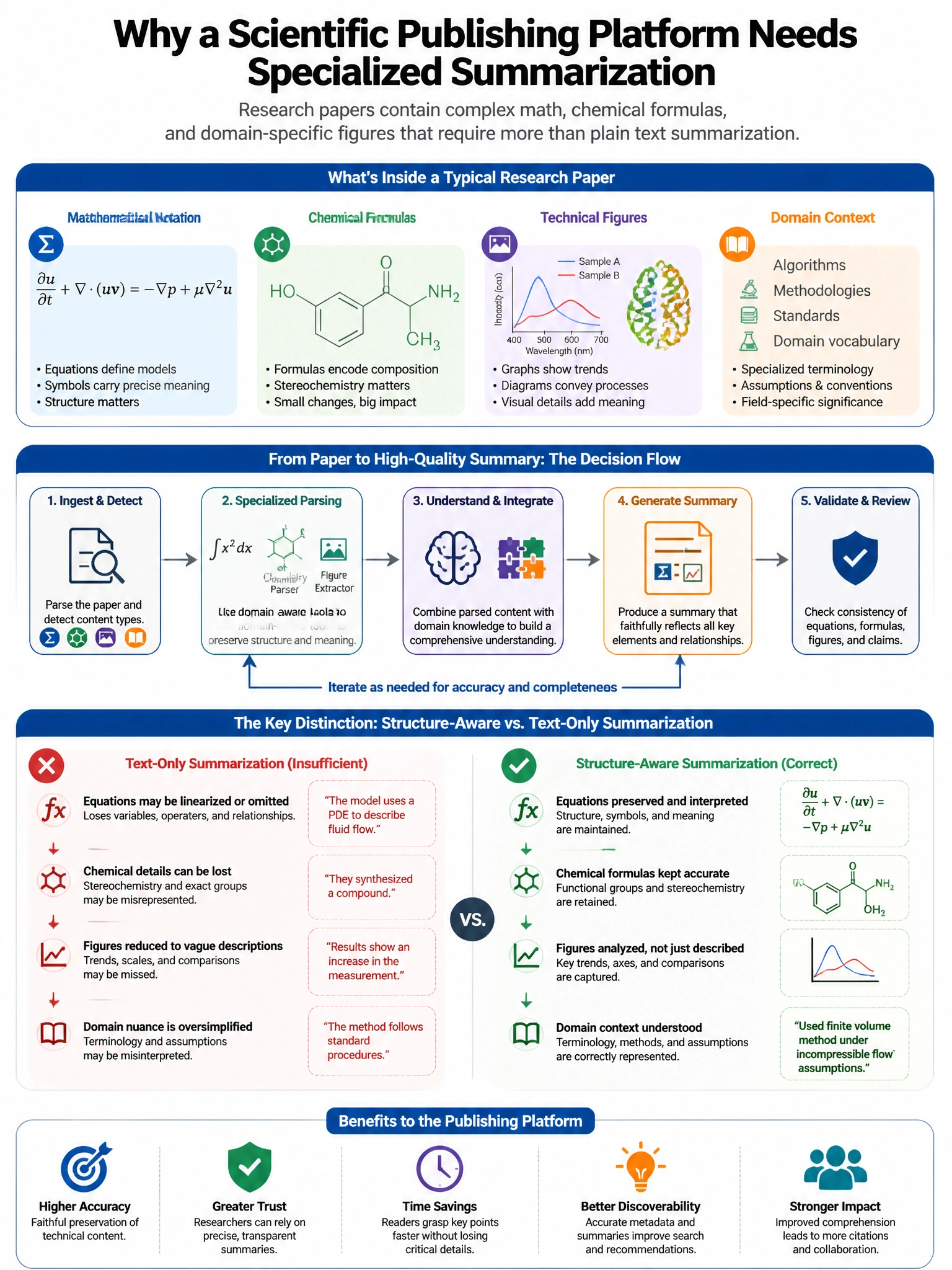
Here's the deal — for scientific papers, PDF text extraction is notoriously lossy on precisely the content that matters most: mathematical equations often become garbled or missing, chemical structures lose spatial relationships, table alignment breaks, and figure-caption linkages are severed. Claude's vision capability can read rendered page images and understand figures in context — seeing that Figure 3 illustrates the mechanism described in the surrounding paragraph, or correctly interpreting a reaction scheme.
Full explanation below image
Full Explanation
For scientific papers, PDF text extraction is notoriously lossy on precisely the content that matters most: mathematical equations often become garbled or missing, chemical structures lose spatial relationships, table alignment breaks, and figure-caption linkages are severed. Claude's vision capability can read rendered page images and understand figures in context — seeing that Figure 3 illustrates the mechanism described in the surrounding paragraph, or correctly interpreting a reaction scheme. This produces materially higher-quality summaries for scientific content. Option A underestimates how poorly standard PDF text extraction handles equations and specialized notation — this is a well-documented failure mode in scientific document processing. Option C is incorrect; the approaches are not equivalent for technical scientific content. Option D (captions without figures) loses the visual information that captions describe.