
When evaluating whether Claude is suitable for a specific application, what is MORE reliable than published benchmark scores?
Select an answer to reveal the explanation.
Short Explanation
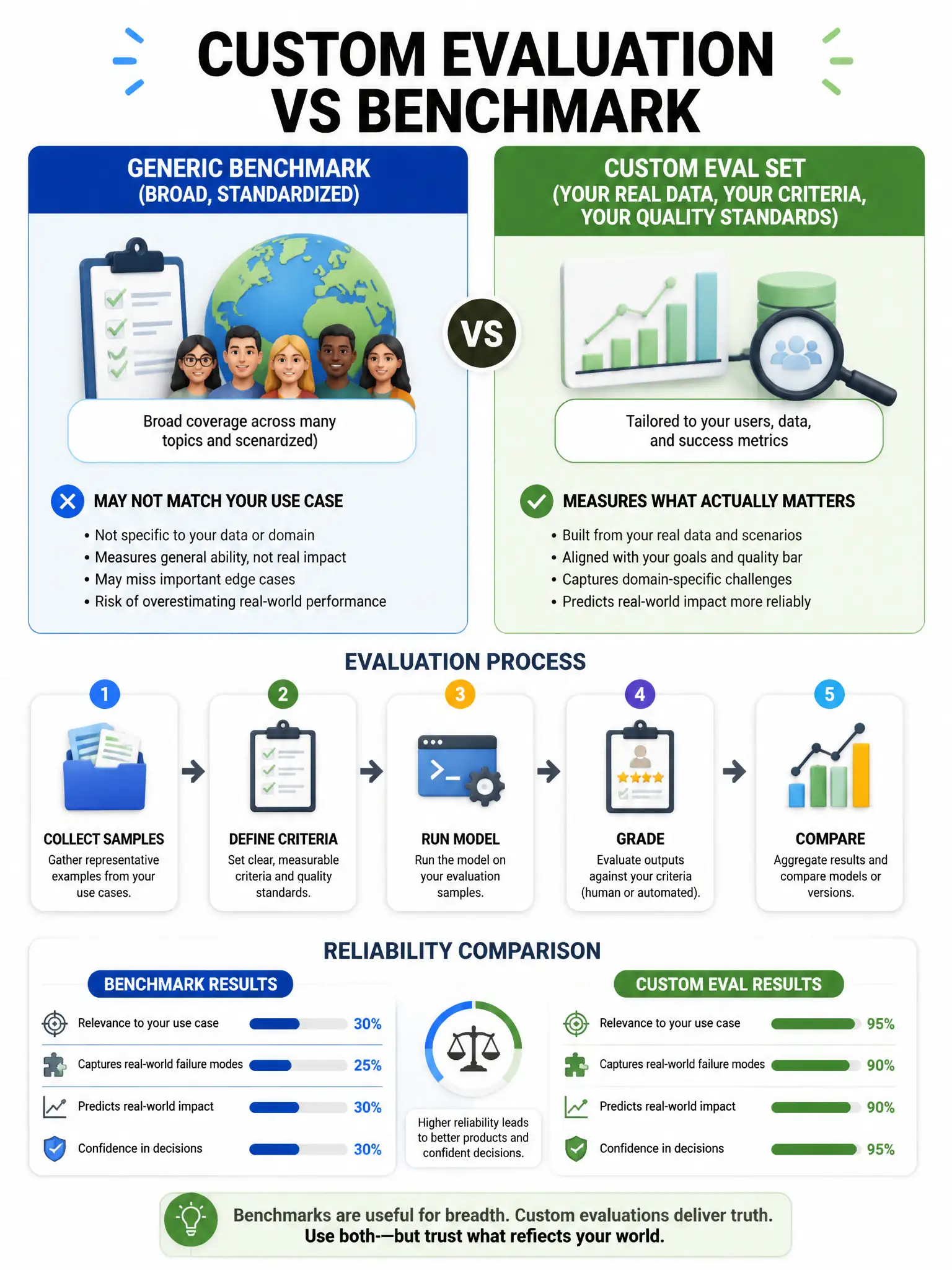
Benchmarks measure generic capability. Your use case is specific. The only real test is running your actual data through Claude and grading the outputs against what you actually need.
Full Explanation
Published benchmarks, including MMLU and HumanEval, measure performance on standardized tasks that may not represent your specific use case. A model that scores highly on code benchmarks might perform poorly on your domain-specific writing tasks. The most reliable evaluation is to build a test set from your real data, define your quality criteria explicitly, evaluate multiple models against those criteria, and measure what actually matters to your application. This is called 'offline evaluation' or 'evals.' The claim that published benchmark scores are always the definitive measure of real-world performance overvalues benchmarks. The claim that parameter count determines quality, with more parameters always meaning better performance, doesn't map reliably to task-specific performance. The claim that the most recently released model is always best is false, because different models have different strengths.