
A historic sail-loft helper’s invocation logs hold visitor questions for three years with no policy. Counsel wants a stated retention window and a deletion path. What kind of control is that?
Select an answer to reveal the explanation.
Short Explanation
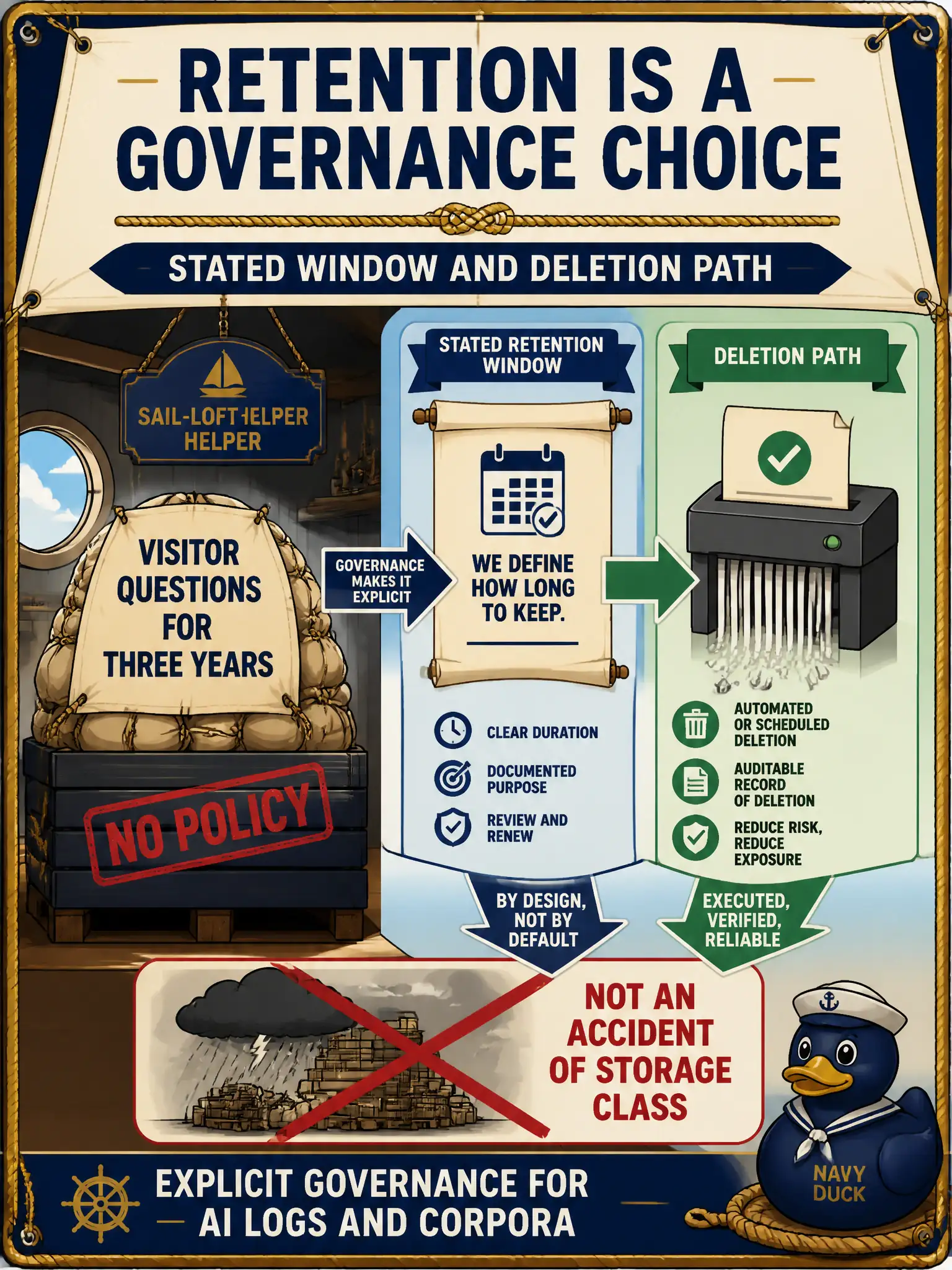
Think of three years of visitor questions with no stated window. Retention is an explicit governance choice, plus a deletion path. Storage class is not a policy.
Full Explanation
Three years of visitor questions in the sail-loft invocation logs with no stated policy means retention happened by accident of storage class and neglect. Counsel’s ask for a stated retention window and a deletion path is retention as an explicit governance choice for AI logs and corpora. Decide how long prompts and completions are kept, who may access them, encryption at rest, and how deletion or anonymization runs when the window ends.
Keeping logs forever because a storage class exists fails by concept: storage class is a durability and cost setting, not a retention policy with a deletion path or legal rationale. Amazon Inspector fails because CVE scanning of hosts is not a deletion workflow for conversation logs. A dashboard title fails because charts do not define retention windows or execute deletion of invocation content.
Exam caveat: retention must align with open-records, privacy, and litigation holds—overly short windows can conflict with a legal duty to preserve; document both the default window and hold exceptions. Operational check: publish the retention window for invocation logs, configure lifecycle expiration or a documented deletion job on the log store, test deletion on a sample prefix, and verify access logs show who can still read retained content.