
The same type-foundry asks what remains on their side after they choose a managed foundation-model API. Which list is accurate?
Select an answer to reveal the explanation.
Short Explanation
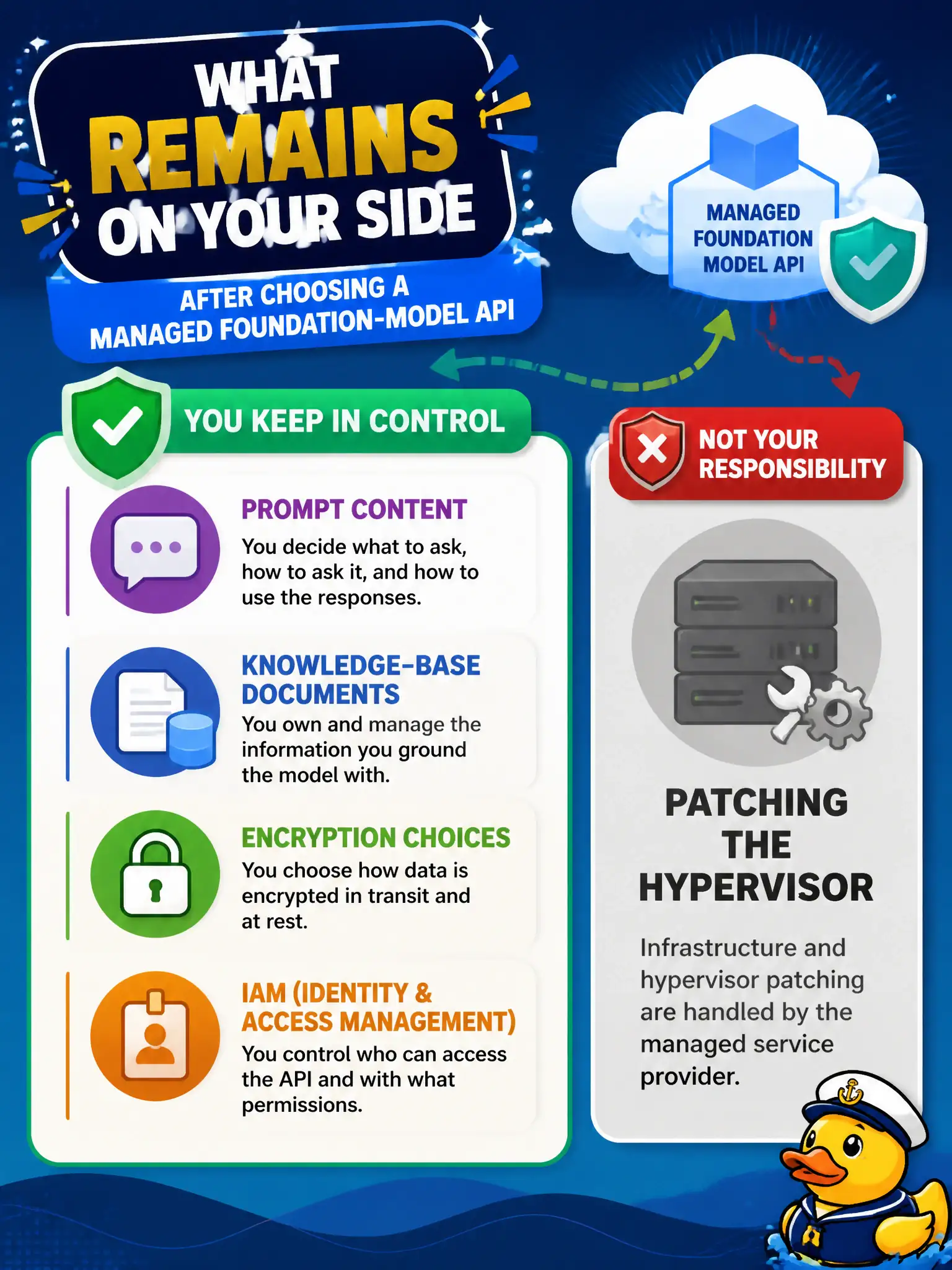
Think of what stays on the foundry’s side after a managed FM API. Prompts, knowledge-base documents, encryption choices, and IAM. Not patching the hypervisor.
Full Explanation
After the type-foundry chooses a managed foundation-model API, what remains on their side is prompt content, knowledge-base documents, encryption choices, and IAM—not patching the hypervisor. Customer duties follow the data and the identities: what text is sent, what corpora ground answers, how artifacts are encrypted, and which principals may invoke or administer the application.
Saying the customer only patches the hypervisor while prompts and IAM move to AWS fails because hypervisor patching is a cloud-provider duty in managed services, whereas prompts and IAM remain customer-owned. Saying a managed API ends every customer duty fails because configuration and data handling remain. Saying dashboard titles alone are the customer-owned AI duties fails because charts do not replace encryption, IAM, or corpus governance.
Exam caveat: managed retrieval and agent features can blur boundaries—if the customer uploads documents, those documents and their access policies stay on the customer side even when the API is fully managed. Operational check: inventory customer-owned assets (prompt templates, KB docs, KMS keys, IAM roles), assign owners, and confirm no runbook still lists hypervisor patching as a foundry task for the managed FM API path.