
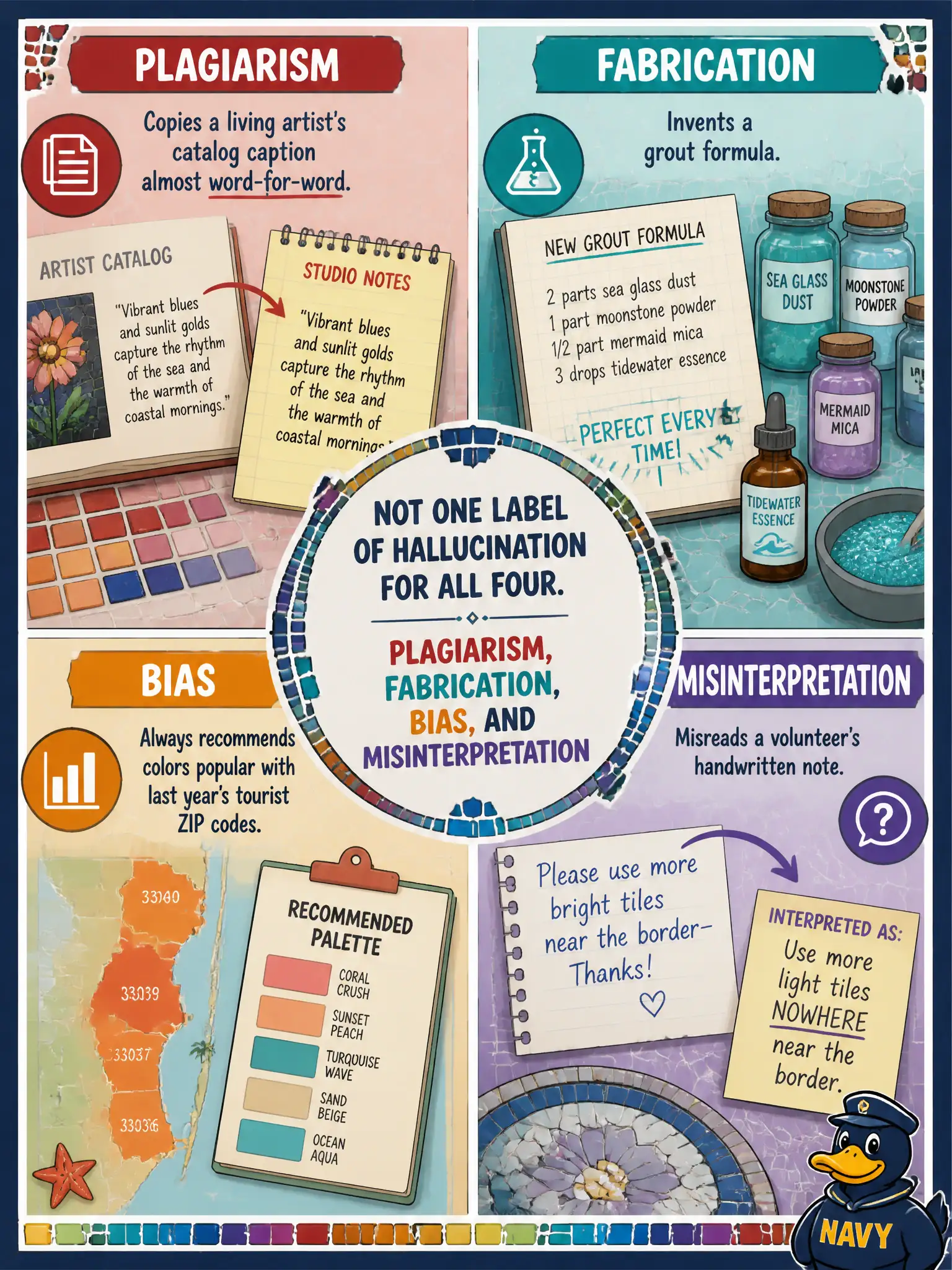
A community mosaic studio reviews four bad generations: one copies a living artist’s catalog caption almost word-for-word, one invents a grout formula, one always recommends colors popular with last year’s tourist ZIP codes, and one misreads a volunteer’s handwritten note. Which assignment is accurate?
Select an answer to reveal the explanation.
Short Explanation
Think of four bad mosaic generations: a copied caption, an invented grout formula, a tourist-ZIP color tilt, and a misread handwritten note. That is plagiarism, fabrication, bias, and misinterpretation. Do not stamp hallucination on all four.
Full Explanation
The four mosaic-studio failures are distinct: copying a living artist’s catalog caption is plagiarism; inventing a grout formula is fabrication; steering colors by last year’s tourist ZIP codes is bias; misreading a handwritten note is misinterpretation. Responsible review should assign those labels rather than stamping one vague “hallucination” on all four community studio incidents. Precise naming drives different fixes—attribution and rights, factual grounding, data balance, and input understanding for volunteers.
Calling all four hallucination collapses different defects into one bucket and blocks targeted remediation for a civic arts program. Calling all four latency misreads content defects as speed problems. Calling all four inclusivity confuses access design with copying, invention, skew, and misreads of handwritten intake notes.
Exam caveat: “hallucination” on the exam is often too coarse when the stem lists several failure modes. Match each symptom to the more specific responsible-AI term instead of one umbrella label.
Operational check: tag production incidents with the specific defect class, route plagiarism to rights review, fabrication to grounding checks, bias to data audits, and misinterpretation to OCR or intake fixes, then verify each class’s rate trends down separately.