
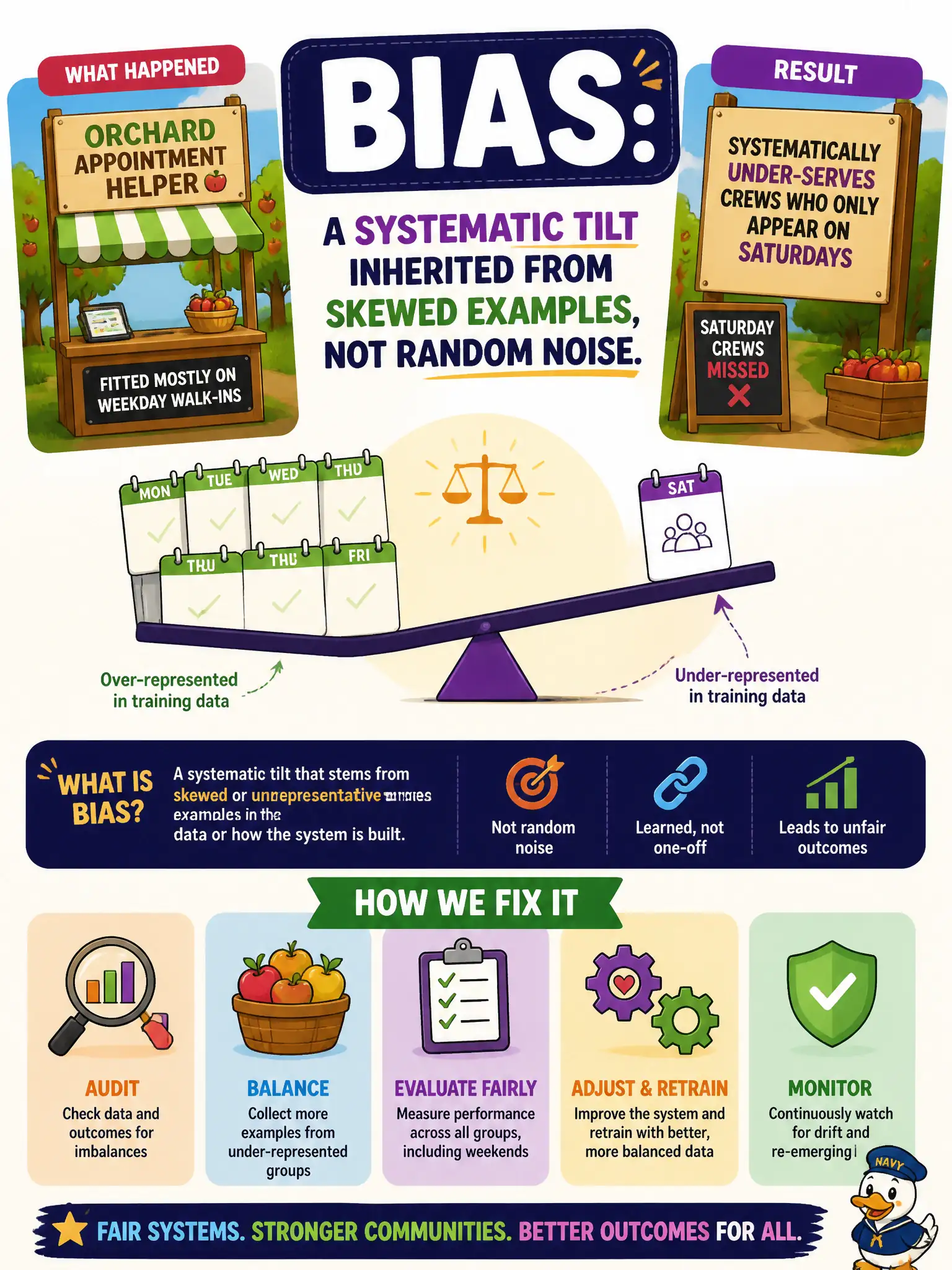
A community orchard-stand appointment helper was fitted mostly on weekday walk-ins and now systematically under-serves crews who only appear on Saturdays. Which responsible-AI defect is that?
Select an answer to reveal the explanation.
Short Explanation
Think of a helper fitted mostly on weekday walk-ins that now under-serves Saturday crews. That is bias, a systematic tilt from skewed examples. It is not a broken GPU or a milliseconds problem.
Full Explanation
An orchard-stand helper fitted mostly on weekday walk-ins that systematically under-serves Saturday crews shows bias: a systematic tilt inherited from skewed examples, not random noise or a broken accelerator. The model learned a weekday-heavy pattern and now fails a whole crew type that was underrepresented in the fitting data. That is a data-and-representation defect in responsible AI terms for a community orchard program that depends on weekend volunteer and paid labor.
A hardware fault or broken GPU does not explain a weekday-only fit that under-serves Saturday crews at the stand. Creativity is not a desired style when whole crews are underserved; unequal service is not artistic variation in appointment handling. Latency is about response time, not about systematically missing Saturday appointment patterns during peak harvest weekends.
Exam caveat: bias can look like “the model prefers what it saw most.” On the exam, skewed training or fitting data plus unequal outcomes points to bias, not creativity or hardware failure.
Operational check: audit appointment outcomes by day-of-week and crew type, add Saturday examples to the fitting or evaluation set, and retest until Saturday crews receive service quality comparable to weekday walk-ins before peak harvest weekends.