
A carnival Saturday helper must stay up if a single Availability Zone hiccups during the storm-day rush. Which infrastructure choice fits?
Select an answer to reveal the explanation.
Short Explanation
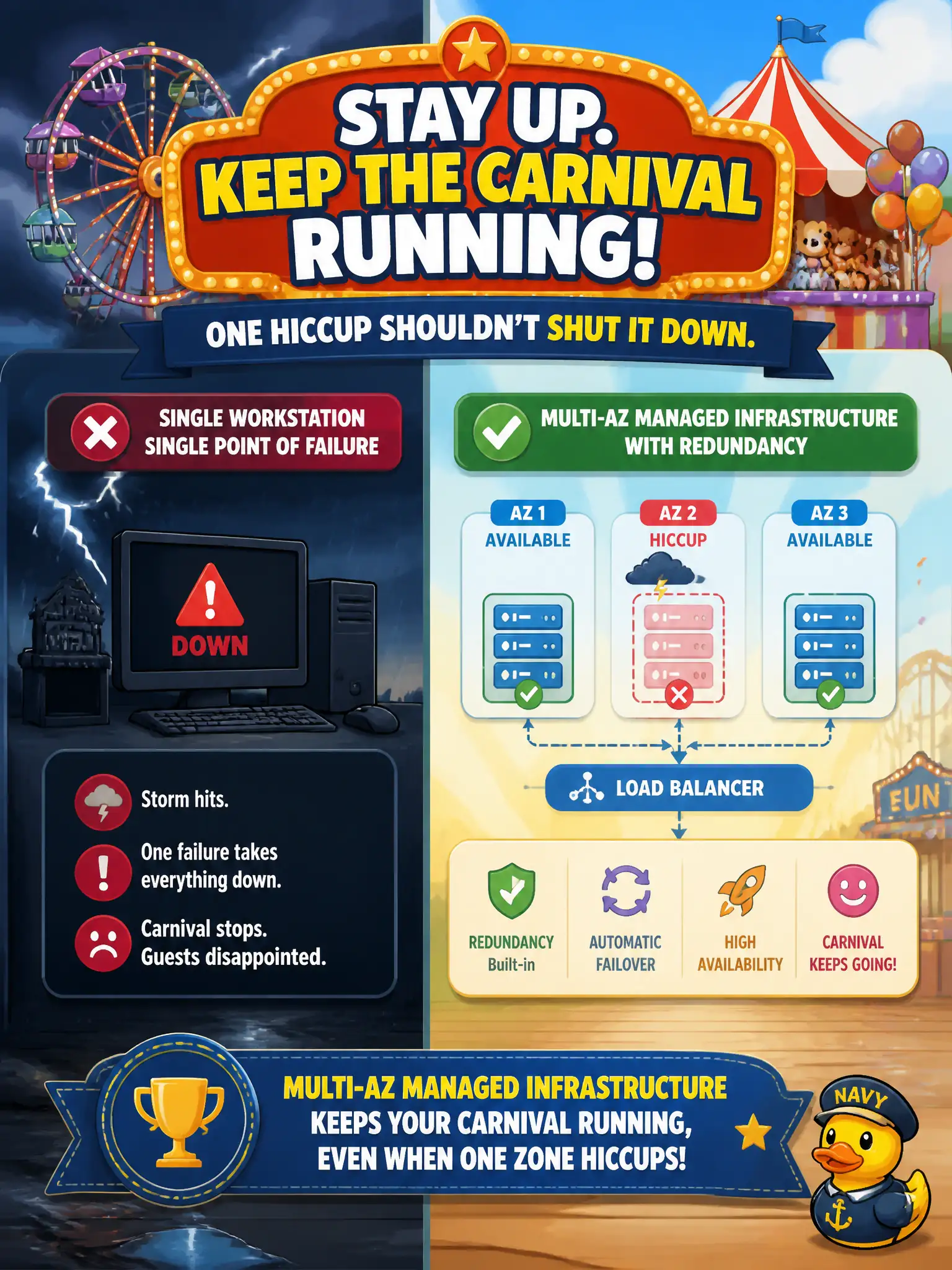
Think of Saturday storm-day rush. The helper has to survive one Availability Zone hiccup. Multi-AZ managed infrastructure is the spare generator. A booth laptop or turning it off fails the line.
Full Explanation
Saturday storm-day rush at the carnival helper is an availability problem: the service must keep answering when a single Availability Zone hiccups. Multi-AZ managed infrastructure with built-in redundancy spreads the helper across failure domains so one AZ impairment does not take the whole line offline. That pattern is why GenAI helpers that matter during peak public demand are hosted on managed multi-AZ foundations rather than on a single office machine.
A single office workstation fails the requirement because it is one failure point; when that AZ or that machine is unhealthy, the helper disappears for the rush. A laptop under the ticket booth fails for the same conceptual reason—local power and local hardware are not multi-AZ redundancy, and booth power or network loss is still a single fault domain. Turning the helper off on storm days fails because the busiest demand window is exactly when availability matters; shutting down to avoid the problem abandons the visitors the helper was meant to serve.
Exam caveat: availability and redundancy are first-class reasons to prefer managed GenAI hosting over ad-hoc workstations, even when the application itself is a simple conversational helper. Operational check: verify the helper runs on a multi-AZ managed path, exercise a failure drill that simulates one AZ impairment, and confirm requests continue to succeed without manual booth intervention.