
A three-person swim-club software pair wants an AI-assisted IDE to help write and wire a GenAI prototype. Production visitors will not call a model through this tool. Which offering matches this job?
Select an answer to reveal the explanation.
Short Explanation
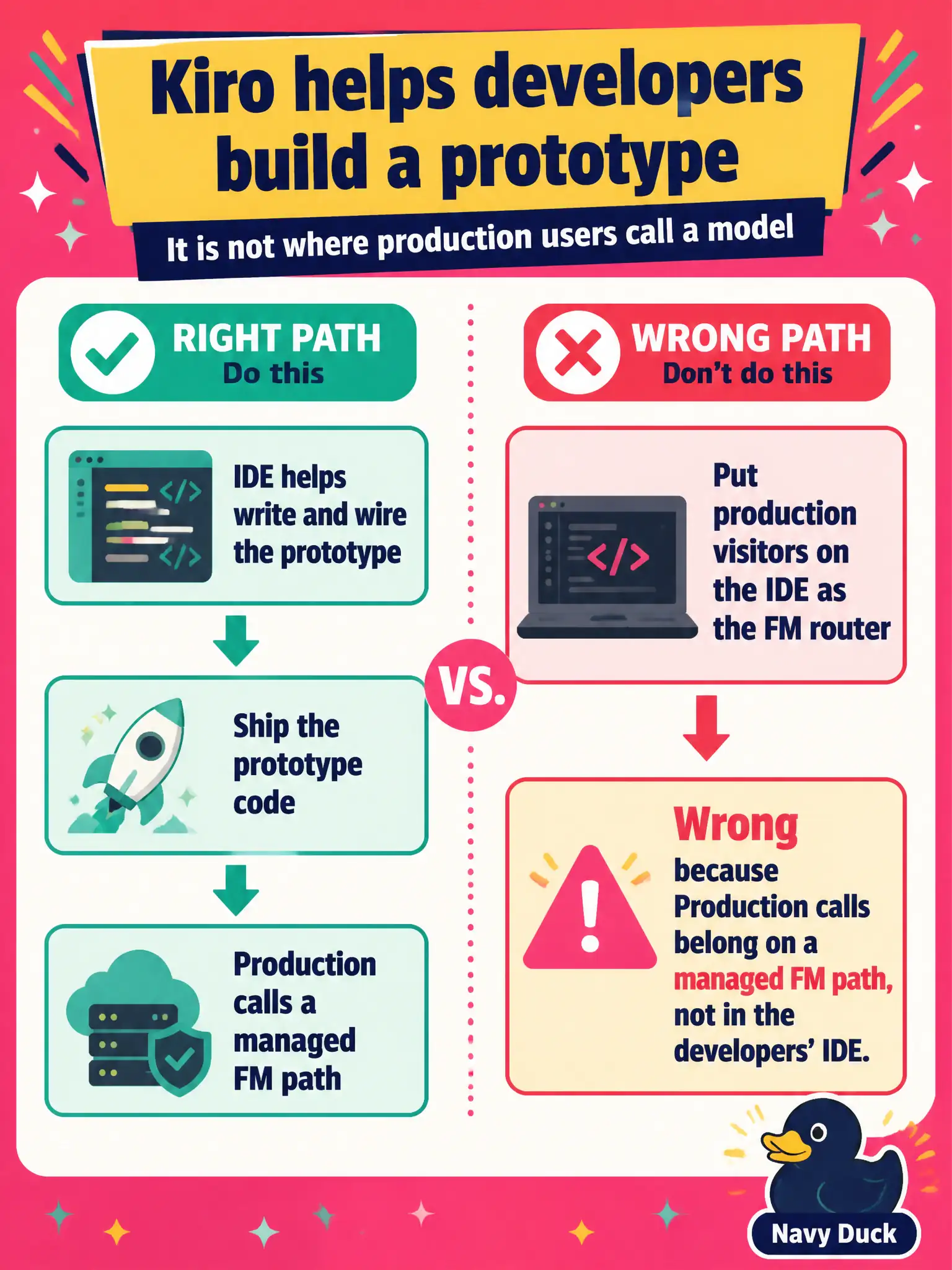
Think of an AI-assisted IDE for a three-person prototype, not the thing visitors call in production. That is Kiro. Bedrock, Quick, and Polly are different shops.
Full Explanation
Kiro is an agentic developer environment for writing and wiring a GenAI prototype. A three-person swim-club software pair that wants AI-assisted IDE help—while production visitors will not call a model through that tool—is describing the build-time developer offering, not the production FM path. Keep authoring tools distinct from runtime consumption on the exam.
Amazon Bedrock is the managed FM API for application consumption; treating an IDE as the production FM routing layer confuses authoring tools with runtime invocation. Amazon Quick does dashboards and business Q&A; it does not write the prototype’s application code. Amazon Polly synthesizes speech from text; spoken audio is not an IDE and does not wire a GenAI prototype for the swim club.
Exam caveat: prototypes built in a developer tool still need a separate production architecture, IAM, and evaluation before members rely on them. Operational check: keep Kiro in the build path, deploy the finished helper behind the intended managed API or app tier, confirm production traffic never depends on a developer workstation or IDE session, and document the handoff from prototype to hosted service.
On the exam, map “help us write the prototype” to the developer environment and “help visitors call a model” to a managed FM or app runtime. Mixing those layers produces brittle demos that work on one laptop and fail when the swim club opens the helper to members.