
A creamery has a private 12-year pasteurizer-fault log and needs to train and host its own predictor. Prompting a public foundation model is not enough. Which AWS service matches this job?
Select an answer to reveal the explanation.
Short Explanation
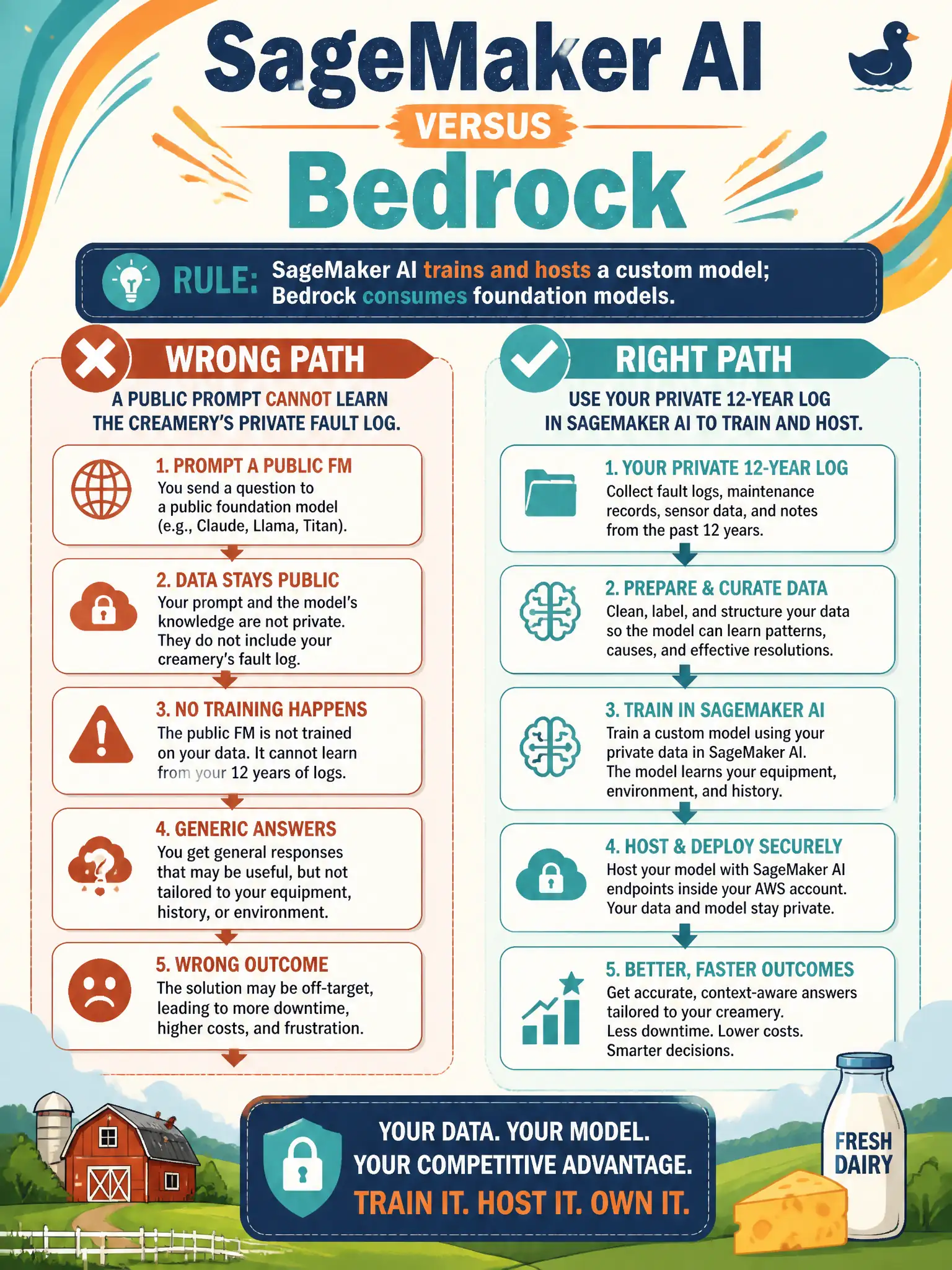
Think of a private 12-year log that needs its own trained predictor. That is SageMaker AI. Prompting Bedrock is not enough, Quick does not train, and an IDE is not the production host.
Full Explanation
Amazon SageMaker AI matches a creamery that must train and host its own predictor on a private 12-year pasteurizer-fault log. That is a custom supervised lifecycle: prepare data, train, evaluate, and host a model you own, which is SageMaker’s practitioner role when prompting a public foundation model is not enough for proprietary fault history.
Bedrock-only as if every private log must become a public prompt misses the need to train on that proprietary history; consuming an FM does not replace the custom train-and-host path. Amazon Quick visualizes and asks questions of business tables; it does not train a pasteurizer-fault predictor. Kiro is an agentic developer environment for building software, not the production host for industrial predictors.
Exam caveat: private logs still need access control, lineage, and evaluation against holdout faults before production—custom training without governance is not finished work. Operational check: keep the fault log in an approved account, track training job lineage, validate metrics on unseen faults, and deploy only through a governed hosting endpoint with rollback.
Prompting alone cannot invent years of pasteurizer-specific failure modes that live only in the private log. The creamery’s requirement is therefore model creation and hosting under its control, which is why the custom SageMaker lifecycle—not a dashboard, IDE, or public-prompt-only path—is the match.