
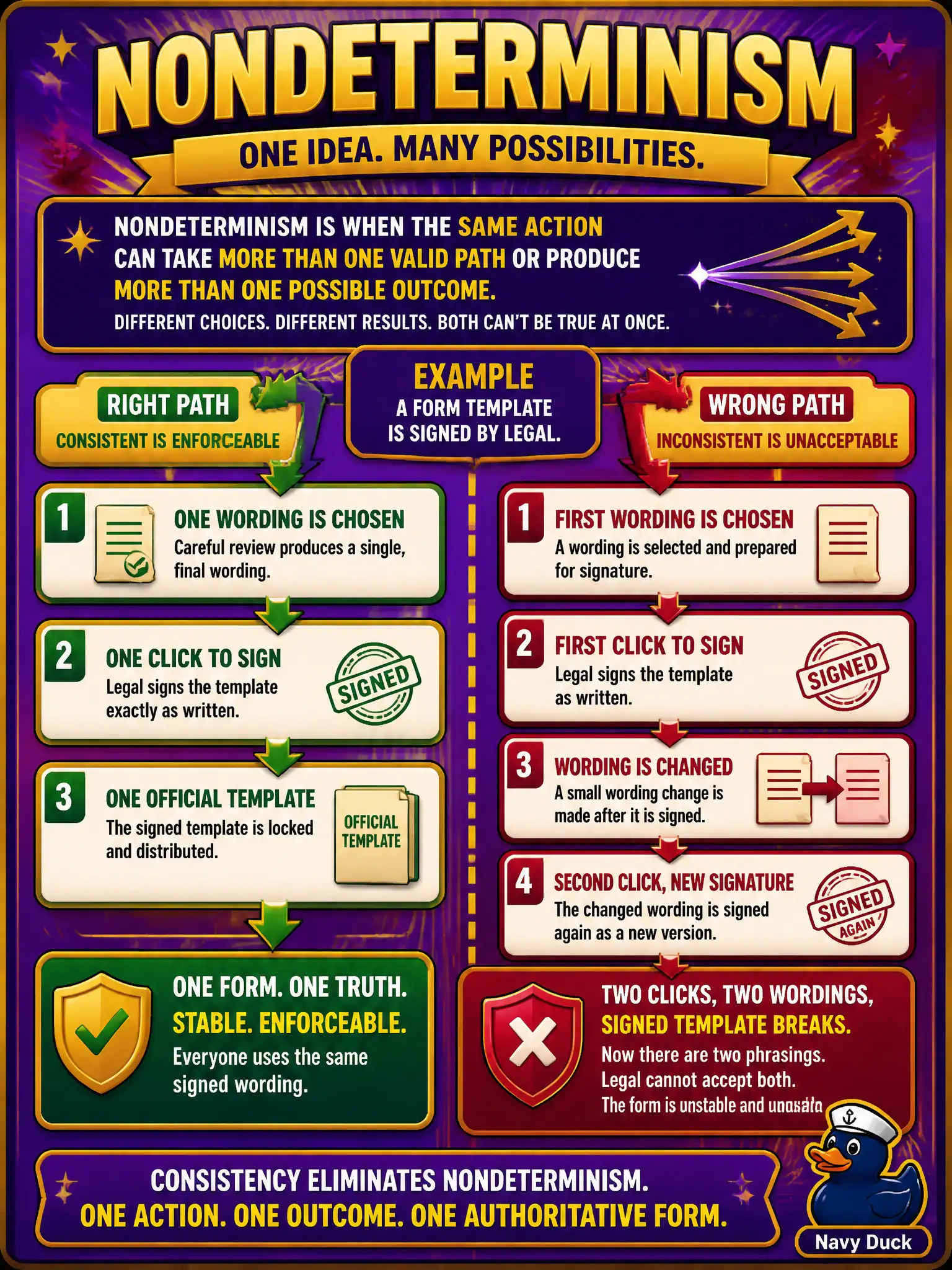
The same school-board facilities prompt yields two different phrasings on two clicks and breaks a reply template legal already signed. Which limitation is this?
Select an answer to reveal the explanation.
Short Explanation
Think of two clicks, two phrasings, and a legal template that breaks. That is nondeterminism. A wording change is not a fake accession number, and it does not make a signed form more stable.
Full Explanation
Nondeterminism means the same prompt can yield different wording across runs, even when the underlying facts are unchanged. The school-board facilities prompt producing two phrasings on two clicks and breaking a legal-signed reply template is nondeterminism colliding with a locked format—not proof that every wording change invents a false accession number.
A locked form becoming more stable because wording changed is backwards: varying wording destabilizes a signed template that legal already approved. Hallucination is fluent false content; mere rephrasing of a correct idea is variability of form, not automatically a fabricated identifier or false accession claim. A clustering error on unused folder colors is an unrelated unsupervised-task distractor that does not explain template breakage.
Exam caveat: nondeterminism is about output variance. It is distinct from hallucination (false claims) even though both can appear in generative systems. Template-bound legal replies often need deterministic decoding or constrained generation.
Operational check: for signed facilities templates, fix temperature and decoding settings, use constrained or fill-in-the-blank generation for locked fields, and regression-test that two consecutive runs preserve required template slots.