
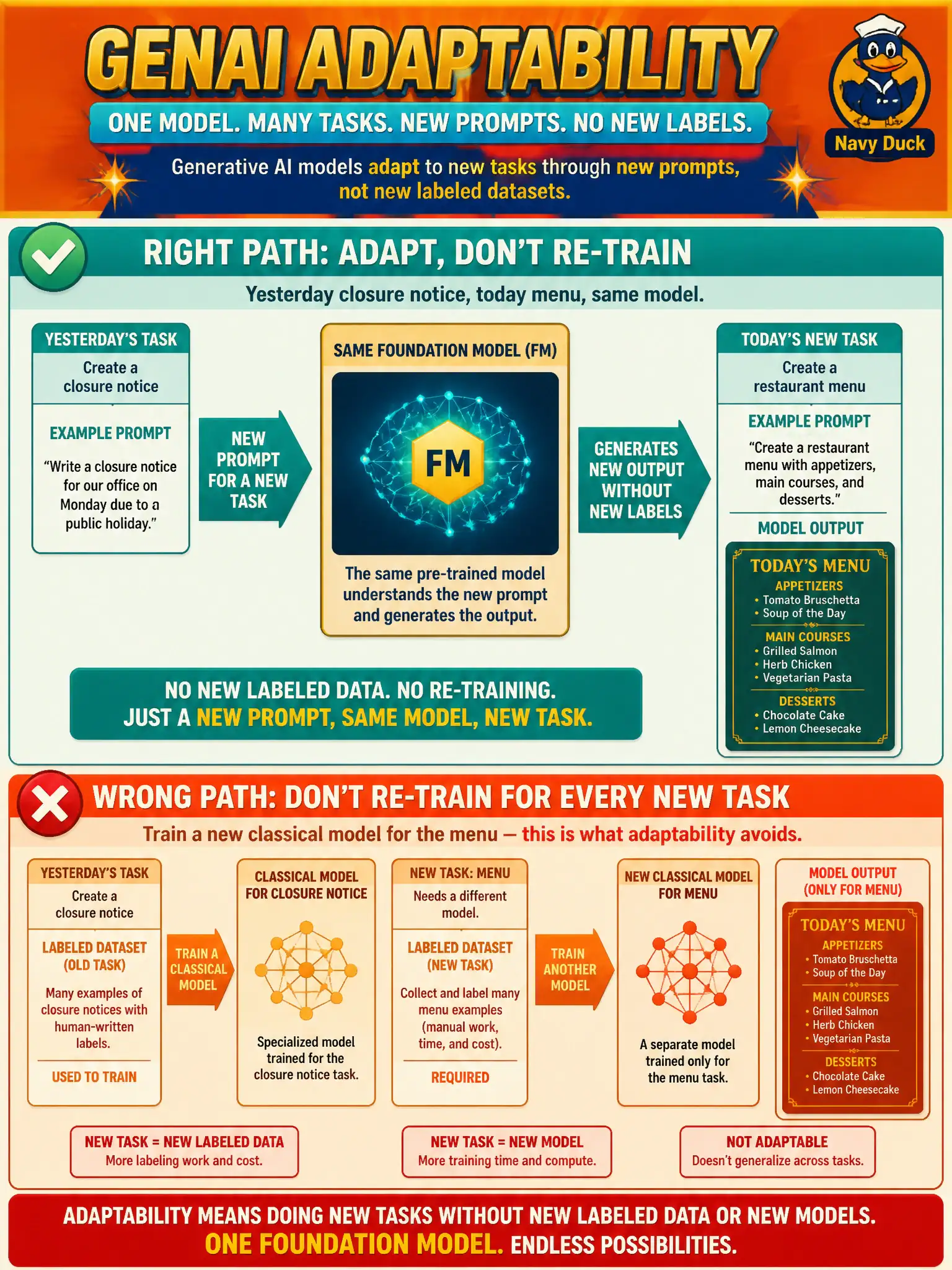
The same foundation model that drafted an ice-rink closure notice yesterday drafts a snack-bar menu today after only a new prompt. Nobody built a new labeled dataset. Which advantage is this?
Select an answer to reveal the explanation.
Short Explanation
Think of yesterday's ice-rink notice and today's snack-bar menu from the same model, just a new prompt. That is adaptability. It is not a new classical model per task, and it is not the definition of nondeterminism.
Full Explanation
Adaptability is the foundation-model advantage that a new prompt can retarget the same model to a new task without building a new labeled dataset or training a new classical model. Drafting an ice-rink closure notice yesterday and a snack-bar menu today after only a prompt change, with no new labeled set, is that advantage.
The need to train a new classical model for every new task is the opposite of adaptability; that is the classical ML burden generative foundations reduce for many drafting jobs. A requirement to collect thousands of menu labels before any draft may apply to supervised training, but it is not required when a prompt alone retargets a capable foundation model. Nondeterminism is variability of wording across runs, not the ability to point one model at two different tasks.
Exam caveat: adaptability is about task switching via prompts (or light customization), not about output randomness. Do not mark nondeterminism when the stem celebrates reuse across tasks.
Operational check: keep separate prompt templates for closure notices and snack-bar menus, smoke-test both after any shared model upgrade, and avoid silently reusing a closure-tuned prompt on menu work without review.