
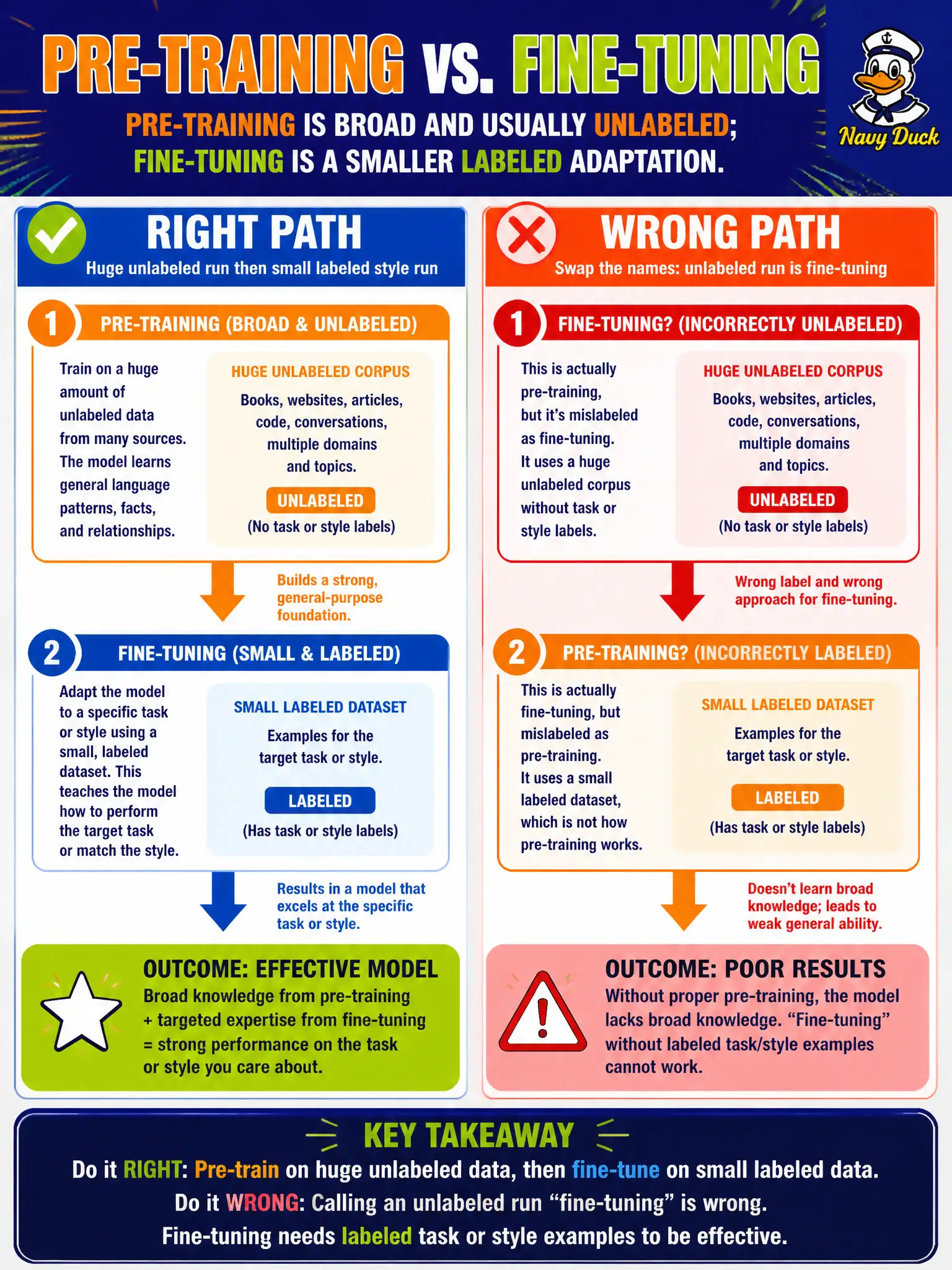
One vendor describes a huge unlabeled-text run that taught a model general language. Another describes a smaller labeled run that taught that same model the scout-handbook caption style. Which pairing names those stages?
Select an answer to reveal the explanation.
Short Explanation
Think of reading the whole library, then practicing the scout-handbook voice. The huge unlabeled run is pre-training. The smaller labeled style run is fine-tuning. Inferencing does not change those weights.
Full Explanation
Pre-training is the large, usually unlabeled run that teaches general language competence across broad text. Fine-tuning is the smaller, labeled adaptation that specializes the same model to a domain or style—here scout-handbook caption style. The vendor descriptions map cleanly: the huge unlabeled run is pre-training; the smaller labeled style run is fine-tuning.
Reversing those names fails conceptually: fine-tuning is not the massive unlabeled corpus pass, and pre-training is not the small labeled style adaptation. Calling both runs batch inferencing is wrong because inferencing uses a finished model to produce outputs without describing weight-updating training stages; the stem describes training runs where weights change. Clustering handbook file names is an unsupervised grouping task and names neither pre-training nor fine-tuning.
Exam caveat: scale and label regime are the usual discriminators—broad unlabeled pre-training versus narrower labeled fine-tuning—not whether the organization 'liked' the demo.
Operational check: keep separate datasets and job records for any pre-training corpus versus the labeled handbook-style set, and verify evaluation captions against held-out handbook pages before promoting a fine-tuned checkpoint to the scout desk.