
A transit-union bulletin team has not trained or prompted yet. They still must decide which internal notices are allowed as source material and which publicly hosted foundation model they will start from. A vendor says skip that and deploy on Friday. Which statement is accurate?
Select an answer to reveal the explanation.
Short Explanation
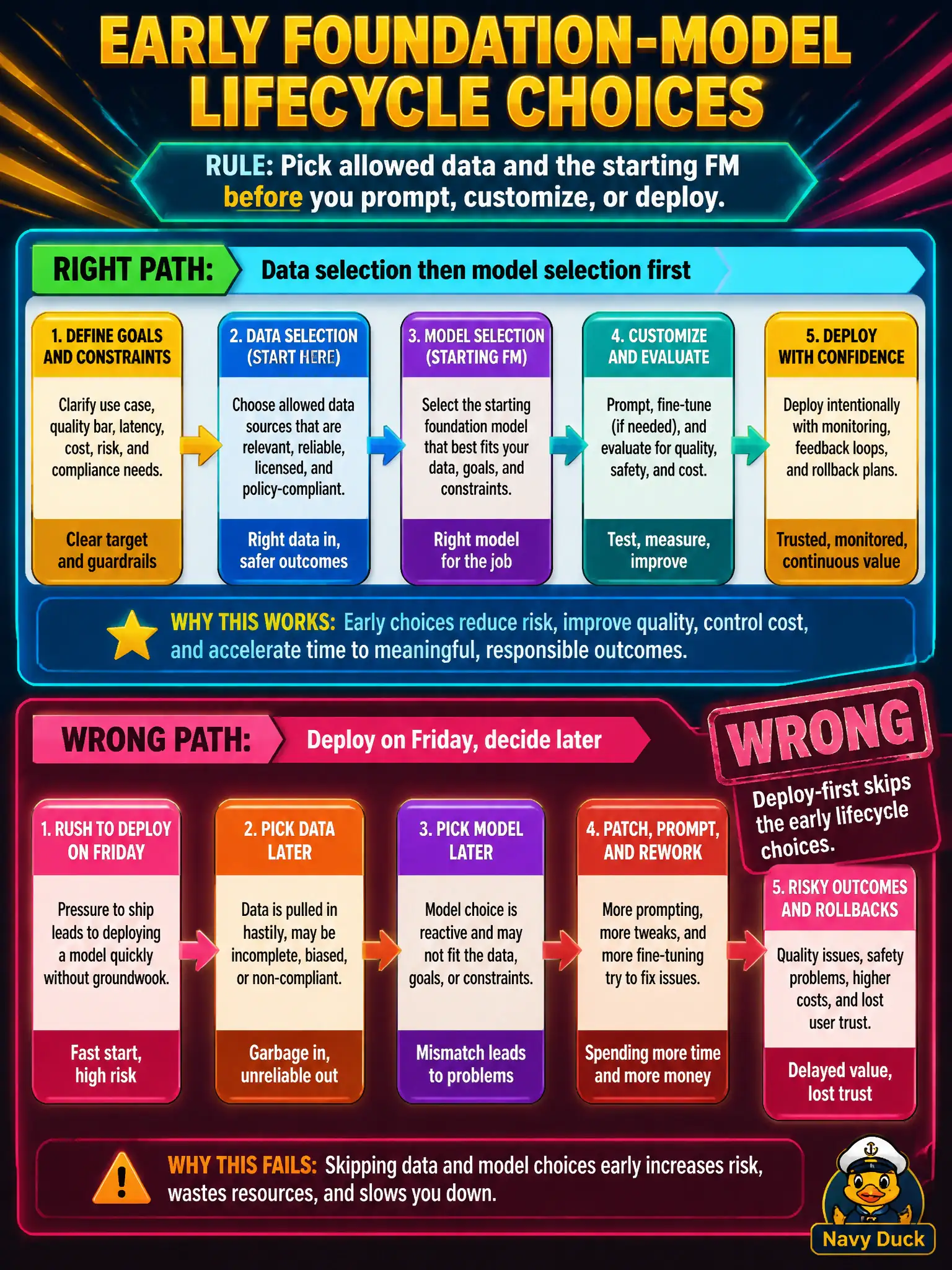
Think of picking the ingredients and the cookbook before you cook. Data selection and model selection sit at the front of the foundation-model lifecycle. Friday deploy first, or starting at monitoring, skips the pantry.
Full Explanation
In the foundation-model lifecycle, data selection and model selection sit at the front: teams decide which internal notices are allowable source material and which publicly hosted foundation model to start from before they train, prompt, customize, or deploy. The transit-union bulletin team has not trained or prompted yet, so those selection decisions are the correct next work—not a Friday deploy that skips them.
Deploying on Friday first, then deciding what data and which model were used, reverses the lifecycle and locks the team into unexamined sources and an unchosen base. Claiming lifecycle work starts at monitoring, before any source material exists, misplaces monitoring, which is a post-deploy control, not a substitute for choosing data and a starting model. Saying foundation models have no lifecycle because they are already pretrained is false: pretraining is one stage; organizations still select, customize, evaluate, deploy, and monitor.
Exam caveat: pretrained does not mean 'no lifecycle.' Selection of data and base model remains mandatory even when the vendor shipped weights already trained on a large corpus.
Operational check: document an allow-list of bulletin sources and a written model-selection rationale (modality, context needs, residency) before any pilot prompt work, and block Friday deploy tickets that lack those artifacts.