
A school-board facilities packet is 40 pages. Supervisors want a one-page brief they can read in the parking lot. They do not want the pages grouped into unlabeled piles and they do not want a new illustration of the building. Which use case is this?
Select an answer to reveal the explanation.
Short Explanation
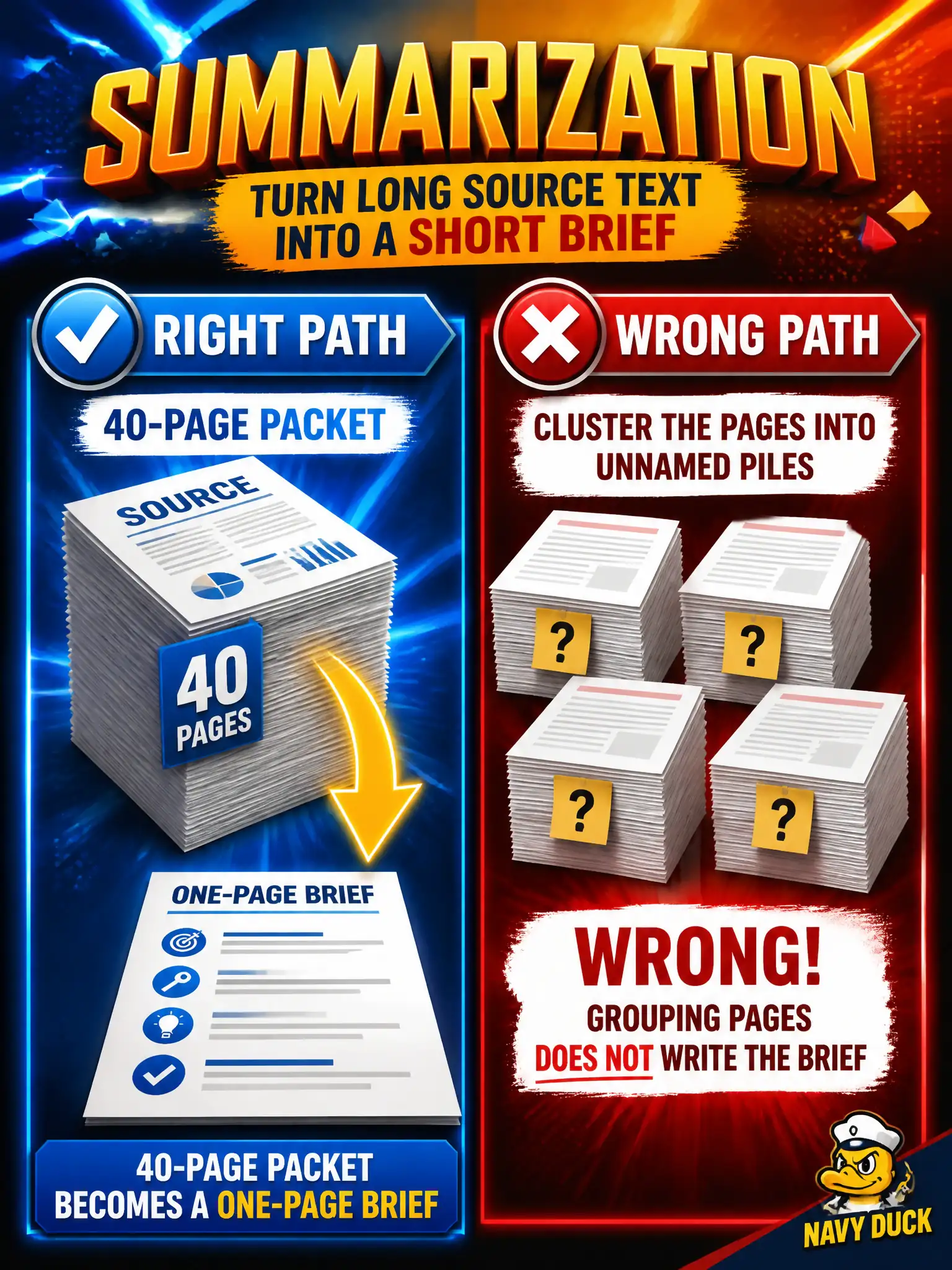
Think of a 40-page packet turned into a one-pager you can read in the parking lot. That is summarization. Clustering makes unnamed piles, and drawing the building is a different ask.
Full Explanation
Turning a 40-page school-board facilities packet into a one-page brief for the parking lot is summarization of long source text into a short brief. Summarization preserves key decisions, costs, and risks while discarding bulk detail supervisors cannot read between meetings. The board ruled out unlabeled grouping of pages and ruled out drawing a new building picture.
Clustering the pages into unnamed groups is unsupervised organization without producing a readable one-page narrative. Clusters do not give supervisors a brief they can act on in the parking lot.
Image generation of a new building drawing creates artwork, not a textual condensation of the packet. Visuals may accompany a brief later, but they are not the requested use case.
Speech synthesis of the lunch menu converts text to spoken audio for an unrelated cafeteria topic. It does not summarize facilities content.
Exam caveat: summaries can omit legally material caveats; for board packets, require that dollar amounts, deadlines, and dissenting notes survive compression or are explicitly flagged as omitted.
Operational check: compare the one-page brief against a checklist of must-keep fields from the packet (motion text, budget delta, timeline) and reject automated summaries that drop any required field before distribution.