
A community-theater shop wants original poster illustrations from a short text description. They already have last year's poster and do not want a class label on that existing photo. Which generative approach fits?
Select an answer to reveal the explanation.
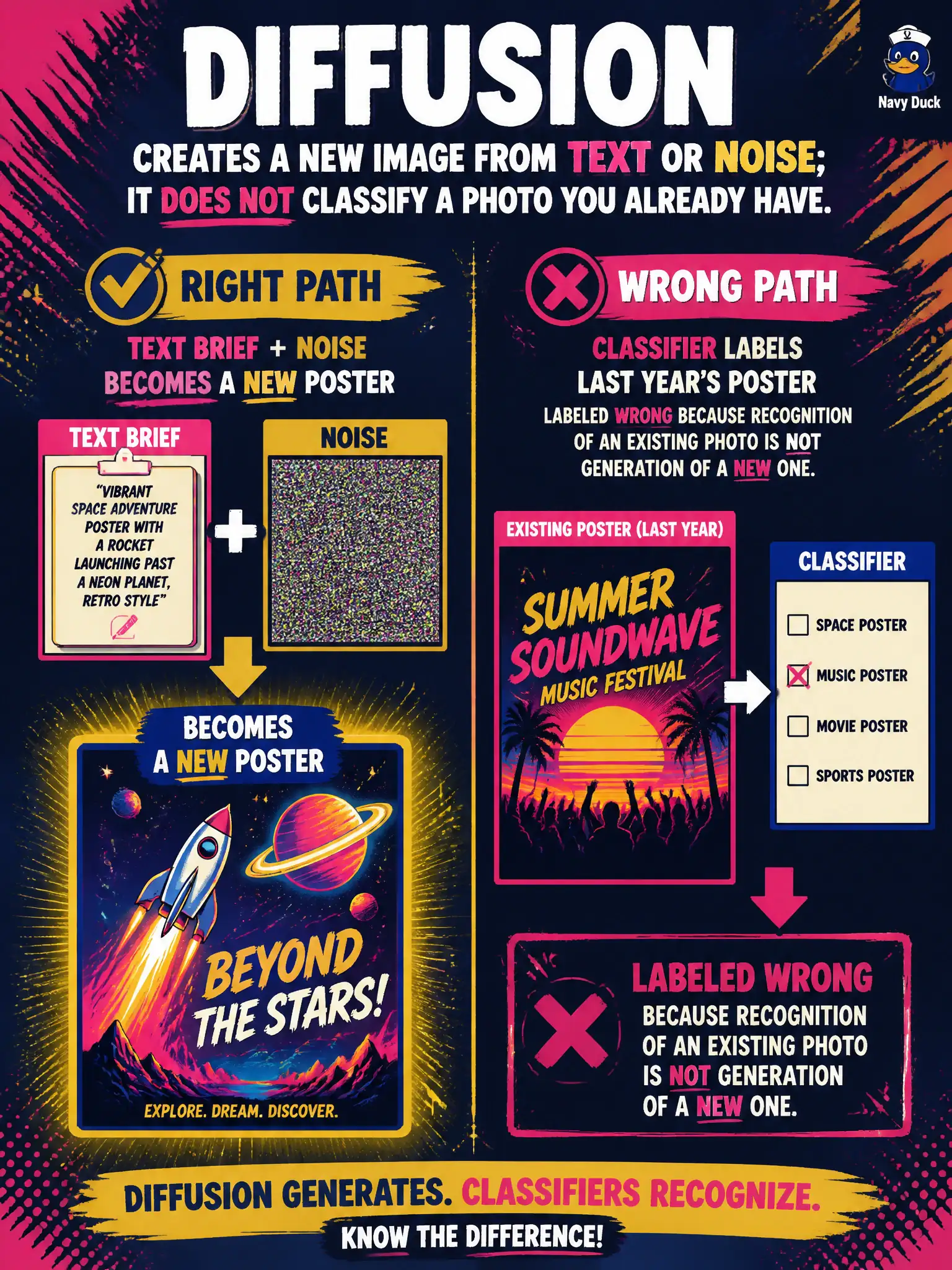
Short Explanation
Think of asking for a brand-new poster from a short description, not a sticker on last year's photo. A diffusion-style image generator creates the picture from text or noise. A classifier, a summarizer, and Transcribe do not draw.
Full Explanation
Original poster illustrations from a short text description call for a diffusion-style image generator that creates a new picture from text or noise. The community-theater shop wants net-new artwork, already has last year's poster, and explicitly does not want a class label on that existing photo. Diffusion image generation matches creative synthesis rather than analysis of an old file.
A classifier that only labels objects in last year's poster performs image analysis on an existing asset. Labeling does not produce a new illustration for this season's show.
A text-only summarizer compresses language and cannot emit an image. It might shorten a synopsis, but it will not draw a poster.
Amazon Transcribe turns speech into text. It is a speech-recognition service, not an image generator, and the shop's input is a short text description rather than audio that must become artwork.
Exam caveat: generative images can raise copyright and brand-guideline issues for theaters; novelty of the picture does not automatically clear rights for distinctive styles or trademarked marks.
Operational check: generate several poster candidates from the approved brief, run a staff brand and rights review, and archive the prompt plus seed or job id so the chosen illustration can be reproduced for print reprints.