
A community-theater model that predicts who will attend a Saturday show has a strong F1 score. Weekend box-office overtime did not drop, and concession sales stayed flat. Which kind of measure should leadership review next?
Select an answer to reveal the explanation.
Short Explanation
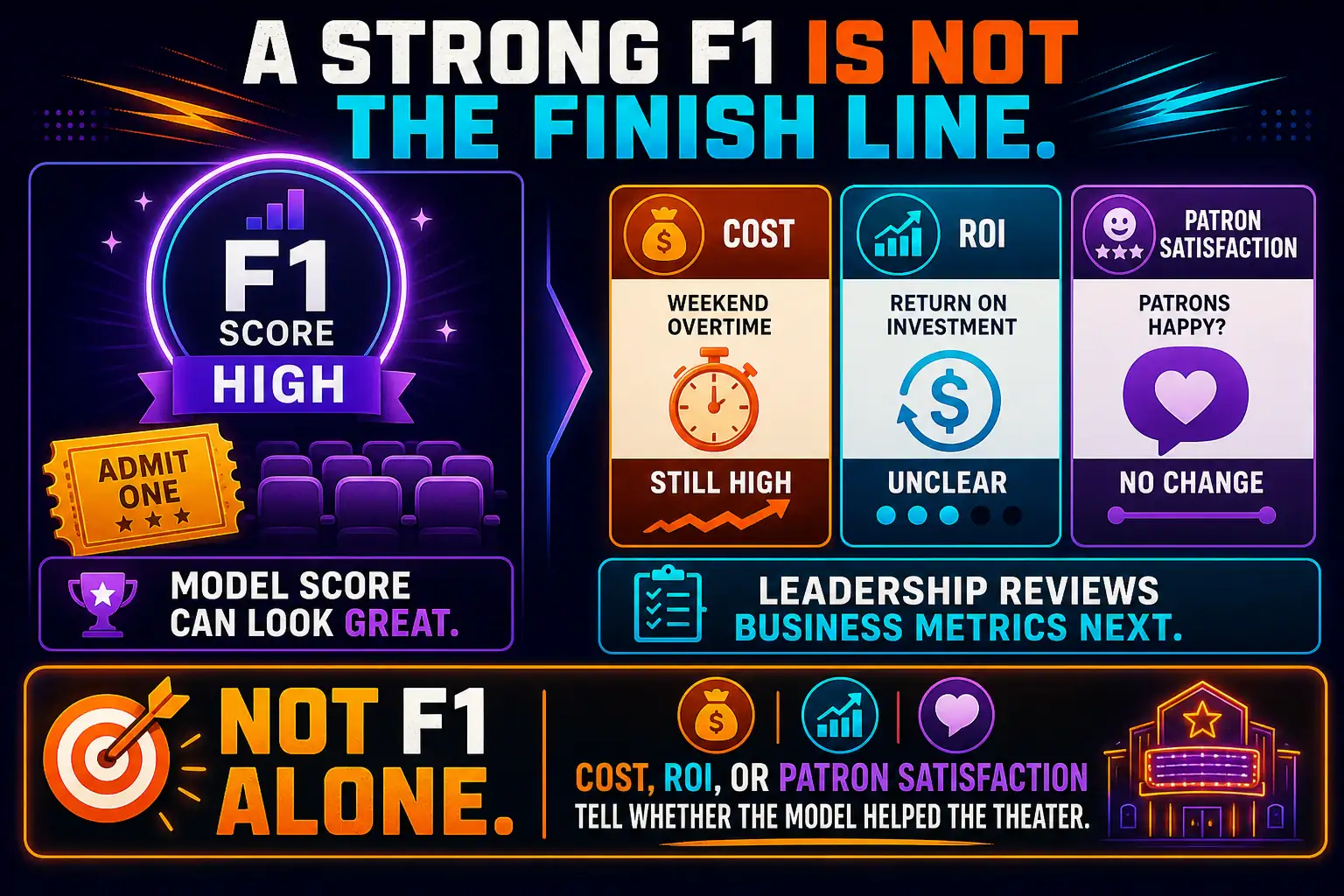
Think of a play that sells every seat on paper and still does not pay the overtime bill. F1 says the guesses are good. Business metrics ask whether cost, ROI, or happy patrons actually moved. GPU heat and RMSE do not replace that.
Full Explanation
A strong F1 on Saturday attendance prediction means the community-theater model is good at classifying who will show up, not that the program delivered business value. Leadership should next review business metrics such as overtime cost, ROI, or patron satisfaction—measures that ask whether the forecast changed staffing, concessions, or experience in the real theater. Statistical quality is necessary but not sufficient when weekend box-office overtime and concession sales did not move.
Relying only on F1 assumes a statistical score always means the program paid off. F1 can rise while scheduling still overstaffs, understaffs, or fails to influence concessions; the scorecard and the ledger can diverge.
GPU temperature is an infrastructure health signal, not a business outcome. Heat may matter for capacity planning, but it does not tell directors whether the attendance model reduced overtime or improved patron experience.
RMSE on a yes-or-no attendance flag misapplies a regression error metric to a classification target and still would not replace ROI or cost review. Even a well-chosen ML metric does not substitute for whether the theater's operations and revenue goals moved.
Exam caveat: AWS AI exam items often separate model metrics from business KPIs. Choosing only F1 when the stem shows flat business results is a common trap.
Operational check: define leading and lagging business indicators before the next show cycle—overtime hours, concession attach rate, and complaint or satisfaction scores—and compare weeks with and without acting on the model's predictions under the same show mix.