
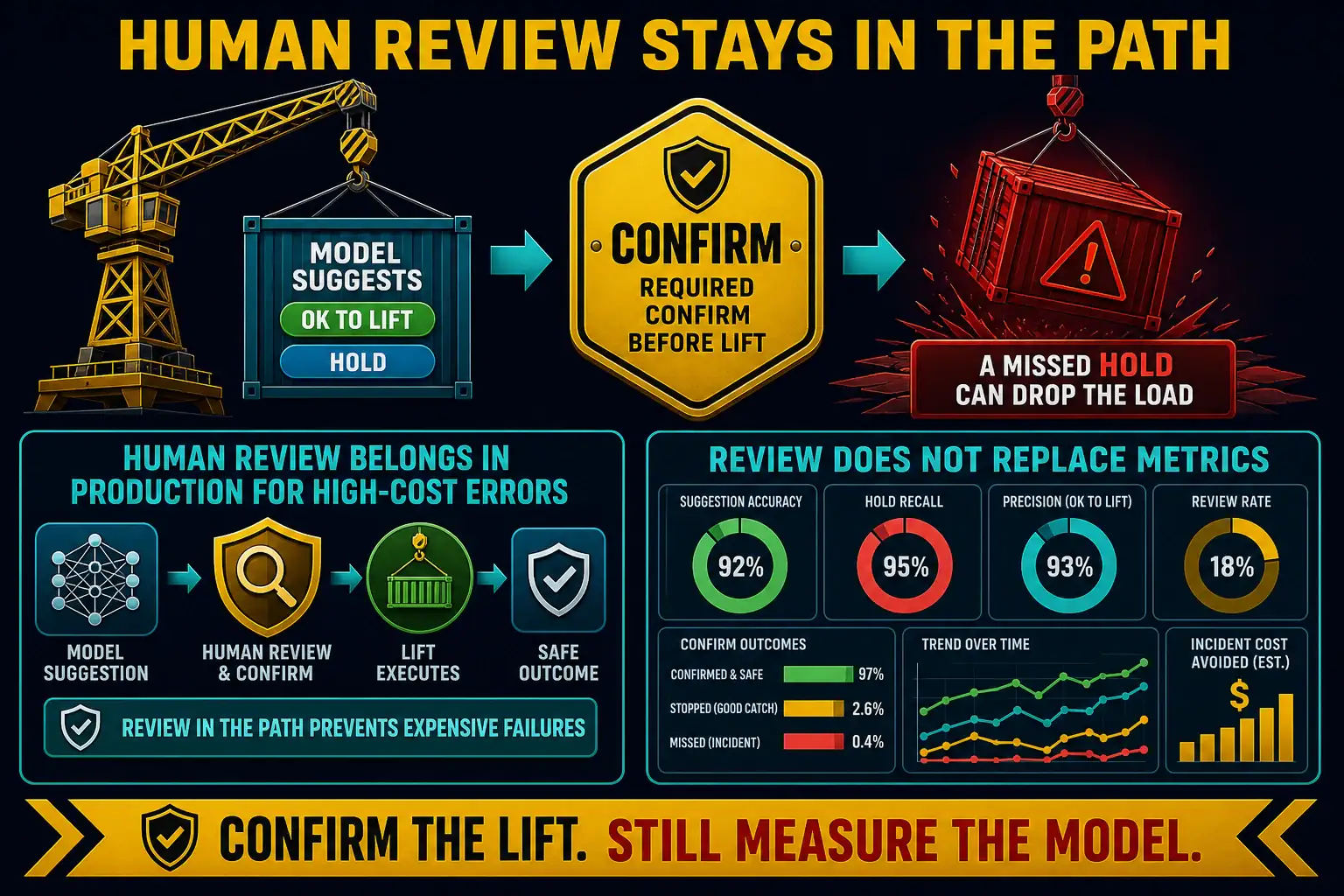
A shipyard crane model can suggest ok-to-lift or hold. A missed hold can drop a load, so a rigger must confirm the suggestion before the lift starts. Leadership still wants evaluation metrics on the suggestions. Which statement is correct?
Select an answer to reveal the explanation.
Short Explanation
Think of a rigger who has to nod before the crane moves. Human review sits in the live path because a missed hold can drop a load, and you still keep metrics on the suggestions. A person in the loop is not a reason to throw the scorecard away.
Full Explanation
When a missed hold can drop a load, human review belongs in the production path: the crane model may suggest ok-to-lift or hold, but a rigger must confirm before the lift starts. That human-in-the-loop control reduces high-cost errors without erasing the need for evaluation metrics on the suggestions themselves. Leadership can still track precision, recall, or false ok-to-lift rates on the model's proposals while the rigger remains the final gate for safety.
Dropping evaluation metrics once a rigger is in the loop is incorrect. Human review catches individual mistakes; metrics reveal systemic model quality, trend degradation, and whether the suggestion stream is getting safer or noisier over time. Oversight and measurement complement each other.
Treating human review as only a training-data labeling step misunderstands where people can sit in the lifecycle. Labelers annotate historical examples for training, but production review after the score is a separate, valid pattern for high-stakes decisions. The scenario places the rigger after the suggestion, which is operational control, not dataset creation.
Calling the rigger confirm step batch inferencing of last year's invoices mixes unrelated concepts. Batch inference scores historical or queued records offline; a live confirm before a lift is an online human gate on a safety-critical action, not invoice batch scoring.
Exam caveat: human-in-the-loop does not automatically satisfy compliance or safety if review is rubber-stamped. The control only works when the rigger has authority, time, and clear criteria to override the model.
Operational check: log suggestion, rigger decision, and outcome for every lift; report disagreement rates and missed-hold near misses weekly so metrics and human overrides inform retraining and procedure updates together.